. 2018 Feb 12;6(1):31.
doi: 10.1186/s40168-018-0413-8.

The Populus holobiont: dissecting the effects of plant niches and genotype on the microbiome

Affiliations

The Populus holobiont: dissecting the effects of plant niches and genotype on the microbiome

M A Cregger et al. Microbiome. .

Abstract

Background: Microorganisms serve important functions within numerous eukaryotic host organisms. An understanding of the variation in the plant niche-level microbiome, from rhizosphere soils to plant canopies, is imperative to gain a better understanding of how both the structural and functional processes of microbiomes impact the health of the overall plant holobiome. Using Populus trees as a model ecosystem, we characterized the archaeal/bacterial and fungal microbiome across 30 different tissue-level niches within replicated Populus deltoides and hybrid Populus trichocarpa × deltoides individuals using 16S and ITS2 rRNA gene analyses.

Results: Our analyses indicate that archaeal/bacterial and fungal microbiomes varied primarily across broader plant habitat classes (leaves, stems, roots, soils) regardless of plant genotype, except for fungal communities within leaf niches, which were greatly impacted by the host genotype. Differences between tree genotypes are evident in the elevated presence of two potential fungal pathogens, Marssonina brunnea and Septoria sp., on hybrid P. trichocarpa × deltoides trees which may in turn be contributing to divergence in overall microbiome composition. Archaeal/bacterial diversity increased from leaves, to stem, to root, and to soil habitats, whereas fungal diversity was the greatest in stems and soils.

Conclusions: This study provides a holistic understanding of microbiome structure within a bioenergy relevant plant host, one of the most complete niche-level analyses of any plant. As such, it constitutes a detailed atlas or map for further hypothesis testing on the significance of individual microbial taxa within specific niches and habitats of Populus and a baseline for comparisons to other plant species.

Keywords: 16S rRNA; Fungal pathogen; ITS2; Populus deltoides; Populus trichocarpa × deltoides hybrid.


Conflict of interest statement

Ethics approval and consent to participate

Not applicable

Consent for publication

Not applicable

Competing interests

The authors declare that they have no competing interests.

Publisher’s Note

Springer Nature remains neutral with regard to jurisdictional claims in published maps and institutional affiliations.

Figures

Fig. 1
Fig. 1
NMDS ordinations of both archaeal/bacterial and fungal communities across the four broad habitat classifications (leaves, stems, roots, soil) and genotypes (P. deltoides, P. trichocarpa × deltoides hybrid). Darker colors represent P. deltoides (DD) samples, whereas respective light colors represent hybrid samples (TD). Based on perMANOVA results, habitat was more influential for archaeal/bacterial and fungal community composition than genotype (Table 1)
Fig. 2
Fig. 2
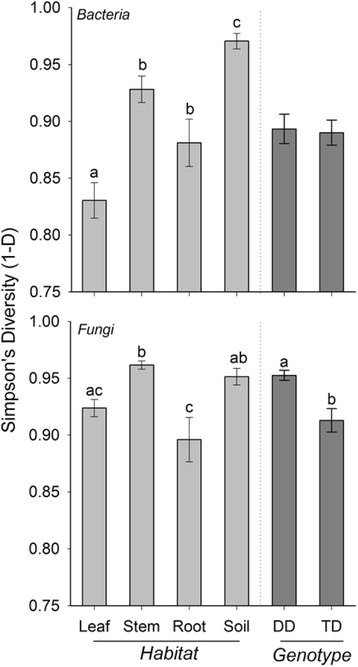
Simpson’s (1 − D) diversity across broad habitats (leaf, stem, root, and soil—denoted in light gray) and genotypes (DD = P. deltoides, TD = P. trichocarpa × deltoides—denoted in dark gray) for both archaeal/bacterial and fungal communities. For both archaea/bacteria and fungi, diversity differed across habitats (p ≤ 0.01). Fungal diversity differed between genotypes (p ≤ 0.01). Letters denote significant differences based on Tukey’s HSD post hoc comparison tests. Diversity was arcsine square root transformed prior to analysis, but raw data average and standard errors per habitat and genotype are shown
Fig. 3
Fig. 3
NMDS ordination of both archaeal/bacterial and fungal communities across all 30 leaf, stem, root, and soil niches and Populus genotypes (P. deltoides, P. trichocarpa × deltoides hybrid). Darker colors represent P. deltoides (DD) samples whereas respective light colors represent hybrid samples (TD). For leaf communities: circles = developing leaf samples and triangles = mature leaf samples. For stem communities: circles = year 1, triangles = year 2, and squares = year 3 samples. Niche was most influential for archaeal/bacterial communities for leaves and stems, whereas genotype was most influential for fungal communities in leaves only. Niche was more influential for fungi in stems (Table 2). For roots and soils, in both archaeal/bacterial and fungal communities, niche was more influential than genotype (Additional file 1: Table S12)
Fig. 4
Fig. 4
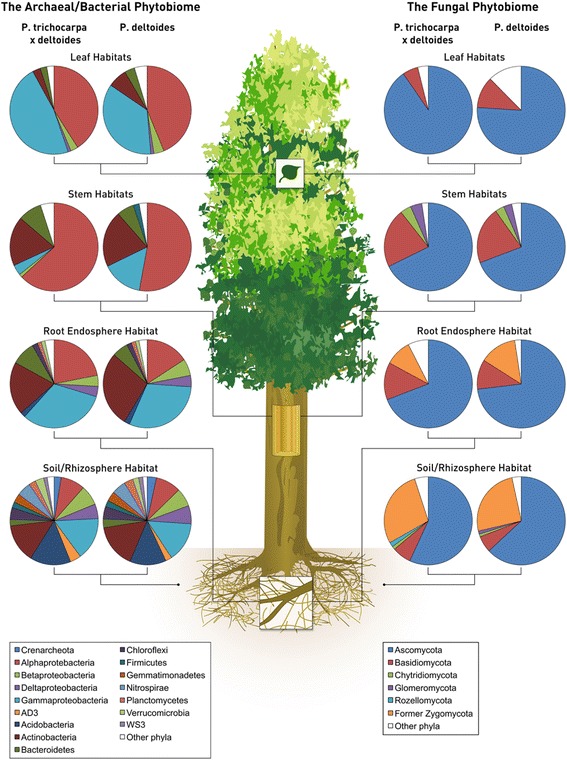
Relative abundance of the dominant (> 0.1%) archaeal/bacterial phyla—class for proteobacteria—and fungal phyla averaged across niches within the broad tree habitats of leaves, stems, roots, and soils within Populus delotides (DD) and Populus trichocarpa × deltoides (TD) hybrids
Fig. 5
Fig. 5
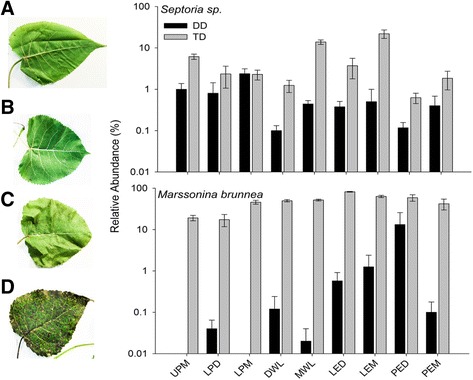
Log relative abundance of OTUs classified as the Populus leaf pathogens Septoria sp. and Marssonina brunnea across leaf niches within P. deltoides (DD) and P. trichocarpa × deltoides hybrids (TD). Bars represent means ± SE. Any bars missing indicate that OTU is absent from all samples within that habitat category. Septoria sp. and Marssonina brunnea relative abundance differed across habitats and genotypes (p ≤ 0.05). Representative of developing vs. mature leaves for Populus deltoides (a vs b) and TD hybrids (c vs d), respectively. The X-axis denotes leaf niche sampled. UPM upper phyllosphere mature, LPD lower phyllosphere developing, LPM lower phyllosphere mature, DWL whole leaf developing phyllosphere, MWL whole leaf mature phyllosphere, LED leaf endosphere developing, LEM leaf endosphere mature, PED petiole endosphere developing, PEM petiole endosphere mature

References

    1. Pii Y, Mimmo T, Tomasi N, Terzano R, Cesco S, Crecchio C. Microbial interactions in the rhizosphere: beneficial influences of plant growth-promoting rhizobacteria on nutrient acquisition process. A review. Biol Fertil Soils. 2015;51:403–415. doi: 10.1007/s00374-015-0996-1. - DOI
    1. de Zelicourt A, Al-Yousif M, Hirt H. Rhizosphere microbes as essential partners for plant stress tolerance. Mol Plant. 2013;6:242–245. doi: 10.1093/mp/sst028. - DOI - PubMed
    1. Berendsen RL, Pieterse CMJ, Bakker PAHM. The rhizosphere microbiome and plant health. Trends Plant Sci. 2012;17:478–486. doi: 10.1016/j.tplants.2012.04.001. - DOI - PubMed
    1. Pineda A, Soler R, Pozo MJ, Rasmann S, Turlings TCJ. Editorial: above-belowground interactions involving plants, microbes and insects. Front Plant Sci. 2015;6:318. - PMC - PubMed
    1. Hacquard S, Schadt CW. Towards a holistic understanding of the beneficial interactions across the Populus microbiome. New Phytol. 2015;205:1424–1430. doi: 10.1111/nph.13133. - DOI - PubMed

Publication types

MeSH terms