


Dietary patterns and physical activity in the metabolically (un)healthy obese: the Dutch Lifelines cohort study
- PMID: 29433580
- PMCID: PMC5809859
- DOI: 10.1186/s12937-018-0319-0
Dietary patterns and physical activity in the metabolically (un)healthy obese: the Dutch Lifelines cohort study
Abstract
Background: Diversity in the reported prevalence of metabolically healthy obesity (MHO), suggests that modifiable factors may be at play. We evaluated differences in dietary patterns and physical activity between MHO and metabolically unhealthy obesity (MUO).
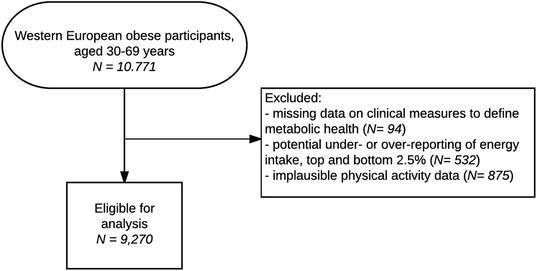
Methods: Cross-sectional data of 9270 obese individuals (30-69 years) of the Lifelines Cohort Study was used. MHO was defined as obesity and no metabolic syndrome risk factors and no cardiovascular disease history. MUO was defined as obesity and ≥2 metabolic syndrome risk factors. Sex-specific associations of dietary patterns (identified by principal component analysis) and physical activity with MHO were assessed by multivariable logistic regression (reference group: MUO). Analyses were adjusted for multiple covariates.
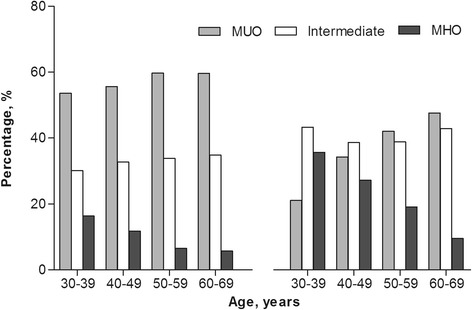
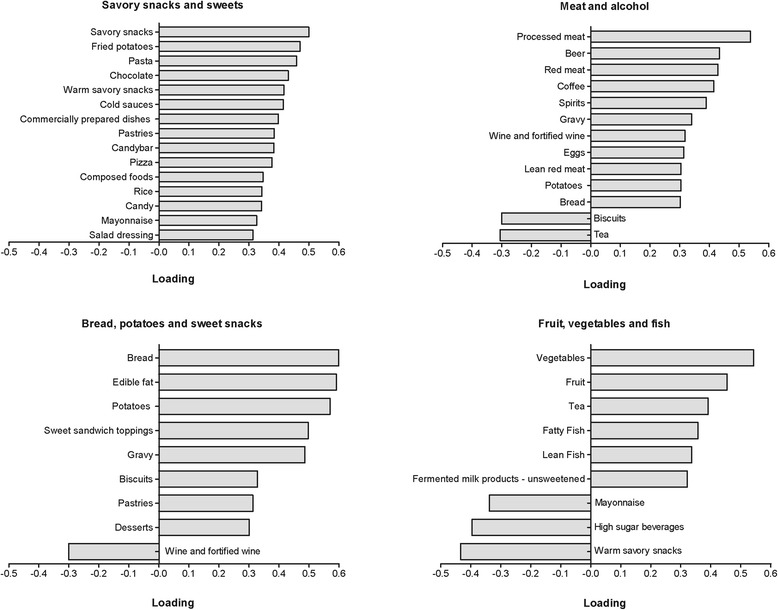
Results: Among 3442 men and 5828 women, 10.2% and 24.4% had MHO and 56.9% and 35.3% MUO, respectively. We generated four obesity-specific dietary patterns. Two were related to MHO, and in women only. In the highest quartile (Q) of 'bread, potatoes and sweet snacks' pattern, odds ratio (OR) (95% CI) for MHO was 0.52 (0.39-0.70). For the healthier pattern 'fruit, vegetables and fish', an OR of 1.36 (1.09-1.71) in Q3 and 1.55 (1.21-1.97) in Q4 was found for MHO. For physical activity, there was a positive association between moderate physical activity and vigorous physical activity in the highest tertile and MHO in women and men, respectively (OR 1.19 (1.01-1.41) and OR 2.02 (1.50-2.71)).
Conclusion: The healthier diet -characterized by 'fruit, vegetables and fish'- and moderate physical activity in women, and vigorous physical activity in men may be related to MHO. The (refined) carbohydrate-rich 'bread, potatoes and sweet snacks' dietary pattern was found to counteract MHO in women.
Keywords: Dietary patterns; Lifestyle; Metabolic health; Obesity; Physical activity.
Conflict of interest statement
Ethics approval and consent to participate
Before study entry, all participants signed an informed consent. The Lifelines Cohort Study is conducted according to the principles of the 1964 Declaration of Helsinki and its later amendments and in accordance with the research code of the University Medical Center Groningen (UMCG). The study has been approved by the medical ethics review committee of the UMCG.
Consent for publication
not applicable.
Competing interests
The authors declare that they have no competing interests.
Publisher’s Note
Springer Nature remains neutral with regard to jurisdictional claims in published maps and institutional affiliations.
Figures
References
-
- Bell JA, Kivimaki M, Hamer M. Metabolically healthy obesity and risk of incident type 2 diabetes: a meta-analysis of prospective cohort studies. Obesity reviews : an official journal of the International Association for the Study of Obesity. 2014;15(6):504–515. doi: 10.1111/obr.12157. - DOI - PMC - PubMed
-
- Lassale C, Tzoulaki I, Moons KGM, Sweeting M, Boer J, Johnson L, Huerta JM, Agnoli C, Freisling H, Weiderpass E, Wennberg P, der AD v, Arriola L, Benetou V, Boeing H, Bonnet F, Colorado-Yohar SM, Engstrom G, Eriksen AK, Ferrari P, Grioni S, Johansson M, Kaaks R, Katsoulis M, Katzke V, Key TJ, Matullo G, Melander O, Molina-Portillo E, Moreno-Iribas C, Norberg M, Overvad K, Panico S, Quiros JR, Saieva C, Skeie G, Steffen A, Stepien M, Tjonneland A, Trichopoulou A, Tumino R, van der Schouw YT, WMM V, Langenberg C, Di Angelantonio E, Riboli E, Wareham NJ, Danesh J, Butterworth AS. Separate and combined associations of obesity and metabolic health with coronary heart disease: a pan-European case-cohort analysis. Eur Heart J. 2017; 10.1093/eurheartj/ehx448. - PMC - PubMed
Publication types
MeSH terms
Grants and funding
LinkOut - more resources
Full Text Sources
Other Literature Sources
Medical
Molecular Biology Databases
