


High neighborhood incarceration rate is associated with cardiometabolic disease in nonincarcerated black individuals
- PMID: 29433977
- PMCID: PMC5986608
- DOI: 10.1016/j.annepidem.2018.01.011
High neighborhood incarceration rate is associated with cardiometabolic disease in nonincarcerated black individuals
Abstract
Purpose: To examine the association between residence in neighborhoods with high rates of incarceration and cardiometabolic disease among nonincarcerated individuals.
Methods: We used data from two community cohort studies (n = 1368) in Atlanta, Georgia-META-Health and Predictive Health (2005-2012)-to assess the association between neighborhood incarceration rate and cardiometabolic disease, adjusting for individual-level and neighborhood-level factors. We also examined the interaction between race and neighborhood incarceration rate.
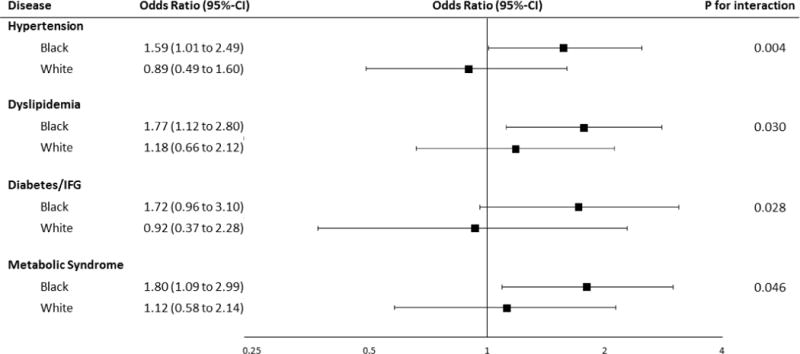
Results: Individuals living in neighborhoods with high incarceration rates were more likely to have dyslipidemia (odds ratio [OR] = 1.47; 95% confidence interval [CI] = 1.03-2.09) and metabolic syndrome (OR = 1.67; 95% CI = 1.07-2.59) in fully adjusted models. Interactions between race and neighborhood incarceration rate were significant; black individuals living in neighborhoods with high incarceration rates were more likely to have hypertension (OR = 1.59; 95% CI = 1.01-2.49), dyslipidemia (OR = 1.77; 95% CI = 1.12-2.80), and metabolic syndrome (OR = 1.80; 95% CI = 1.09-2.99).
Conclusions: Black individuals living in neighborhoods with high rates of incarceration have worse cardiometabolic health profiles. Criminal justice reform may help reduce race-specific health disparities in the United States.
Keywords: Cardiovascular health; Mass incarceration; Racial disparities.
Copyright © 2018 Elsevier Inc. All rights reserved.
Conflict of interest statement
Figures
References
-
- Havranek EP, Mujahid MS, Barr DA, Blair IV, Cohen MS, Cruz-Flores S, et al. Social Determinants of Risk and Outcomes for Cardiovascular Disease: A Scientific Statement From the American Heart Association. Circulation. 2015;132(9):873–98. - PubMed
-
- Kaeble D, Glaze L. Correctional Populations in the United States, 2015. Washington D.C: U.S. Department of Justice, Programs OoJ; 2016. NCJ 250374 Contract No.: NCJ 250374.
-
- Carson EA, Anderson E. Prisoners in 2015. Washington D.C: U.S. Department of Justice, Programs OoJ; 2016. NCJ 250229 Contract No.: NCJ 250229.
Publication types
MeSH terms
Grants and funding
LinkOut - more resources
Full Text Sources
Other Literature Sources
Medical
