Review
. 2018 Mar;21(3):309-314.
doi: 10.1038/s41593-018-0076-6. Epub 2018 Feb 12.

Memory formation depends on both synapse-specific modifications of synaptic strength and cell-specific increases in excitability

Affiliations
Review

Memory formation depends on both synapse-specific modifications of synaptic strength and cell-specific increases in excitability

John Lisman et al. Nat Neurosci. 2018 Mar.

Abstract

The modification of synaptic strength produced by long-term potentiation (LTP) is widely thought to underlie memory storage. Indeed, given that hippocampal pyramidal neurons have >10,000 independently modifiable synapses, the potential for information storage by synaptic modification is enormous. However, recent work suggests that CREB-mediated global changes in neuronal excitability also play a critical role in memory formation. Because these global changes have a modest capacity for information storage compared with that of synaptic plasticity, their importance for memory function has been unclear. Here we review the newly emerging evidence for CREB-dependent control of excitability and discuss two possible mechanisms. First, the CREB-dependent transient change in neuronal excitability performs a memory-allocation function ensuring that memory is stored in ways that facilitate effective linking of events with temporal proximity (hours). Second, these changes may promote cell-assembly formation during the memory-consolidation phase. It has been unclear whether such global excitability changes and local synaptic mechanisms are complementary. Here we argue that the two mechanisms can work together to promote useful memory function.


Conflict of interest statement

Competing interests

The authors declare no competing financial interests.

Figures
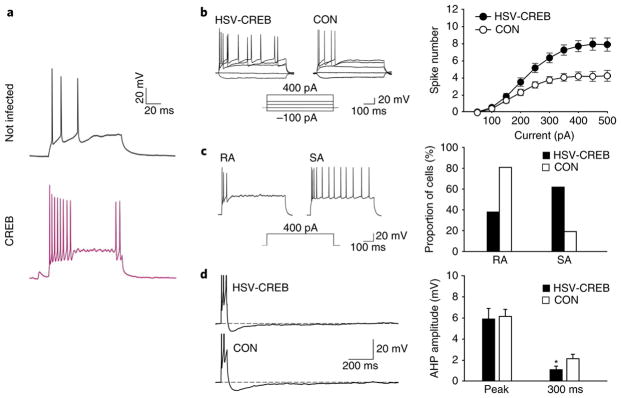
Fig. 1
Fig. 1. CREB increases neuronal excitability
a, Cultured hippocampal neurons were injected with a depolarizing current pulse. Cells transfected with CREB showed increased action potential firing compared with that in nontransfected cells. bd, Acute lateral slices of rat amygdala were divided into three groups (HSV-CREB-transfected, HSV-LacZ-transfected, and nontransfected) and underwent whole-cell recordings 3 d after treatment. b, CREB-overexpressing neurons (transfected with HSV-CREB) fired more action potentials (right) than control neurons (CON; nontransfected and HSV-LacZ-transfected). c, Spike frequency adaptation was analyzed with a 400-pA, 600-ms current injection. Cells were classified as rapidly adapting (RA) if they fired between one and five spikes and then remained silent, or as slowly adapting (SA) if they fired six or more spikes. A greater fraction of HSV-CREB-transfected cells (compared with control cells) fired more than six times in response to current injection, which indicates that CREB reduces spike frequency adaptation and thus alters firing properties. d, Amplitude of post-burst AHP at the negative peak and 300 ms after current injection. There was no difference in amplitude at the negative peak, whereas at 300 ms, HSV-CREB cells showed a significant reduction in AHP amplitude (right; significant difference indicated by asterisk). All data are presented as mean ± s.e.m. *P < 0.05, unpaired t-test. Panel a reproduced with permission from ref. . Panels b and c reproduced with permission from ref. .
Fig. 2
Fig. 2. Allocate-to-link hypothesis
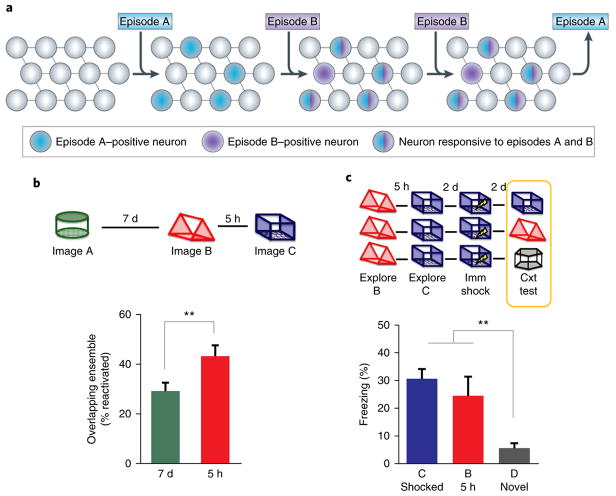
a, Memories that are encoded close in time are represented by overlapping neural populations as a result of learning-related increases in excitability. This temporal window has been experimentally shown to last at least 5 h, but it is presumed that it can last as long as 1 d. This model provides a novel mechanism for temporal association and memory linking over time. b,c, Transfer of contextual fear provides support for temporal association via overlapping neural populations. b, Animals explored context A 7 d before context B, which was explored 5 h before context C. Calcium imaging data demonstrated greater overlap between neuronal ensembles activated during exploration of contexts B and C (5 h) than between those activated during exploration of contexts A and C (7 d). c, Transfer-of-fear experimental design. The context in which the mice were tested is outlined by a yellow rectangle and corresponds with the provided freezing assay data. There was little difference in freezing between contexts C and B, whereas there was significantly less freezing in D than in both C and B (data not shown). Imm, immediate; Cxt, context. Results are shown as mean ± s.e.m. **P < 0.01. Panel a reproduced with permission from ref. . Panels b and c reproduced with permission from ref. .
Fig. 3
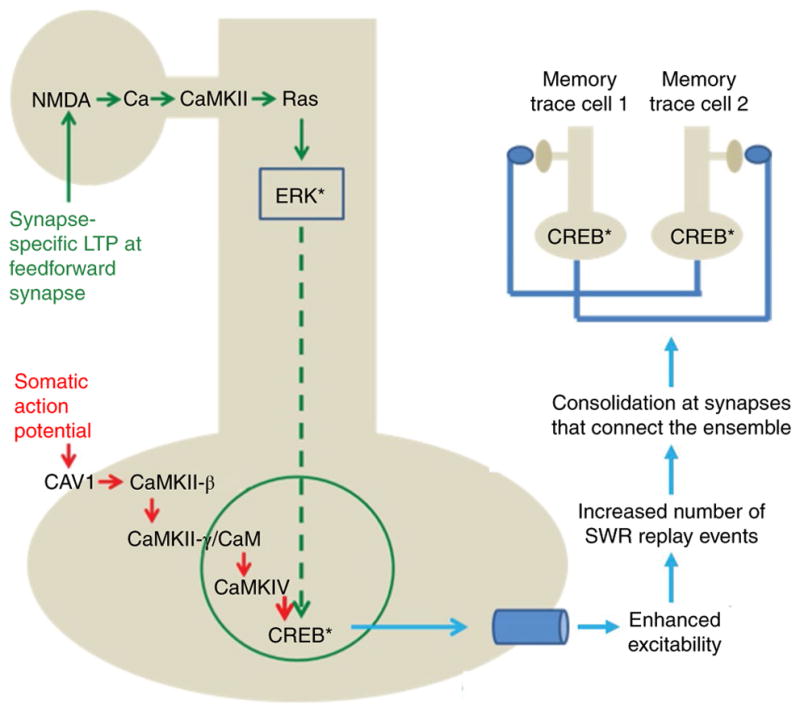
Fig. 3. CREB-dependent enhancement of excitability is controlled both by dendritic LTP events and by somatic spiking, an enhancement that facilitates ensemble formation
Induction of LTP at feedforward synapses results in CaMKII activation, which then leads to extracellular signal-regulated protein kinase (ERK) activation at the synapse via synaptic Ras-GTPase-activating protein (synGAP) and Ras (see also refs. ). Activated ERK (together with Jacob) then moves to the soma, leading to phosphorylation of CREB. CREB activation may occur by a second pathway: action potentials in the soma activate voltage-dependent Ca2+ channels. The resulting increase in Ca2+ levels initiates a complex cascade that leads to the entry of calmodulin (CaM) into the nucleus and the phosphorylation of CREB by calcium/calmodulin-dependent protein kinase IV (CaMKIV). Top right: two memory trace cells and their interconnections. The CREB-dependent increase in excitability in these cells enhances their participation in memory replay during SWR, leading to consolidation of the synaptic connections that link memory trace cells and thus the formation of a stable ensemble. Asterisks denote phosphorylation.

References

    1. Hebb DO. The Organization of Behavior: A Neuropsychological Theory. Wiley; New York: 1949.
    1. Bliss TV, Collingridge GL. A synaptic model of memory: long-term potentiation in the hippocampus. Nature. 1993;361:31–39. - PubMed
    1. Bliss TVP, Collingridge GL. Expression of NMDA receptor-dependent LTP in the hippocampus: bridging the divide. Mol Brain. 2013;6:5. - PMC - PubMed
    1. Nakazawa K, McHugh TJ, Wilson MA, Tonegawa S. NMDA receptors, place cells and hippocampal spatial memory. Nat Rev Neurosci. 2004;5:361–372. - PubMed
    1. Giese KP, Fedorov NB, Filipkowski RK, Silva AJ. Autophosphorylation at Thr286 of the alpha calcium-calmodulin kinase II in LTP and learning. Science. 1998;279:870–873. - PubMed

Publication types

Substances