. 2018 Feb;15(2):1912-1916.
doi: 10.3892/ol.2017.7473. Epub 2017 Nov 22.

Severe acute toxicity following gemcitabine administration: A report of four cases with cytidine deaminase polymorphisms evaluation

Affiliations

Severe acute toxicity following gemcitabine administration: A report of four cases with cytidine deaminase polymorphisms evaluation

Beata Hryciuk et al. Oncol Lett. 2018 Feb.

Abstract

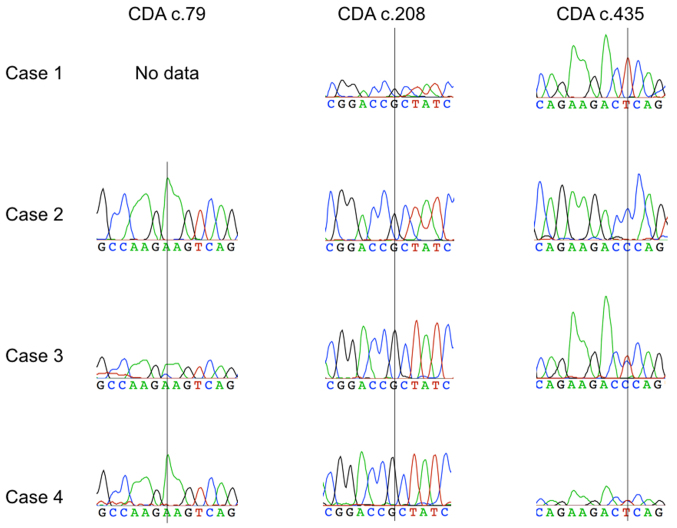
Gemcitabine (GCB) is a pyrimidine antimetabolite widely used in various solid tumors as a single agent or as a component of multidrug regimens. In the majority of patients, GCB is well tolerated, however life-threatening complications occasionally occur. The current report presents four cases of severe acute toxicity, which included two that were fatal, following administration of GCB alone or in combination with cisplatin. Of the four cases, in one, a Naranjo Adverse Drug Reaction Probability Score was definite, in two, probable and in one possible. To determine the potential causes of these toxicities, polymorphic variants of cytidine deaminase, the primary enzyme involved in the hepatic metabolism of GCB, were assessed. The homogeneous c.435TT variant was detected in one patient and a heterozygotic c.435CT variant in two, one of whom additionally harbored a heterozygotic c.79AC variant.

Keywords: chemotherapy toxicity; cytidine deaminase; gemcitabine; polymorphism.


Figures
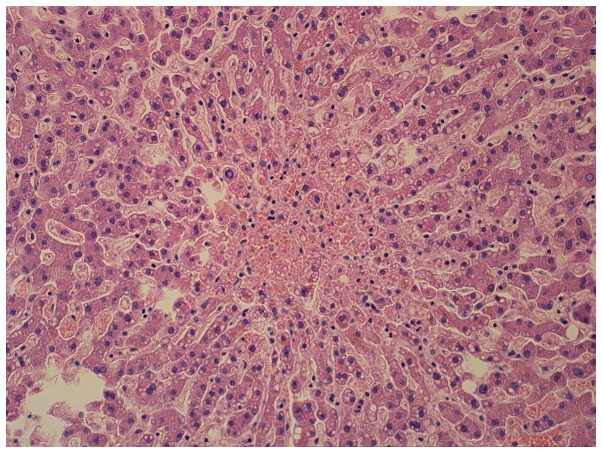
Figure 1.
Figure 1.
Hepatocyte necrosis in the centers of lobules. The foci of cell necrosis; hepatocytes with features of microvesicular degeneration and intracellular cholestasis (hematoxylin and eosin; magnification, ×200).
Figure 2.
Figure 2.
Acute renal tubular necrosis (eosinophilic, flattened epithelium with cell cytoplasm homogenization, exfoliative to tubular lumen; hematoxylin and eosin; magnification, ×200).
Figure 3.
Figure 3.
The evaluation of CDA polymorphism: 79A>C, 208G>A, 435C>T; four cases. CDA, cytidine deaminase.

References

    1. Toschi L, Finocchiaro G, Bartolini S, Gioia V, Cappuzzo F. Role of gemcitabine in cancer therapy. Future Oncol. 2005;1:7–17. doi: 10.1517/14796694.1.1.7. - DOI - PubMed
    1. Aapro MS, Martin C, Hatty S. Gemcitabine-a safety review. Anticancer Drugs. 1998;9:191–201. doi: 10.1097/00001813-199803000-00001. - DOI - PubMed
    1. Tonato M, Mosconi AM, Martin C. Safety profile of gemcitabine. Anticancer Drugs. 1995;6(Suppl 6):S27–S32. doi: 10.1097/00001813-199512006-00005. - DOI - PubMed
    1. Wong A, Soo RA, Yong WP, Innocenti F. Clinical pharmacology and pharmacogenetics of gemcitabine. Drug Metab Rev. 2009;41:77–88. doi: 10.1080/03602530902741828. - DOI - PubMed
    1. van Moorsel CJ, Pinedo HM, Veerman G, Bergman AM, Kuiper CM, Vermorken JB, van der Vijgh WJ, Peters GJ. Mechanisms of synergism between cisplatin and gemcitabine in ovarian and non-small-cell lung cancer cell lines. Br J Cancer. 1999;80:981–990. doi: 10.1038/sj.bjc.6690452. - DOI - PMC - PubMed