. 2018 Feb;15(2):2611-2618.
doi: 10.3892/ol.2017.7560. Epub 2017 Dec 8.

3-Oxoacid CoA transferase 1 as a therapeutic target gene for cisplatin-resistant ovarian cancer

Affiliations

3-Oxoacid CoA transferase 1 as a therapeutic target gene for cisplatin-resistant ovarian cancer

San-Duk Yang et al. Oncol Lett. 2018 Feb.

Abstract

Ovarian cancer (OC) is the second leading cause of mortality from gynecological malignancies and has the highest mortality rate worldwide. As it is commonly asymptomatic during the early stages of the disease, >70% of patients with OC are diagnosed at advanced stages with metastasis. Despite treatment methods, including optimal debulking surgery and chemotherapy with the platinum-based drug cisplatin, OC recurrence is often inevitable, with an overall 5-year survival rate of 45%, mostly due to the steady development of cisplatin resistance. To identify genes involved in cisplatin resistance, the present study determined the half-maximal inhibitory concentrations of eight different OC cell lines and classified them into two groups (sensitive and resistant). mRNA expression was analyzed with GeneChip Human Gene 1.0 ST Arrays, and DNA methylation profiles were evaluated with the HumanMethylation450 BeadChip. Using an integrated approach of analyzing gene expression levels and DNA methylation profiles simultaneously, 26 genes were selected that were differentially expressed and methylated between the resistant and sensitive groups. Among these 26 genes, 3-oxoacid CoA transferase 1 (OXCT1), which was demonstrated to be downregulated and hypermethylated at promoter CpGs in the cisplatin-resistant group compared with the cisplatin-sensitive group, was selected for further investigation. Treatment with a DNA methyltransferase inhibitor restored hypermethylation-mediated gene silencing of OXCT1 in the cisplatin-resistant group, but not in the cisplatin-sensitive group. Furthermore, overexpression of OXCT1 conferred sensitivity to cisplatin in OC cells. The results of the present study suggest that OXCT1 serves an important role in conferring cisplatin sensitivity, and may provide a potential therapeutic target for cisplatin chemotherapy in patients with recurrent OC.

Keywords: 3-oxoacid CoA transferase 1; DNA methylation; cisplatin; integrated analysis; ovarian cancer.


Figures
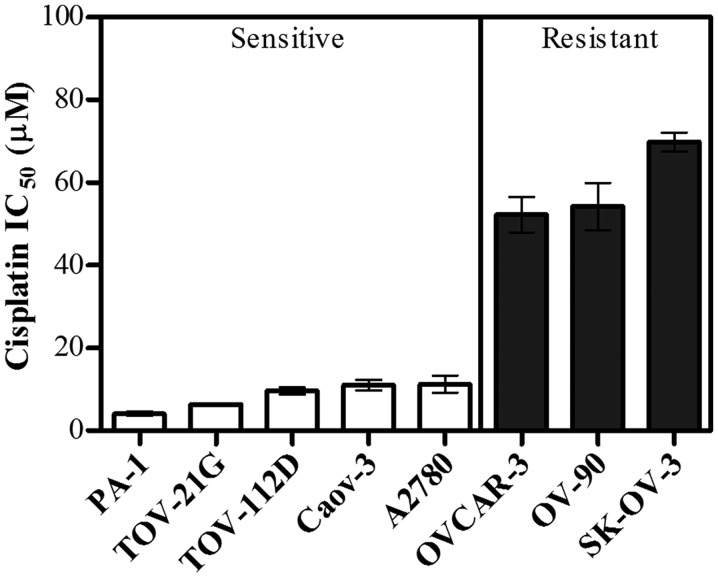
Figure 1.
Figure 1.
The IC50 values of eight human ovarian cancer cell lines. Cell viability was assessed using MTT assays following exposure to cisplatin for 48-h. The error bars indicate the mean ± standard deviation of triplicate experiments. IC50, half-maximal inhibitory concentration.
Figure 2.
Figure 2.
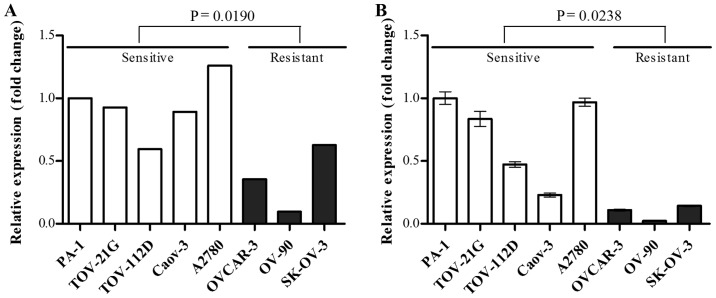
Downregulation of OXCT1 expression in cisplatin-resistant cell lines. OXCT1 mRNA expression was determined by (A) gene expression microarray and (B) reverse transcription-quantitative polymerase chain reaction. Data are presented as the mean ± standard deviation of triplicate evaluations. Statistical analyses were performed using a t-test. OXCT1, 3-oxoacid CoA transferase 1.
Figure 3.
Figure 3.
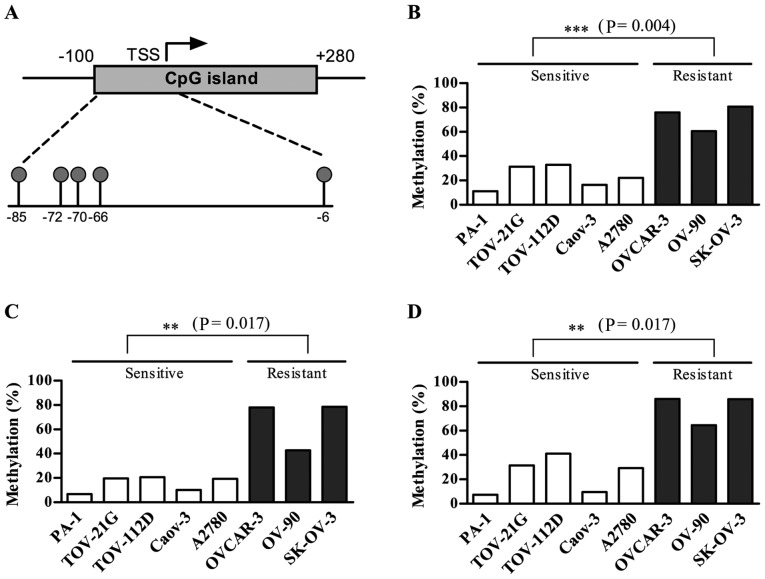
Hypermethylation of CGIs within OXCT1 promoter in cisplatin-resistant cell lines. The DNA methylation status of CGI within the OXCT1 promoter region was quantified using the Illumina HumanMethylation 450 BeadChip in eight ovarian cancer cell lines. (A) The Illumina HumanMethylation 450 BeadChip included five CpG sites within the CGI promoter region of the OXCT1 gene, which are located at positions −85, −72, −70, −66 and −6 from the TSS. The DNA methylation status of three CpGs at positions (B) −66, (C) −70 and (D) −85 relative to TSS are shown. Statistical analyses were performed using t-tests. **P<0.01; ***P<0.001. CGI, CpG islands; OXCT1, 3-oxoacid CoA transferase 1; TSS, transcription start site.
Figure 4.
Figure 4.
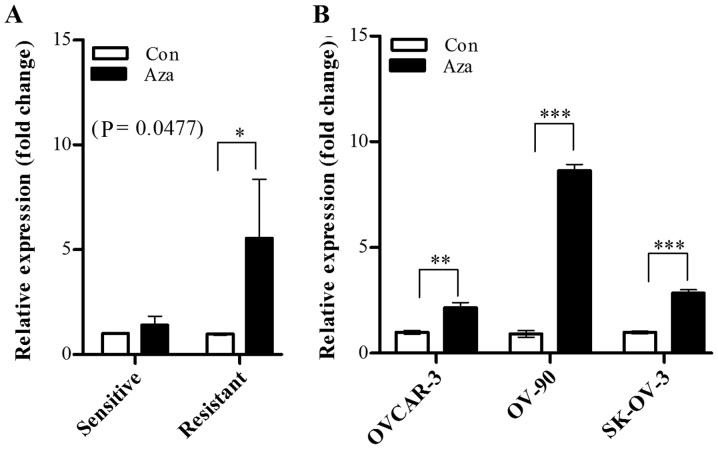
Restoration of OXCT1 expression following demethylation in cisplatin-resistant cell lines. Eight ovarian cancer cell lines were treated with 5-aza-2′-deoxycytidine. Following treatment with 5-aza-2′-deoxycytidine, OXCT1 mRNA expression levels were determined by reverse transcription-quantitative polymerase chain reaction. The OXCT1 mRNA expression levels relative to the untreated control are shown for (A) the cisplatin-sensitive and cisplatin-resistant groups of cell lines, and (B) the individual cisplatin-resistant cell lines. The error bars indicate the mean ± standard deviation of triplicate evaluations. Statistical analyses were performed using t-tests. *P<0.05; **P<0.01; ***P<0.001. Con, control; Aza, 5-aza-2′-deoxycytidine; OXCT1, 3-oxoacid CoA transferase 1.
Figure 5.
Figure 5.
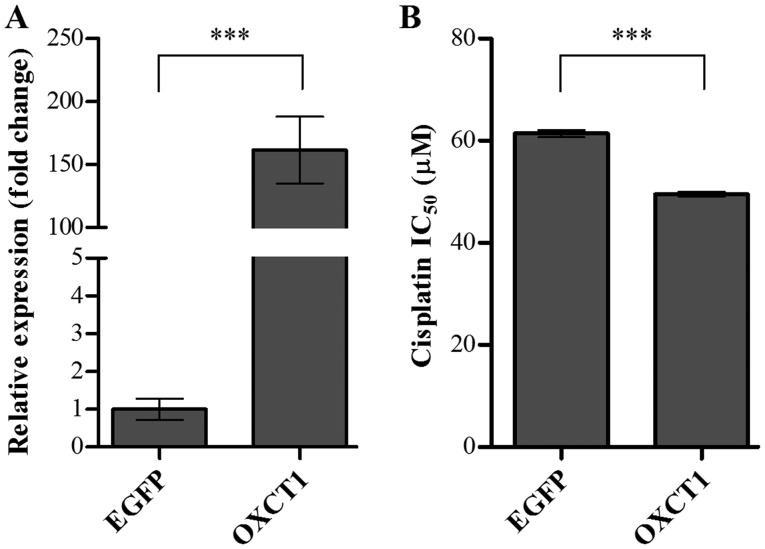
Sensitization of cells to cisplatin following overexpression of OXCT1. Cisplatin-resistant SK-OV-3 cells were transiently transfected with EGFP and OXCT1 expression constructs. (A) Following 24 h of transfection, OXCT1 transfection efficiency was confirmed by evaluating OXCT1 mRNA expression levels by reverse transcription-quantitative polymerase chain reaction. (B) Cell viability of transfected cells was determined using MTT assay following a 48-h treatment with cisplatin. Data are presented as the mean ± standard deviation from three independent experiments. Statistical analyses were performed using t-tests. ***P<0.001. OXCT1, 3-oxoacid CoA transferase 1; EGFP, enhanced green fluorescent protein.

References

    1. Lowe KA, Chia VM, Taylor A, O'Malley C, Kelsh M, Mohamed M, Mowat FS, Goff B. An international assessment of ovarian cancer incidence and mortality. Gynecol Oncol. 2013;130:107–114. doi: 10.1016/j.ygyno.2013.03.026. - DOI - PubMed
    1. Notani PN. Global variation in cancer incidence and mortality. Curr Sci-Bangalore. 2001;81:465–474.
    1. Salani R, Backes FJ, Fung MF, Holschneider CH, Parker LP, Bristow RE, Goff BA. Posttreatment surveillance and diagnosis of recurrence in women with gynecologic malignancies: Society of gynecologic oncologists recommendations. Am J Obstet Gynecol. 2011;204:466–478. doi: 10.1016/j.ajog.2011.03.008. - DOI - PubMed
    1. Ruan Z, Liu J, Kuang Y. Isolation and characterization of side population cells from the human ovarian cancer cell line SK-OV-3. Exp Ther Med. 2015;10:2071–2078. doi: 10.3892/etm.2015.2836. - DOI - PMC - PubMed
    1. Borley J, Wilhelm-Benartzi C, Brown R, Ghaem-Maghami S. Does tumour biology determine surgical success in the treatment of epithelial ovarian cancer? A systematic literature review. Br J Cancer. 2012;107:1069–1074. doi: 10.1038/bjc.2012.376. - DOI - PMC - PubMed