Review
. 2017 Oct 9;4(4):356-370.
doi: 10.1080/23328940.2017.1367457. eCollection 2017.

Pathophysiology of heatstroke in dogs - revisited

Affiliations
Review

Pathophysiology of heatstroke in dogs - revisited

Yaron Bruchim et al. Temperature (Austin). .

Abstract

Heatstroke results from a failure to dissipate accumulated heat during exposure to hot environments, or during strenuous physical exercise under heat stress. It is characterized by core body temperatures > 41°C, with central nervous system dysfunction. Functional morphology and thermoregulatory effectors differences between dogs and humans may require special heatstroke protective adaptations in dogs, however, the risk factors for developing heatstroke are similar in both. In dogs, these include hot, especially highly humid environments, excessive physical activity, obesity, large (>15 kg) body weight, being of certain breed (e.g., Labrador retrievers and brachycephalic breeds), upper airway obstruction and prolonged seizures. Lack of acclimation to heat and physical fitness decreases the survival of heat stroked dogs. At the systemic level, blood pooling within the large internal organs (e.g., spleen, liver) is a major contributor to the development of shock and consequent intestinal ischemia, hypoxia and endothelial hyperpermeability, commonly occurring in heatstroke patients. Evoked serious complications include rhabdomyolysis, acute kidney injury, acute respiratory distress syndrome and ultimately, sepsis and disseminated intravascular coagulation. The most common clinical signs in dogs include acute collapse, tachypnea, spontaneous bleeding, shock signs and mental abnormalities, including depression, disorientation or delirium, seizures, stupor and coma. In such dogs, presence of peripheral blood nucleated red blood cells uniquely occurs, and is a highly sensitive diagnostic and prognostic biomarker. Despite early, appropriate body cooling, and intensive supportive treatment, with no available specific treatment to ameliorate the severe inflammatory and hemostatic derangements, the mortality rate is around 50%, similar to that of human heatstroke victims. This review discusses the pathophysiology of canine heatstroke from a veterinarian's point of view, integrating new and old studies and knowledge.

Keywords: acute kidney injury; canine; disseminated intravascular coagulation; heat shock protein.


Figures
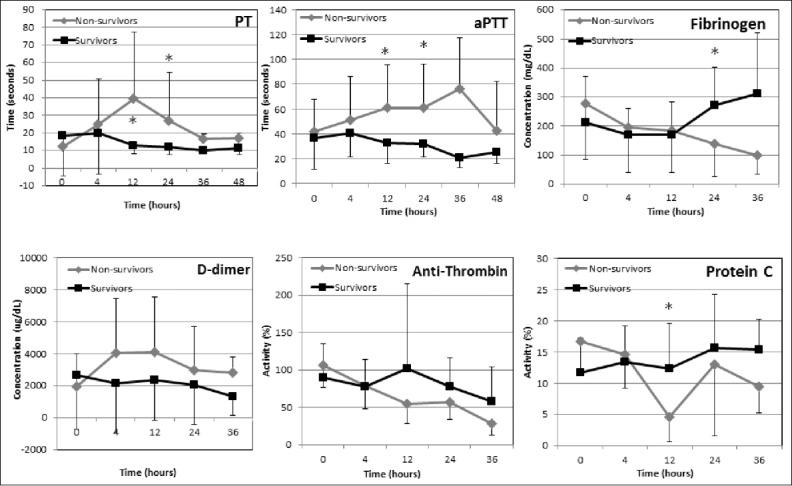
Figure 1.
Figure 1.
Trends of hemostatic analytes during hospitalization of 30 dogs with naturally-occurring heatstroke. The survivors (n = 18) are depicted by solid black line, while the non-survivors by solid gray lines. *, significant difference between the survivors and the non survivors; PT, prothrombin time; aPTT, activated partial thromboplastin time. Data are presented as mean ±SD. (From Bruchim et al. JVECCS 2016). © Wiley-Blackwell. Reproduced by permission of Wiley-Blackwell. Permission to reuse must be obtained from the rightsholder.
Figure 2.
Figure 2.
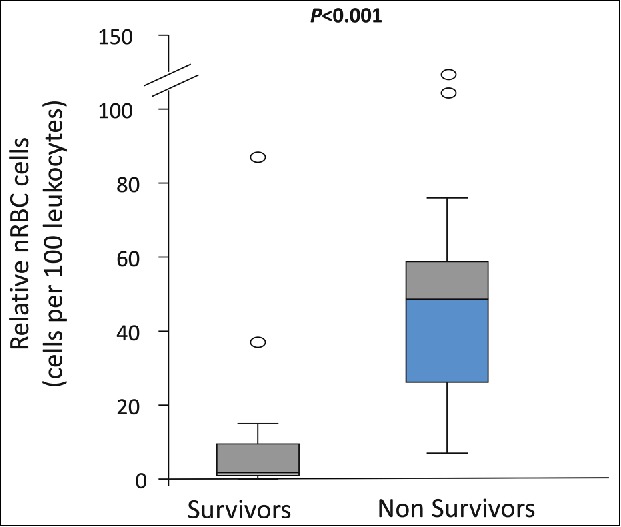
The relative nucleated red blood cell count (nRBC) in 41 dogs with naturally occurring heatstroke upon admission to the hospital. Non-survivors had significantly (P = 0.001) higher nRBCs compared to the survivors (median 55 nRBC/100 leukocytes vs. median 5 nRBC/100 leukocytes, respectively). (From Aroch et al. 2009). © Wiley-Blackwell. Reproduced by permission of Wiley-Blackwell. Permission to reuse must be obtained from the rightsholder.
Figure 3.
Figure 3.
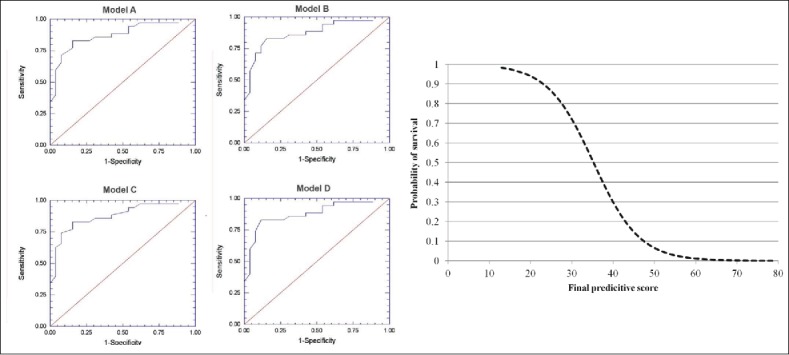
A novel severity scoring system for dogs with heatstroke upon admission to the hospital; In the left side, 4 receiver operator (ROC) analyses curves for 4 models done evaluate the performance of the proposed scoring system in 30 dogs with naturally occurring heatstroke upon admission to the hospital. The area under the ROC curve (AUC) for the final predictive score using model A as a predictor of the outcome (i.e., survival vs. death) was 0.92 (95% confidence interval (0.86-0.99), with an optimal cutoff point of 35.0, corresponding to sensitivity and specificity of 93% and 86%, respectively. In the right side, the graph depicts the probability of survival against the predictive score upon admission to the hospital. The probability of survival is 50% with a predictive score of 35.0. * Receiver Operator Characteristic- implies for the best sensitivity and specificity at various threshold points. (From Segev et al. JVECCS 2016). © Wiley-Blackwell. Reproduced by permission of Wiley-Blackwell. Permission to reuse must be obtained from the rightsholder.
Figure 4.
Figure 4.
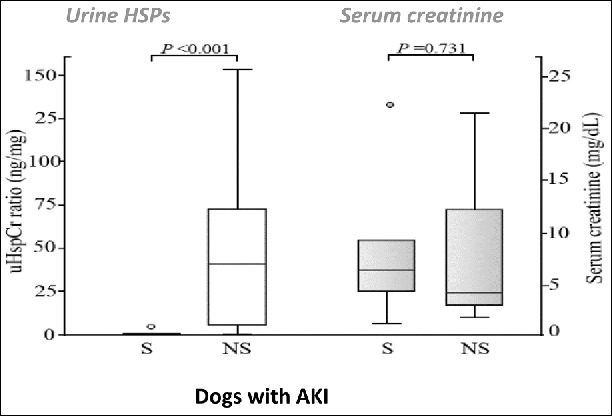
Urine heat shock protein 72 (uHSP72) concentrations in 6 survivors (S) and 6 non-survivors (NS) dogs sustaining acute kidney injury (AKI). The uHSP72/urine creatinine ratio was significantly (P > 0.001) higher among the non-survivors compared to the survivors; serum creatinine did not differ among the groups. (From Bruchim et al. Vet J 2017). © Elsevier. Reproduced by permission of Elsevier. Permission to reuse must be obtained from the rightsholder.
Figure 5.
Figure 5.
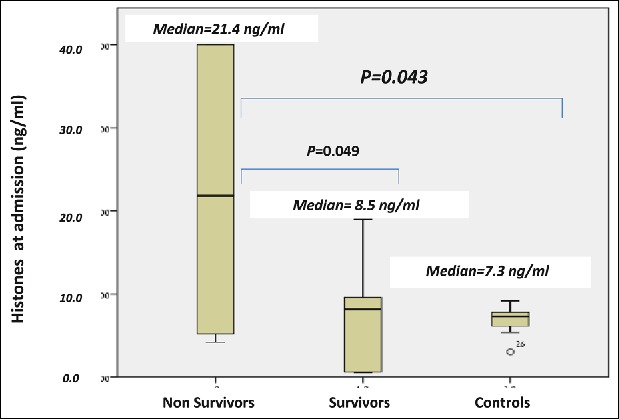
Median total serum histones concentration at presentation to the hospital in 10 non- survivors and 6 survivor dogs of naturally-occurring heatstroke and 7 healthy control dogs. Median total serum histones are significantly (P = 0.043) increased in all dogs with naturally occurring heatstroke compared the 7 healthy controls. Median total serum histones in the non-survivors was significantly (P = 0.049) higher compared to survivors of heatstroke (21.3 ng/ml vs. 8.5 ng/ml, respectively). (From Bruchim et al. Cell Stress & Chaperon 2017). © Springer. Reproduced by permission of Springer. Permission to reuse must be obtained from the rightsholder.
Figure 6.
Figure 6.
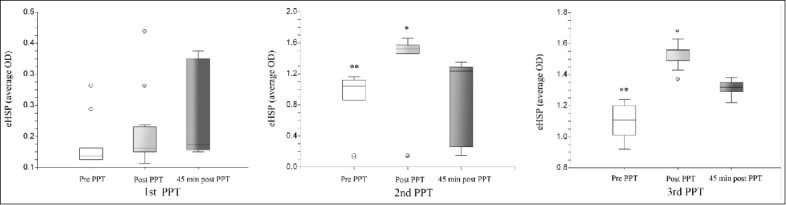
1, Physical Performance Test; – pre-PPT; – immediately post PPT; – 45 min post PPT. eHSP72 in serum of the studied dogs under basal conditions, at the end of the PPT and 45 min post-PPT; Figure 6a- the first year of the study. Figure 6b- the second year of the study; Figure 6c- the third year of the study. Each box represents Median (range); *, significant increase in eHSP72 immediately post-PPT at the second and third PPTs; **- significant increase in the basal eHSP72 at the second and third PPTs. (From Bruchim et al. JAP 2014). © American Physiological Society. Reproduced by permission of American Physiological Society. Permission to reuse must be obtained from the rightsholder.
None
None
None

References

    1. Hemmelgarn C, Gannon K. Heatstroke: thermoregulation, pathophysiology, and predisposing factors. Compendium. 2013;35:E4. PMID:23677841 - PubMed
    1. Rosenberg H, Pollock N, Schiemann A, Bulger T, Stowell K. Malignant hyperthermia: a review. Orphanet J Rare Dis. 2015;10:93. doi: 10.1186/s13023-015-0310-1. PMID:26238698 - DOI - PMC - PubMed
    1. Misset B, De Jonghe B, Bastuji-Garin S, Gattolliat O, Boughrara E, Annane D, Hausfater P, Garrouste-Orgeas M, Carlet J. Mortality of patients with heatstroke admitted to intensive care units during the 2003 heat wave in France: a national multiple-center risk-factor study. Critical Care Med. 2006;34:1087-1092. doi: 10.1097/01.CCM.0000206469.33615.02 - DOI - PubMed
    1. Shibolet S, Lancaster MC, Danon Y. Heat stroke: a review. Aviation Space Environ Med. 1976;47:280-301 - PubMed
    1. Hsu SF, Chao CM, Chang CP, Lin MT, Cheng BC. Heat shock protein 72 may improve hypotension by increasing cardiac mechanical efficiency and arterial elastance in heatstroke rats. Int J Cardiol. 2016;219:63-69. doi: 10.1016/j.ijcard.2016.05.004. PMID:27288968 - DOI - PubMed

LinkOut - more resources