. 2018 Mar 5;215(3):985-997.
doi: 10.1084/jem.20171626. Epub 2018 Feb 7.

Optimized RNP transfection for highly efficient CRISPR/Cas9-mediated gene knockout in primary T cells

Affiliations

Optimized RNP transfection for highly efficient CRISPR/Cas9-mediated gene knockout in primary T cells

Akiko Seki et al. J Exp Med. .

Abstract

CRISPR (clustered, regularly interspaced, short palindromic repeats)/Cas9 (CRISPR-associated protein 9) has become the tool of choice for generating gene knockouts across a variety of species. The ability for efficient gene editing in primary T cells not only represents a valuable research tool to study gene function but also holds great promise for T cell-based immunotherapies, such as next-generation chimeric antigen receptor (CAR) T cells. Previous attempts to apply CRIPSR/Cas9 for gene editing in primary T cells have resulted in highly variable knockout efficiency and required T cell receptor (TCR) stimulation, thus largely precluding the study of genes involved in T cell activation or differentiation. Here, we describe an optimized approach for Cas9/RNP transfection of primary mouse and human T cells without TCR stimulation that results in near complete loss of target gene expression at the population level, mitigating the need for selection. We believe that this method will greatly extend the feasibly of target gene discovery and validation in primary T cells and simplify the gene editing process for next-generation immunotherapies.


Figures

Figure 1.
Figure 1.
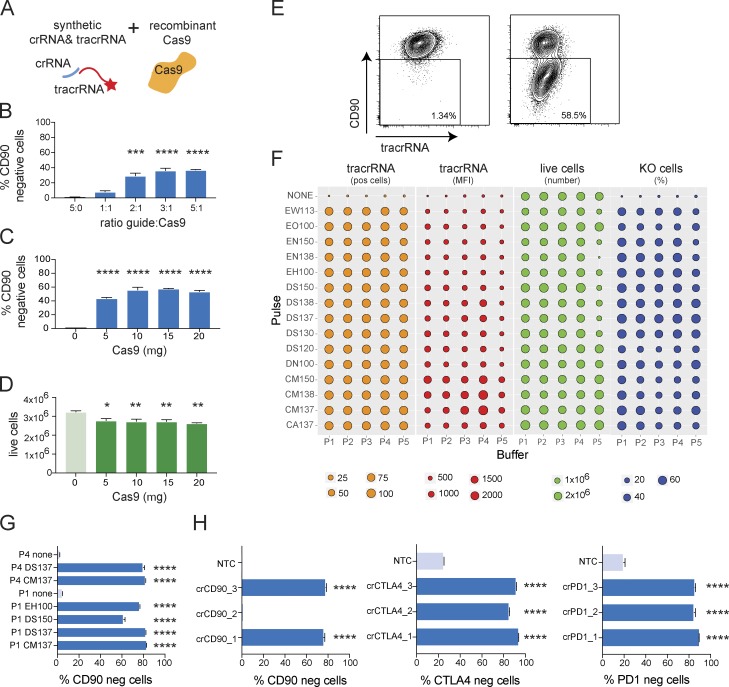
Nucleofection of RNPs leads to highly efficient target gene KO in activated mouse T cells. (A) Schematic depiction of RNP components, chemically stabilized crRNA, fluorescently labeled tracrRNA, and recombinant Cas9 protein. (B) KO efficiency as measured by CD90-negative CD8+ T cells 72 h after nucleofection of RNPs (DN100/P3) targeting CD90, and titration of gRNA to Cas9 ratio. Data are presented as mean ± SD (n = 2) and representative of two independent experiments. (C and D) KO efficiency as measured by CD90-negative CD8+ T cells (C) and cell viability 72 h after nucleofection of RNPs (DN100/P3) targeting CD90 (D), and titration Cas9 amount. Data are presented as mean ± SD (n = 2) and representative of two independent experiments. (E) Example of KO efficiency of RNP transfection targeting CD90 with 3:1 RNA/Cas9 ratio and 10 µg Cas9 3 d after transfection. (F) Systematic optimization of nucleofection parameters for RNP transfection of activated mouse CD8+ T cells. Analysis of transfection efficiency (ATTO550 expression and MFI), cell viability, and CD90 KO frequency 48 h after transfection. Data are from one experiment. (G) Comparison of KO efficiency by flow cytometry after RNP transfection using selected nucleofection pulses and buffers for targeting CD90 in CD8+ activated mouse T cells. Data are presented as mean ± SD (n = 2) and representative of two independent experiments. (H) KO efficiency as measured by flow cytometry using optimized RNP transfection in activated mouse CD8 T cells targeting CD90, CTLA4, or PD1 compared with target expression in cells transfected with NTC. Data are presented as mean ± SD (n = 2) and representative of three independent experiments. *, P < 0.05; **, P < 0.01; ***, P < 0.001; ****, P < 0.0001 by one-way ANOVA.
Figure 2.
Figure 2.
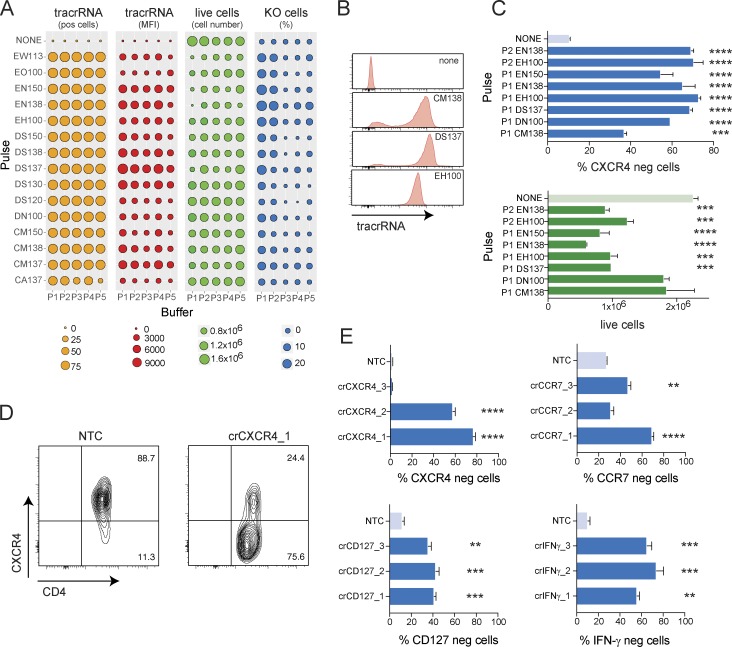
Nucleofection of RNPs leads to highly efficient target gene KO in nonactivated human T cells. (A) Systematic optimization of nucleofection parameters for RNP transfection of nonactivated human CD4+ T cells. Analysis of transfection efficiency (ATTO550 expression and MFI), cell viability, and CXCR4 KO frequency 48 h after transfection. Data are from one experiment. (B) Examples of transfection efficiency (ATTO550-labeled tracrRNA) with different nucleofection pulses 48 h after transfection (gated on live cells). (C) Comparison of KO efficiency and cell viability by flow cytometry 72 h after RNP transfection using selected nucleofection pulses and buffers for targeting CXCR4 in nonactivated human CD4+ T cells. Data are presented as mean ± SD (n = 2) and representative of two independent experiments. (D) CXCR4 expression by flow cytometry 72 h after RNP transfection using the EH100/P2 condition. (E) KO efficiency as measured by flow cytometry using optimized RNP transfection in nonactivated human CD4+ T cells targeting CXCR4, CCR7, CD127, or IFN-γ compared with target expression in cells transfected with NTC. Data are presented as mean ± SD (n = 2) and representative of two independent experiments. **, P < 0.01; ***, P < 0.001; ****, P < 0.0001 by one-way ANOVA.
Figure 3.
Figure 3.
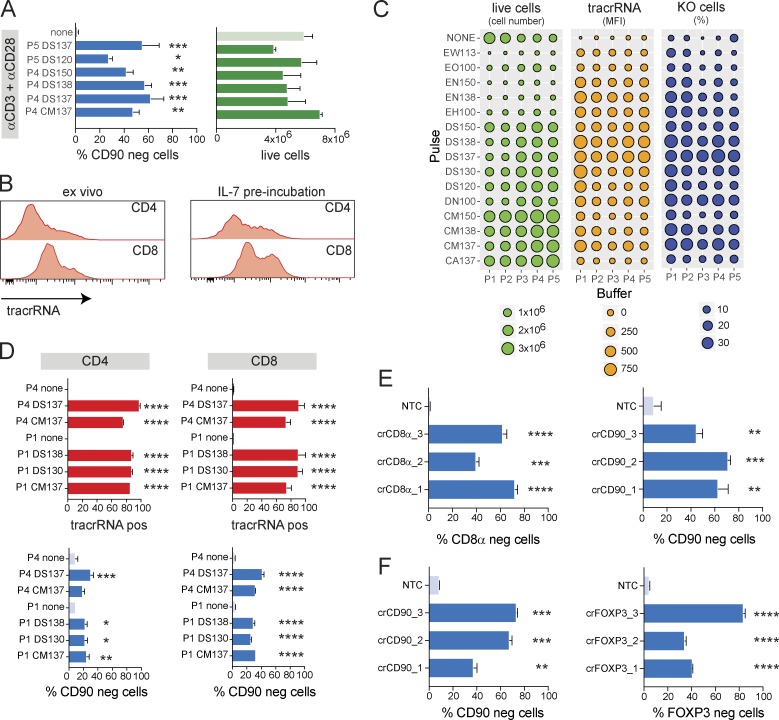
RNP transfection enables gene KO before TCR stimulation in nonactivated mouse T cells. (A) Comparison of KO efficiency and cell viability by flow cytometry 48 h after RNP transfection using selected nucleofection pulses and buffers for targeting CD90 in mouse CD8+ T cells transfected before anti-CD3/anti-CD28 stimulation. Data are presented as mean ± SD (n = 2) and representative of two independent experiments. (B) Transfection efficiency (ATTO550-labeled tracrRNA) 48 h after transfection of mouse CD4+ or CD8+ T cells transfected ex vivo or after 24-h preincubation with IL-7 (gated on live cells). (C) Systematic optimization of nucleofection parameters for RNP transfection of IL-7–preincubated nonactivated mouse CD8+ T cells. Analysis of cell viability, transfection efficiency (ATTO550 MFI), and CD90 KO frequency 72 h after transfection. Data are from one experiment. (D) Comparison of transfection and KO efficiencies by flow cytometry 72 h after RNP transfection using selected nucleofection pulses and buffers for targeting CD90 in mouse CD4+ or CD8+ T cells cultured with IL-7. Data are presented as mean ± SD (n = 2) and representative of two independent experiments. (E and F) KO efficiency as measured by flow cytometry using optimized RNP transfection in nonactivated mouse CD8+ T cells targeting CD8 or CD90 (E) and nonactivated mouse CD4+ T cells targeting CD90 or Foxp3 compared with NTC (F). Data are presented as mean ± SD (n = 2) and representative of two independent experiments. *, P < 0.05; **, P < 0.01; ***, P < 0.001; ****, P < 0.0001 by one-way ANOVA.
Figure 4.
Figure 4.
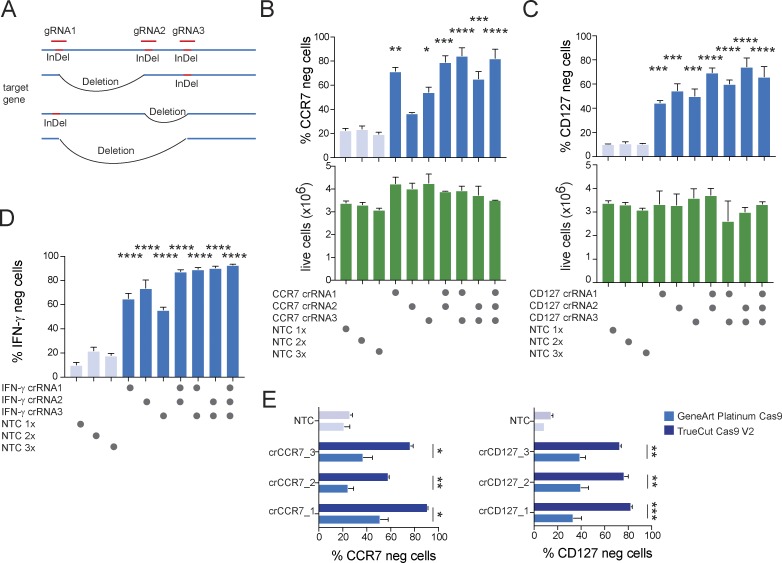
Combination of multiple gRNAs further increases target gene KO efficiency. (A) Schematic depiction of potential outcome of CRISPR targeting of three regions in the same gene leading either to local InDels or deletion of flanked DNA. (B–D) KO efficiency of targeting CCR7 (B), CD127 (C), or IFN-γ (D) using individual gRNAs or the combination of two or three gRNAs per target in nonactivated human CD4+ T cells 72 h after RNP transfection. Data are presented as mean ± SD (n = 2; one-way ANOVA) and representative of two independent experiments. (E) Comparison of KO efficiency 72 h after RNP transfection targeting CCR7 or CD127 in nonactivated human CD4+ T cells using either recombinant GeneArt Platinum Cas9 or TrueCut Cas9 V2. Data are presented as mean ± SD (n = 2; unpaired Student’s t test) and representative of two independent experiments. *, P < 0.05; **, P < 0.01; ***, P < 0.001; ****, P < 0.0001.
Figure 5.
Figure 5.
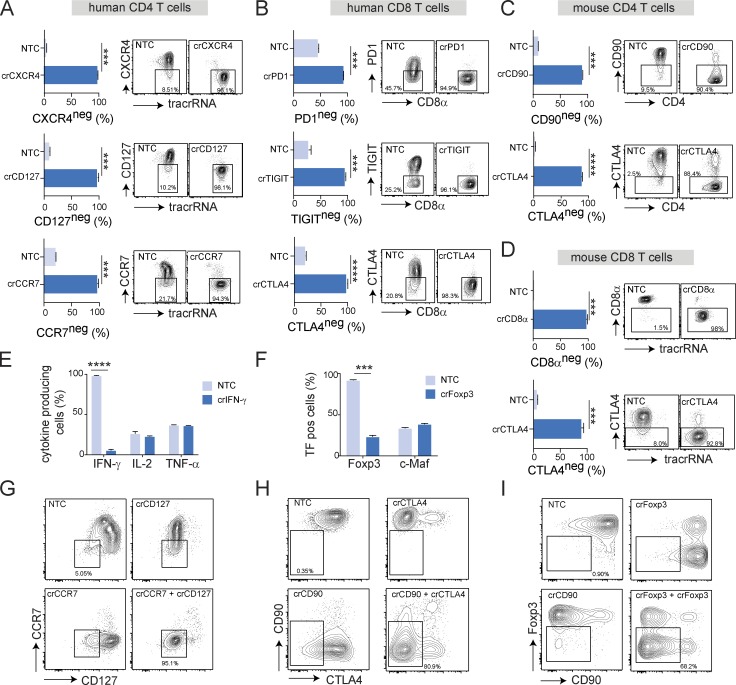
Highly efficient target gene KO in nonactivated human and mouse primary T cells with an optimized CRISPR/Cas9 RNP transfection approach. (A–D) KO efficiency by flow cytometry of CXCR4, CD127, and CCR7 in nonactivated human CD4 T cells 72 h after transfection (A); PD1, TIGIT, and CTLA4 in nonactivated human CD8 T cells 72 h after transfection followed by 72 h of stimulation with anti-CD3/anti-CD28 (B); CD90 and CTLA4 in IL-7–preconditioned nonactivated mouse CD4 T cells 5 d after transfection and incubation with IL-7 (C); and CD8α and CTLA4 in IL-7–preconditioned nonactivated mouse CD8+ T cells after transfection and 5 d of incubation in the presence of IL-7 followed by 48 h stimulation with anti-CD3/anti-CD28 (D; all compared with nontargeting control Cas9 RNP-transfected T cells). Data are presented as mean ± SD (n = 2) and representative of three (A) or two (B–D) independent experiments. (E) IFN-γ expression by flow cytometry in crIFNγ or NTC-transfected nonactivated human CD8+ T cells cultured for 3 d and restimulated for 4 h with PMA/ionomycin. Data are presented as mean ± SD (n = 2) and representative of two independent experiments. (F) FoxP3 and c-Maf expression by flow cytometry in crFoxp3 or NTC transfected IL-7–preconditioned nonactivated mouse CD4+ T cells 5 d after transfection with IL-7 followed by 3 d of polarization into iTreg with TGF-β and IL-2. Data are presented as mean ± SD (n = 2) and representative of two independent experiments. (G–I) KO efficiency by flow cytometry of double KOs targeting CD127 and CCR7 in nonactivated human CD4+ T cells 72 h after transfection (G), CD90 and CTLA4 in nonactivated mouse CD8 T cells after transfection and 5 d of incubation in the presence of IL-7 followed by 48 h stimulation with anti-CD3/anti-CD28 (H), or CD90 and FoxP3 in nonactivated mouse CD4+ T cells after transfection and 5 d of incubation with IL-7 followed by 3 d of polarization into iTreg with TGF-β and IL-2 with anti-CD3/anti-CD28 (I). Data are presented as mean ± SD (n = 2) and representative of two independent experiments. ***, P < 0.001; **** P < 0.0001 by unpaired Student’s t test.

References

    1. Chi S., Weiss A., and Wang H.. 2016. A CRISPR-Based Toolbox for Studying T Cell Signal Transduction. BioMed Res. Int. 2016:5052369–10. 10.1155/2016/5052369 - DOI - PMC - PubMed
    1. Chu V.T., Weber T., Graf R., Sommermann T., Petsch K., Sack U., Volchkov P., Rajewsky K., and Kühn R.. 2016. Efficient generation of Rosa26 knock-in mice using CRISPR/Cas9 in C57BL/6 zygotes. BMC Biotechnol. 16:4 10.1186/s12896-016-0234-4 - DOI - PMC - PubMed
    1. Cong L., Ran F.A., Cox D., Lin S., Barretto R., Habib N., Hsu P.D., Wu X., Jiang W., Marraffini L.A., and Zhang F.. 2013. Multiplex genome engineering using CRISPR/Cas systems. Science. 339:819–823. 10.1126/science.1231143 - DOI - PMC - PubMed
    1. Eyquem J., Mansilla-Soto J., Giavridis T., van der Stegen S.J.C., Hamieh M., Cunanan K.M., Odak A., Gönen M., and Sadelain M.. 2017. Targeting a CAR to the TRAC locus with CRISPR/Cas9 enhances tumour rejection. Nature. 543:113–117. 10.1038/nature21405 - DOI - PMC - PubMed
    1. Gomes-Silva D., Srinivasan M., Sharma S., Lee C.M., Wagner D.L., Davis T.H., Rouce R.H., Bao G., Brenner M.K., and Mamonkin M.. 2017. CD7-edited T cells expressing a CD7-specific CAR for the therapy of T-cell malignancies. Blood. 130:285–296. 10.1182/blood-2017-01-761320 - DOI - PMC - PubMed

Substances