


Traits associated with central pain augmentation in the Knee Pain In the Community (KPIC) cohort
- PMID: 29438225
- PMCID: PMC5959005
- DOI: 10.1097/j.pain.0000000000001183
Traits associated with central pain augmentation in the Knee Pain In the Community (KPIC) cohort
Abstract
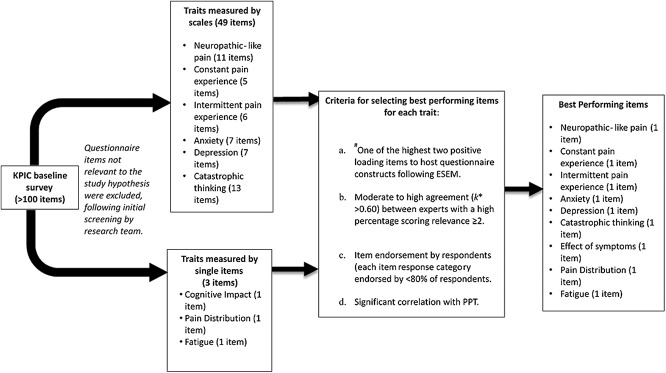
This study aimed to identify self-report correlates of central pain augmentation in individuals with knee pain. A subset of participants (n = 420) in the Knee Pain and related health In the Community (KPIC) baseline survey undertook pressure pain detection threshold (PPT) assessments. Items measuring specific traits related to central pain mechanisms were selected from the survey based on expert consensus, face validity, item association with underlying constructs measured by originating host questionnaires, adequate targeting, and PPT correlations. Pain distribution was reported on a body manikin. A "central pain mechanisms" factor was sought by factor analysis. Associations of items, the derived factor, and originating questionnaires with PPTs were compared. Eight self-report items measuring traits of anxiety, depression, catastrophizing, neuropathic-like pain, fatigue, sleep disturbance, pain distribution, and cognitive impact were identified as likely indices of central pain mechanisms. Pressure pain detection thresholds were associated with items representing each trait and with their originating scales. Pain distribution classified as "pain below the waist additional to knee pain" was more strongly associated with low PPT than were alternative classifications of pain distribution. A single factor, interpreted as "central pain mechanisms," was identified across the 8 selected items and explained variation in PPT (R = 0.17) better than did any originating scale (R = 0.10-0.13). In conclusion, including representative items within a composite self-report tool might help identify people with centrally augmented knee pain.
Conflict of interest statement
Sponsorships or competing interests that may be relevant to content are disclosed at the end of this article.
Figures
References
-
- Akinci A, Al Shaker M, Chang MH, Cheung CW, Danilov A, José Dueñas H, Kim YC, Guillen R, Tassanawipas W, Treuer T, Wang Y. Predictive factors and clinical biomarkers for treatment in patients with chronic pain caused by osteoarthritis with a central sensitisation component. Int J Clin Pract 2016;70:31–44. - PMC - PubMed
-
- Ali A, Lindstrand A, Sundberg M, Flivik G. Preoperative anxiety and depression correlate with dissatisfaction after total knee arthroplasty: a prospective longitudinal cohort study of 186 patients, with 4-year follow-up. J Arthroplasty 2017;32:767–70. - PubMed
-
- Allen KD, Bosworth HB, Chatterjee R, Coffman CJ, Corsino L, Jeffreys AS, Oddone EZ, Stanwyck C, Yancy WS, Dolor RJ. Clinic variation in recruitment metrics, patient characteristics and treatment use in a randomized clinical trial of osteoarthritis management. BMC Musculoskelet Disord 2014;15:413. - PMC - PubMed
-
- Baker PN, van der Meulen JH, Lewsey J, Gregg PJ. The role of pain and function in determining patient satisfaction after total knee replacement. Data from the national joint registry for England and Wales. J Bone Joint Surg Br 2007;89:893–900. - PubMed
MeSH terms
Grants and funding
LinkOut - more resources
Full Text Sources
Other Literature Sources
Medical
