Review
. 2018 Feb 13;10(2):203.
doi: 10.3390/nu10020203.

Toll-Like Receptors: Regulators of the Immune Response in the Human Gut

Affiliations
Review

Toll-Like Receptors: Regulators of the Immune Response in the Human Gut

Hubert Hug et al. Nutrients. .

Abstract

Toll-like receptors (TLRs) are powerful molecular regulators by which the immune system may "sense" the environment and protect the host from pathogens or endogenous threats. In mammalian cells, several TLRs were identified with a tissue and cell type-specific distribution. Understanding the functions of specific TLRs is crucial for the development and discovery of compounds useful to maintaining or re-establishing homeostasis in the gastrointestinal tract (GIT). Due to their relevance in regulating the inflammatory response in the GIT, we will focus here on TLR2, TLR4, and TLR5. In particular, we describe (a) the molecular pathways activated by the stimulation of these receptors with their known bacterial ligands; (b) the non-bacterial ligands known to interact directly with TLR2 and TLR4 and their soluble forms. The scope of this minireview is to highlight the importance of bacterial and non-bacterial compounds in affecting the gut immune functions via the activation of the TLRs.

Keywords: TLR2; TLR4; TLR5; bacterial ligands; gastrointestinal tract; immune system.


Conflict of interest statement

All authors are employees of DSM Nutritional Products.

Figures
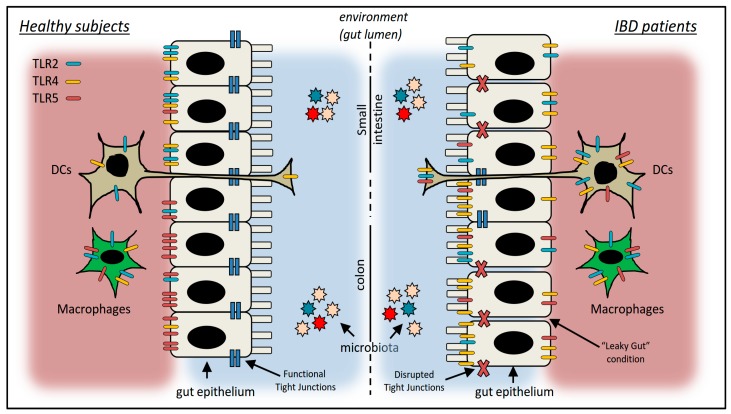
Figure 1
Figure 1
Schematic representation highlighting the expression of Toll-like receptors (TLRs) in the gastrointestinal tract (GIT) of healthy subjects and patients with inflammatory bowel disease (IBD). The gut epithelium represents the interface between the microbial ecosystems present in the lumen of the GIT and the immune system. In healthy conditions, the barrier function of the gut epithelium is guaranteed by the tight junctions between the cells. In pathological conditions, these junctions are disrupted, exposing their basolateral receptors to potentially pathogenic ligands (“Leaky Gut” condition). TLR2, TLR4, and TLR5 are expressed on the gut epithelium cells, as well as on cells of the immune system (here represented only by macrophages and dendritic cells (DCs)). The localization of the specific TLRs is also indicated in the small intestine and colon specifically. Details and references are reported in the text.
Figure 2
Figure 2
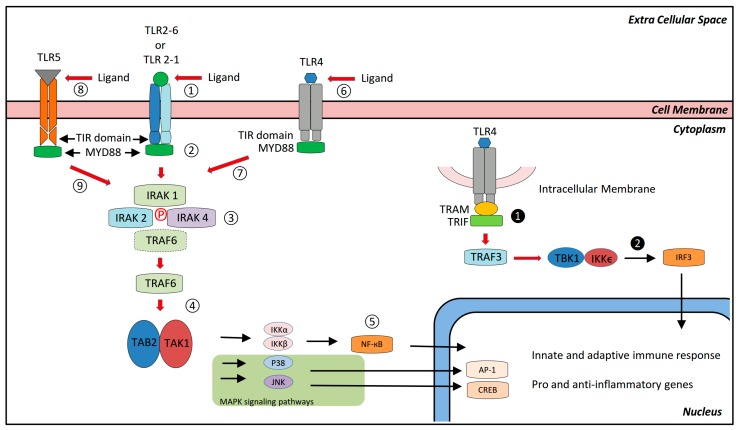
Schematic and simplified representation of the TLR2, TLR4, and TLR5 signaling pathways. Upon ligand recognition, TLR2 is activated and dimerizes with TLR1 or TLR6 ①. A MYD88-dependent intracellular pathway is therefore initiated with ligation of MYD88 (myeloid differentiation primary response protein 88) to the cytoplasmic TLR domain TIR (Toll-IL-1 receptor) ②. MYD88 recruits the IRAK (IL-1R-activating kinases) complex and TRAF6 (TNF-receptor associated factor 6). Phosphorylation of the IRAKs induce activation and release of TRAF6 from the complex ③. TRAF6 then activates the TAK1-binding protein 2 and TGF-activated kinase 1 (TAB2-TAK1) complex ④. Finally, the IκB kinases-α and β (IKKα and IKKβ) complex, responsible for activation of the transcription factor (NF-κB) that translocates into the nucleus, where it regulates gene expression of mainly pro-inflammatory genes ⑤. Moreover, TRAF6 activates the mitogen-activated protein kinases (MAPKs) signaling pathway (JNK and P38), whose final effect is the activation of transcription factors AP-1 and CREB. TLR4 homodimers, following TLR4-ligand interaction ⑥. Induce activation of a MYD88-dependent pathway ⑦, as well as MYD88-independent pathway ❶. The second pathway starts with recruitment of TRAM (TRIF-related adapter molecule) to the TIR domain of the TLR4 homodimers and follows with recruitment of TRIF (TIR domain-containing adaptor inducing IFN-β) ❶. TRIF activates TRAF3 and, finally, the transcription factor IRF3 (Interferon Regulatory Factor 3) via recruitment of TANK-binding kinase 1 (TBK1) and IKKϵ ❷. IRF3 translocates to the nucleus, where it induces the expression of type I interferon (INF) genes. TLR5 ligand (flagellin) activates TLR5 ⑧ and, because of this, the MYD88-dependent pathway described above and in the text ⑨. The final effect is the expression of pro-inflammatory genes.

References

    1. Frosali S., Pagliari D., Gambassi G., Landolfi R., Pandolfi F., Cianci R. How the intricate interaction among toll-like receptors, microbiota, and intestinal immunity can influence gastrointestinal pathology. J. Immunol. Res. 2015;2015:489821. doi: 10.1155/2015/489821. - DOI - PMC - PubMed
    1. Medzhitov R. Recognition of microorganisms and activation of the immune response. Nature. 2007;449:819–826. doi: 10.1038/nature06246. - DOI - PubMed
    1. Yiu J.H., Dorweiler B., Woo C.W. Interaction between gut microbiota and toll-like receptor: From immunity to metabolism. J. Mol. Med. 2017;95:13–20. doi: 10.1007/s00109-016-1474-4. - DOI - PMC - PubMed
    1. Sieling P.A., Modlin R.L. Toll-like receptors: Mammalian “taste receptors” for a smorgasbord of microbial invaders. Curr. Opin. Microbiol. 2002;5:70–75. doi: 10.1016/S1369-5274(02)00288-6. - DOI - PubMed
    1. Iwami K.I., Matsuguchi T., Masuda A., Kikuchi T., Musikacharoen T., Yoshikai Y. Cutting edge: Naturally occurring soluble form of mouse toll-like receptor 4 inhibits lipopolysaccharide signaling. J. Immunol. 2000;165:6682–6686. doi: 10.4049/jimmunol.165.12.6682. - DOI - PubMed