


Phytochemical Analysis, Antioxidant and Antimicrobial Activities of Helichrysum arenarium (L.) Moench. and Antennaria dioica (L.) Gaertn. Flowers
- PMID: 29438342
- PMCID: PMC6017730
- DOI: 10.3390/molecules23020409
Phytochemical Analysis, Antioxidant and Antimicrobial Activities of Helichrysum arenarium (L.) Moench. and Antennaria dioica (L.) Gaertn. Flowers
Abstract
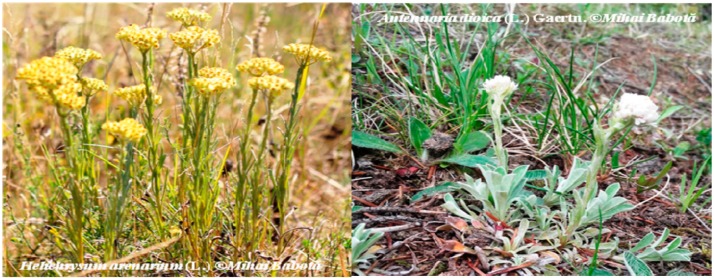
Antennaria dioica (L.) Gaertn. and Helichrysum arenarium (L.) Moench. are two species of the Asteraceae family, known in Romanian traditional medicine for their diuretic, choleretic, and anti-inflammatory properties. The aim of the present study was to evaluate the phenolic and sterolic composition of flowers from the two species and to assess their antioxidant, antibacterial and antifungal properties. LC-MS analyses were performed on methanolic, ethanolic and 70% v/v ethanolic extracts, before and after acid hydrolysis, and revealed high amounts of polyphenols. Chlorogenic acid was found as the main compound for the flowers of A. dioica (502.70 ± 25.11 mg/100 g d.w.), while quercitrin was dominant in H. arenarium (424.28 ± 21.21 mg/100 g d.w.) in 70% v/v ethanolic extracts before hydrolysis. Antioxidant capacity assays showed an important antioxidant potential, which can be correlated with the determined polyphenolic compounds, showing the 70% v/v ethanolic extracts of the two species as being the most effective antioxidant samples for the DPPH assay. Antibacterial and antifungal assays confirm a modest biological potential for the same extract of both species. Results obtained in the present study bring important data and offer scientific evidence on the chemical composition and on the biological activities of the flowers belonging to the two species.
Keywords: A. dioica; H. arenarium; LC-MS; antibacterial activity; antifungal activity; antioxidant capacity; polyphenolic profile.
Conflict of interest statement
The authors declare no conflict of interest.
Figures
References
-
- Erbar C., Leins P. Diversity of styles and mechanisms of secondary pollen presentation in basal Asteraceae-New insights in phylogeny and function. Flora Morphol. Distrib. Funct. Ecol. Plants. 2015;217:109–130. doi: 10.1016/j.flora.2015.10.002. - DOI
-
- Bohm B.A., Stuessy T.F. Flavonoids of the Sunflower Family (Asteraceae) Springer-Verlag/Wien; New York, NY, USA: 2001. Introduction to the Sunflower Family; p. 1.
-
- García-Herrera P., Sánchez-Mata M.C., Cámara M., Fernández-Ruiz V., Díez-Marqués C., Molina M., Tardío J. Nutrient composition of six wild edible Mediterranean Asteraceae plants of dietary interest. J. Food Compos. Anal. 2014;34:163–170. doi: 10.1016/j.jfca.2014.02.009. - DOI
-
- Bessada S.M. F., Barreira J.C. M., Oliveira M.B. P.P. Asteraceae species with most prominent bioactivity and their potential applications: A review. Ind. Crops Prod. 2015;76:604–615. doi: 10.1016/j.indcrop.2015.07.073. - DOI
-
- Abad M.J., Bedoya L.M., Bermejo P. Fighting Multidrug Resistance with Herbal Extracts, Essential Oils and their Components. Academic Press; San Diego, CA, USA: 2013. Essential Oils from the Asteraceae Family Active against Multidrug-Resistant Bacteria; pp. 205–219.
MeSH terms
Substances
LinkOut - more resources
Full Text Sources
Other Literature Sources
Medical
Molecular Biology Databases
