


Personally tailored activities for improving psychosocial outcomes for people with dementia in long-term care
- PMID: 29438597
- PMCID: PMC6491165
- DOI: 10.1002/14651858.CD009812.pub2
Personally tailored activities for improving psychosocial outcomes for people with dementia in long-term care
Update in
-
Personally tailored activities for improving psychosocial outcomes for people with dementia in long-term care.Cochrane Database Syst Rev. 2023 Mar 13;3(3):CD009812. doi: 10.1002/14651858.CD009812.pub3. Cochrane Database Syst Rev. 2023. PMID: 36930048 Free PMC article.
Abstract
Background: People with dementia who are being cared for in long-term care settings are often not engaged in meaningful activities. Offering them activities which are tailored to their individual interests and preferences might improve their quality of life and reduce challenging behaviour.
Objectives: ∙ To assess the effects of personally tailored activities on psychosocial outcomes for people with dementia living in long-term care facilities.∙ To describe the components of the interventions.∙ To describe conditions which enhance the effectiveness of personally tailored activities in this setting.
Search methods: We searched ALOIS, the Cochrane Dementia and Cognitive Improvement Group's Specialized Register, on 16 June 2017 using the terms: personally tailored OR individualized OR individualised OR individual OR person-centred OR meaningful OR personhood OR involvement OR engagement OR engaging OR identity. We also performed additional searches in MEDLINE (Ovid SP), Embase (Ovid SP), PsycINFO (Ovid SP), CINAHL (EBSCOhost), Web of Science (ISI Web of Science), ClinicalTrials.gov, and the World Health Organization (WHO) ICTRP, to ensure that the search for the review was as up to date and as comprehensive as possible.
Selection criteria: We included randomised controlled trials and controlled clinical trials offering personally tailored activities. All interventions included an assessment of the participants' present or past preferences for, or interests in, particular activities as a basis for an individual activity plan. Control groups received either usual care or an active control intervention.
Data collection and analysis: Two authors independently checked the articles for inclusion, extracted data and assessed the methodological quality of included studies. For all studies, we assessed the risk of selection bias, performance bias, attrition bias and detection bias. In case of missing information, we contacted the study authors.
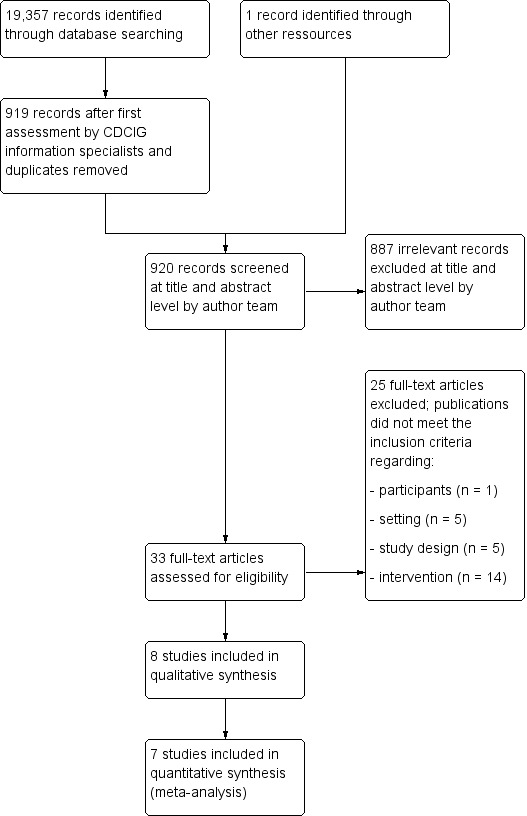
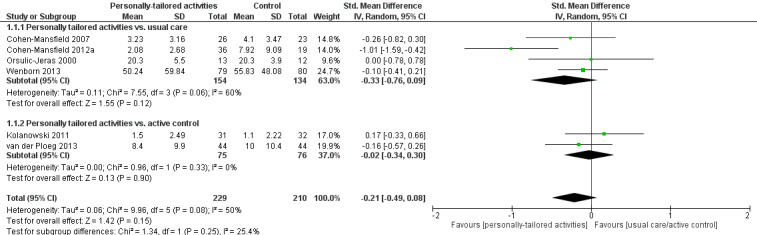
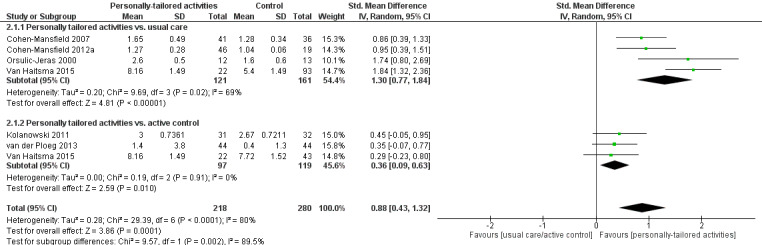
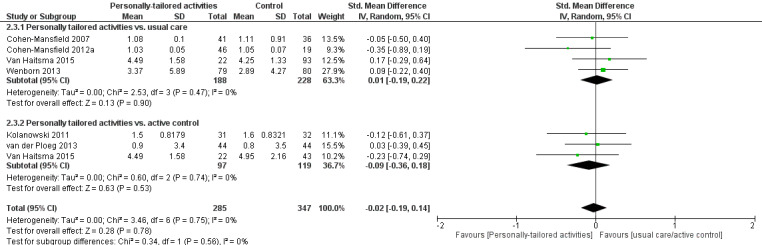
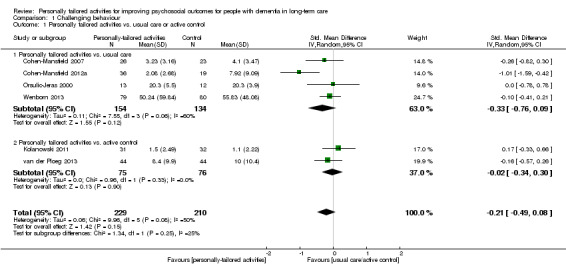
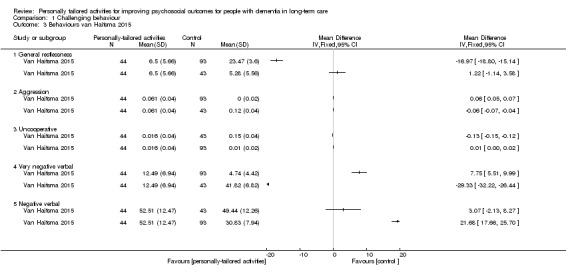
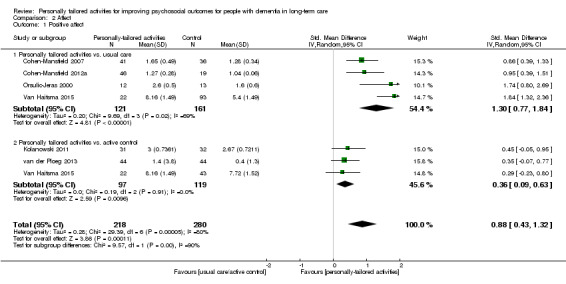
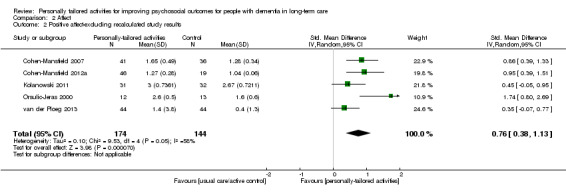
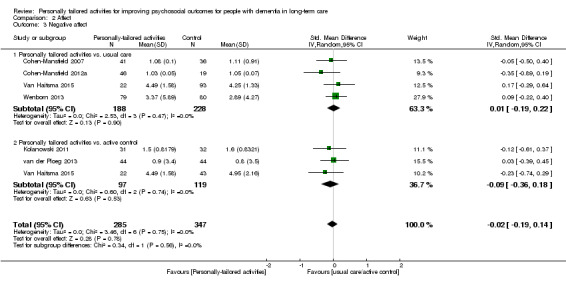
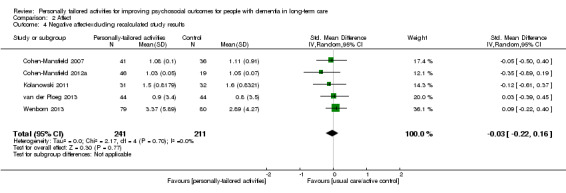
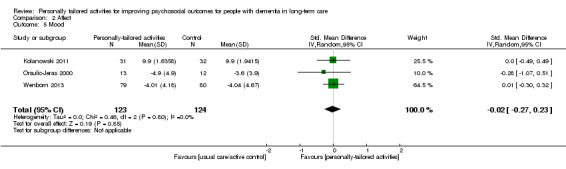
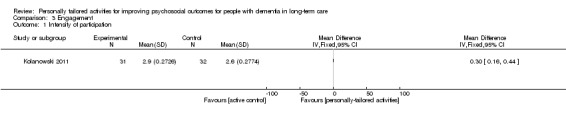
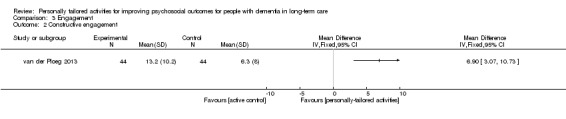
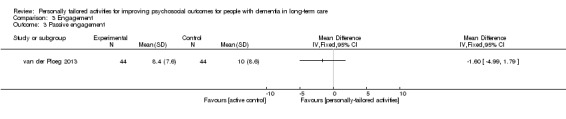
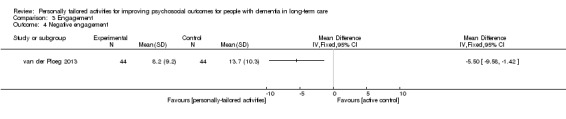
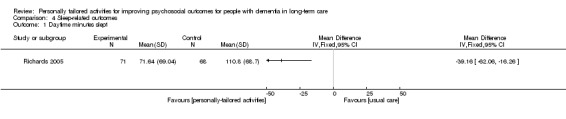
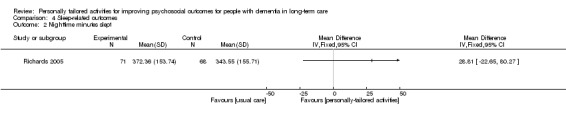
Main results: We included eight studies with 957 participants. The mean age of participants in the studies ranged from 78 to 88 years and in seven studies the mean MMSE score was 12 or lower. Seven studies were randomised controlled trials (three individually randomised, parallel group studies, one individually randomised cross-over study and three cluster-randomised trials) and one study was a non-randomised clinical trial. Five studies included a control group receiving usual care, two studies an active control intervention (activities which were not personally tailored) and one study included both an active control and usual care. Personally tailored activities were mainly delivered directly to the participants; in one study the nursing staff were trained to deliver the activities. The selection of activities was based on different theoretical models but the activities did not vary substantially.We found low-quality evidence indicating that personally tailored activities may slightly improve challenging behaviour (standardised mean difference (SMD) -0.21, 95% confidence interval (CI) -0.49 to 0.08; I² = 50%; 6 studies; 439 participants). We also found low-quality evidence from one study that was not included in the meta-analysis, indicating that personally tailored activities may make little or no difference to general restlessness, aggression, uncooperative behaviour, very negative and negative verbal behaviour (180 participants). There was very little evidence related to our other primary outcome of quality of life, which was assessed in only one study. From this study, we found that quality of life rated by proxies was slightly worse in the group receiving personally tailored activities (moderate-quality evidence, mean difference (MD) -1.93, 95% CI -3.63 to -0.23; 139 participants). Self-rated quality of life was only available for a small number of participants, and there was little or no difference between personally tailored activities and usual care on this outcome (low-quality evidence, MD 0.26, 95% CI -3.04 to 3.56; 42 participants). We found low-quality evidence that personally tailored activities may make little or no difference to negative affect (SMD -0.02, 95% CI -0.19 to 0.14; I² = 0%; 6 studies; 589 participants). We found very low quality evidence and are therefore very uncertain whether personally tailored activities have any effect on positive affect (SMD 0.88, 95% CI 0.43 to 1.32; I² = 80%; 6 studies; 498 participants); or mood (SMD -0.02, 95% CI -0.27 to 0.23; I² = 0%; 3 studies; 247 participants). We were not able to undertake a meta-analysis for engagement and the sleep-related outcomes. We found very low quality evidence and are therefore very uncertain whether personally tailored activities improve engagement or sleep-related outcomes (176 and 139 participants, respectively). Two studies that investigated the duration of the effects of personally tailored activities indicated that the intervention effects persisted only during the delivery of the activities. Two studies reported information about adverse effects and no adverse effects were observed.
Authors' conclusions: Offering personally tailored activities to people with dementia in long-term care may slightly improve challenging behaviour. Evidence from one study suggested that it was probably associated with a slight reduction in the quality of life rated by proxies, but may have little or no effect on self-rated quality of life. We acknowledge concerns about the validity of proxy ratings of quality of life in severe dementia. Personally tailored activities may have little or no effect on negative affect and we are uncertain whether they improve positive affect or mood. There was no evidence that interventions were more likely to be effective if based on one specific theoretical model rather than another. Our findings leave us unable to make recommendations about specific activities or the frequency and duration of delivery. Further research should focus on methods for selecting appropriate and meaningful activities for people in different stages of dementia.
Conflict of interest statement
None known.
Figures

References
References to studies included in this review
Cohen‐Mansfield 2007 {published data only}
-
- Cohen‐Mansfield J, Libin A, Marx MS. Nonpharmacological treatment of agitation: a controlled trial of systematic individualized intervention. Journals of Gerontology. Series A, Biological Sciences and Medical Sciences 2007;62(8):908‐16. - PubMed
Cohen‐Mansfield 2012a {published data only}
-
- Cohen‐Mansfield J, Thein K, Marx MS, Dakheel‐Ali M, Freedman L. Efficacy of nonpharmacologic interventions for agitation in advanced dementia: a randomized, placebo‐controlled trial. Journal of Clinical Psychiatry 2012;73(9):1255‐61. - PubMed
Kolanowski 2011 {published and unpublished data}
Orsulic‐Jeras 2000 {published data only}
-
- Orsulic‐Jeras S, Schneider NM, Camp CJ. Special Feature: Montessori‐Based Activities for Long‐Term Care Residents with Dementia. Topics in Geriatric Rehabilitation 2000;16(1):78‐91.
Richards 2005 {published data only}
-
- Richards KC, Beck C, O'Sullivan PS, Shue VM. Effect of Individualized Social Activity on Sleep in Nursing HomeResidents with Dementia. Journal of the American Geriatrics Society 2005;53(9):1510‐7. - PubMed
van der Ploeg 2013 {published and unpublished data}
-
- Ploeg ES, Eppingstall B, Camp CJ, Runci SJ, Taffe J, O'Connor DW. A randomized crossover trial to study the effect of personalized, one‐to‐one interaction using Montessori‐based activities on agitation, affect, and engagement in nursing home residents with Dementia. International Psychogeriatrics 2013;25(4):565‐75. - PubMed
Van Haitsma 2015 {published data only}
-
- Haitsma KS, Curyto K, Abbott KM, Towsley GL, Spector A, Kleban M. A randomized controlled trial for an individualized positive psychosocial intervention for the affective and behavioral symptoms of dementia in nursing home residents. Journals of Gerontology. Series B, Psychological Sciences and Social Sciences 2015;70(1):35‐45. - PubMed
Wenborn 2013 {published data only}
-
- Wenborn J, Challis D, Head J, Miranda‐Castillo C, Popham C, Thakur R, et al. Providing activity for people with dementia in care homes: A cluster randomised controlled trial. International Journal of Geriatric Psychiatry 2013;28(12):1296‐304. - PubMed
References to studies excluded from this review
Beck 2002 {published data only}
-
- Beck CK, Vogelpohl TS, Rasin JH, Uriri JT, O'Sullivan P, Walls R, et al. Effects of behavioral interventions on disruptive behavior and affect in demented nursing home residents. Nursing Research 2002;51(4):219‐28. - PubMed
Cohen‐Mansfield 2006 {published data only}
-
- Cohen‐Mansfield J, Parpura‐Gill A, Golander H. Utilization of self‐identity roles for designing interventions for persons with dementia. Journals of Gerontology. Series B, Psychological Sciences and Social Sciences 2006;61(4):P202‐12. - PubMed
DiNapoli 2016 {published data only}
-
- DiNapoli EA, Scogin F, Bryant AN, Sebastian S, Mundy MJ. Effect of individualized social activities on quality of life among older adults with mild to moderate cognitive impairment in a geriatric psychiatry facility. Aging & Mental Health 2016;20(3):262‐70. - PubMed
Farina 2006 {published data only}
-
- Farina E, Mantovani F, Fioravanti R, Pignatti R, Chiavari L, Imbornone E, et al. Evaluating two group programmes of cognitive training in mild‐to‐moderate AD: is there any difference between a 'global' stimulation and a 'cognitive‐specific' one?. Aging and Mental Health 2006;10(3):211‐8. - PubMed
Farina 2009 {published data only}
-
- Farina E, Villanelli F. Conducting an Intervention Program Mediated by Recreational Activities and Socialization in Groups for Clients with Alzheimer's Disease. In: Söderback I editor(s). International Handbook of Occupational Therapy Interventions. Springer, 2009:423‐9.
Gerber 1991 {published data only}
-
- Gerber GJ, Prince PN, Snider HG, Atchison K, Dubois L, Kilgour JA. Group activity and cognitive improvement among patients with Alzheimer's disease. Hospital and Community Psychiatry 1991;42(8):843‐5. - PubMed
Hong 2011 {published data only}
-
- Hong GR. [Effects of multisensory stimulation using familiarity: persons with dementia in long‐term care facility in Korea]. Journal of Korean Academy of Nursing 2011;41(4):528‐38. - PubMed
Hopman‐Rock 1999 {published data only}
-
- Hopman‐Rock M, Staats PG, Tak EC, Dröes RM. The effects of a psychomotor activation programme for use in groups of cognitively impaired people in homes for the elderly. International Journal of Geriatric Psychiatry 1999;14(8):633‐42. - PubMed
Hsu 2015 {published data only}
Kolanowski 2005 {published and unpublished data}
-
- Kolanowski AM, Litaker M, Buettner L. Efficacy of theory‐based activities for behavioral symptoms of dementia. Nursing Research 2005;54(4):219‐28. - PubMed
Kovach 2004 {published data only}
-
- Kovach CR, Taneli Y, Dohearty P, Schlidt AM, Cashin S, Silva‐Smith AL. Effect of the BACE intervention on agitation of people with dementia. Gerontologist 2004;44(6):797‐806. - PubMed
Lin 2009 {published data only}
-
- Lin LC, Yang MH, Kao CC, Wu SC, Tang SH, Lin JG. Using acupressure and Montessori‐based activities to decrease agitation for residents with dementia: a cross‐over trial. Journal of the American Geriatrics Society 2009;57(6):1022‐9. - PubMed
Luttenberger 2012 {published data only}
-
- Luttenberger K, Donath C, Uter W, Graessel E. Effects of multimodal nondrug therapy on dementia symptoms and need for care in nursing home residents with degenerative dementia: a randomized‐controlled study with 6‐month follow‐up. Journal of the American Geriatrics Society 2012;60(5):830‐40. - PubMed
Mansbach 2017 {published data only}
-
- Mansbach WE, Mace RA, Clark KM, Firth IM. Meaningful activity for long‐term care residents with dementia: a comparison of activities and raters. Gerontologist 2017;57(1):461‐8. - PubMed
Meeks 2015 {published data only}
Morley 2014 {published data only}
-
- Morley JE, Philpot CD, Gill D, Berg‐Weger M. Meaningful activities in the nursing home. Journal of the American Medical Directors Association 2014;15(2):79‐81. - PubMed
Mowrey 2013 {published data only}
Patel 2016 {published data only}
-
- Patel P, Porter T, Smith J, Mirk A. Montessori based activities in veterans with severe dementia: engagement, affect, and behavior. Journal of the American Geriatrics Society 2016;64(Supplement S1):S66‐7.
Pieper 2016 {published data only}
-
- Pieper MJ, Francke AL, Steen JT, Scherder EJ, Twisk JW, Kovach CR, Achterberg WP. Effects of a stepwise multidisciplinary intervention for challenging behavior in advanced dementia: a cluster randomized controlled trial. Journal of the American Geriatrics Society 2016;64(2):261‐9. - PubMed
Politis 2004 {published data only}
-
- Politis AM, Vozzella S, Mayer LS, Onyike CU, Baker AS, Lyketsos CG. A randomized, controlled, clinical trial of activity therapy for apathy in patients with dementia residing in long‐term care. International Journal of Geriatric Psychiatry 2004;19(11):1087‐94. - PubMed
Rapp 2013 {published data only}
-
- Rapp MA, Mell T, Majic T, Treusch Y, Nordheim J, Niemann‐Mirmehdi M, et al. Agitation in nursing home residents with dementia (VIDEANT Trial): effects of a cluster‐randomized, controlled, guideline implementation trial. Journal of the American Medical Directors Association 2013;14(9):690‐5. - PubMed
Sackley 2009 {published data only}
Sánchez 2016 {published data only}
-
- Sánchez A, Marante‐Moar MP, Sarabia C, Labra C, Lorenzo T, Maseda A, et al. Multisensory stimulation as an intervention strategy for elderly patients with severe dementia: a pilot randomized controlled trial. American Journal of Alzheimer's Disease and Other Dementias 2016;31(4):341‐50. - PMC - PubMed
Schneider 2003 {published data only}
-
- Schneider NM, Camp CJ. Use of Montessori‐based activities by visitors of nursing home residents with dementia. Clinical Gerontologist 2003;26(1‐2):71‐84.
Sung 2010 {published data only}
-
- Sung HC, Chang AM, Lee WL. A preferred music listening intervention to reduce anxiety in older adults with dementia in nursing homes. Journal of Clinical Nursing 2010;19(7‐8):1056‐64. - PubMed
Treusch 2015 {published data only}
-
- Treusch Y, Majic T, Page J, Gutzmann H, Heinz A, Rapp MA. Apathy in nursing home residents with dementia: results from a cluster‐randomized controlled trial. European Psychiatry 2015;30(2):251‐7. - PubMed
Vink 2014 {published data only}
-
- Vink Annemieke C, Zuidersma Marij, Boersma Froukje, Jonge Peter, Zuidema Sytse U, Slaets Joris P. Effect of music therapy versus recreational activities on neuropsychiatric symptoms in elderly adults with dementia: an exploratory randomized controlled trial. Journal of the American Geriatrics Society 2014;62(2):392‐3. - PubMed
Wilks 2017 {published data only}
Additional references
Alexopoulos 1988
-
- Alexopoulos GS, Abrams RC, Young RC, Shamoian CA. Cornell Scale for Depression in Dementia. Biological Psychiatry 1988;23(3):271‐84. - PubMed
Algase 1996
-
- Algase DL, Beck C, Kolanowski A, Whall A, Berent SK, Richards K, et al. Need‐driven dementia‐compromised behavior: An alternative view of disruptive behavior. American Journal of Alzheimer's Disease and Other Dementias 1996;11(6):10–9.
American Psychiatric Association 1994
-
- American Psychiatric Association. Diagnosis and Statistical Manual of MentalDisorders (4th edition). Washington (DC): American Psychiatric Association, 1994.
Arons 2013
Azermai 2012
-
- Azermai M, Petrovic M, Elseviers MM, Bourgeois J, Bortel LM, Vander Stichele RH. Systematic appraisal of dementia guidelines for the management of behavioural and psychological symptoms. Ageing Research Reviews 2012;11(1):78‐86. - PubMed
Ballard 2013
-
- Ballard C, Corbett A. Agitation and aggression in people with Alzheimer's disease. Current Opinion in Psychiatry 2013;26(3):252‐9. - PubMed
Bernstein 2007
-
- Bernstein AB, Remsburg RE. Estimated prevalence of people with cognitive impairment: results from nationally representative community and institutional studies. Gerontologist 2007;47(3):350‐4. - PubMed
Buettner 2003
Campbell 2012
-
- Campbell MK, Piaggio G, Elbourne DR, Altman DG, CONSORT Group. Consort 2010 statement: extension to cluster randomised trials. BMJ 2012;345:e5661. - PubMed
Chen 2000
-
- Chen YL, Ryden MB, Feldt K, Savik K. The relationship between social interaction and characteristics of aggressive, cognitively impaired nursing home residents. American Journal of Alzheimer's Disease 2000;15(1):10‐7.
Cohen‐Mansfield 1989a
-
- Cohen‐Mansfield J, Werner P, Marx MS. An observational study of agitation in agitated nursing home residents. International Psychogeriatrics / IPA 1989;1(2):153‐65. - PubMed
Cohen‐Mansfield 1989b
-
- Cohen‐Mansfield J, Marx M, Rosenthal S. A description of agitation in a nursing home. Journal of Gerontology 1989;44(3):M77–M84. - PubMed
Cohen‐Mansfield 1992
-
- Cohen‐Mansfield J, Marx MS, Werner P. Observational data on time use and behavior problems in the nursing home. Journal of Applied Gerontology 1992;11(1):111‐21. - PubMed
Cohen‐Mansfield 2000
-
- Cohen‐Mansfield J. Theoretical frameworks for behavioral problems in dementia. Alzheimer's Care Today 2000;1(4):8‐21.
Cohen‐Mansfield 2004
-
- Cohen‐Mansfield J, Libin A. Assessment of agitation in elderly patients with dementia: correlations between informant rating and direct observation. International Journal of Geriatric Psychiatry 2004;19(9):881‐91. - PubMed
Cohen‐Mansfield 2009a
Cohen‐Mansfield 2009b
Cohen‐Mansfield 2010
Cohen‐Mansfield 2011
Cohen‐Mansfield 2012b
Cohen‐Mansfield 2012c
-
- Cohen‐Mansfield J, Thein K, Marx MS, Dakheel‐Ali M, Murad H, Freedman LS. The relationships of environment and personal characteristics to agitated behaviors in nursing home residents with dementia. Journal of Clinical Psychiatry 2012;73(3):392‐9.. - PubMed
Colling 2000
-
- Colling KB. A taxonomy of passive behaviors in people with Alzheimer's disease. Journal of Nursing Scholarship 2000;32(3):239‐44. - PubMed
Cooney 2009
-
- Cooney A, Murphy K, O'Shea E. Resident perspectives of the determinants of quality of life in residential care in Ireland. Journal of Advanced Nursing 2009;65(5):1029‐38. - PubMed
Costa 1992
-
- Costa P, McCrae R. Revised NEO Personality Inventory and NEO Five‐Factor Inventory: Professional Manual. Odessa: Psychological Assessment Resources, 1992.
Craig 2008
Deci 2000
-
- Deci EL, Ryan RM. The "what" and "why" of goal pursuits: Human needs and the self‐determination of behavior. Psychological Inquiry 2000;11(4):227‐68.
Dobbs 2005
-
- Dobbs D, Munn J, Zimmerman S, Boustani M, Williams CS, Sloane PD, et al. Characteristics associated with lower activity involvement in long‐term care residents with dementia. Gerontologist 2005;1(Suppl 1):81‐6. - PubMed
Edvardsson 2014
-
- Edvardsson David, Petersson Lisa, Sjogren Karin, Lindkvist Marie, Sandman Per‐Olof. Everyday activities for people with dementia in residential aged care: Associations with person‐centredness and quality of life. International Journal of Older People Nursing 2014;9(4):269‐76. - PubMed
Eldridge 2016
Folstein 1975
-
- Folstein MF, Folstein SE, McHugh PR. Mini Mental State: a practical guide for grading the cognitive state of patients for the clinician. Journal of Psychiatric Research 1975;12:189–198. - PubMed
Fredrickson 2001
Gomez‐Gallego 2015
-
- Gomez‐Gallego M, Gomez‐Garcia J, Ato‐Lozano E. Addressing the bias problem in the assessment of the quality of life of patients with dementia: determinants of the accuracy and precision of the proxy ratings. Journal of Nutrition, Health & Aging 2015;19(3):365‐72. - PubMed
GRADEpro GDT [Computer program]
-
- McMaster University (developed by Evidence Prime). GRADEpro GDT. Version accessed 08 February 2018. Hamilton (ON): McMaster University (developed by Evidence Prime), 2015.
Grant 2013
Guyatt 2011
-
- Guyatt G, Oxman AD, Akl EA, Kunz R, Vist G, Brozek J, et al. GRADE guidelines: 1. Introduction‐GRADE evidence profiles and summary of findings tables. Journal of Clinical Epidemiology 2011;64(4):383‐94. - PubMed
Guétin 2009
-
- Guétin S, Portet F, Picot MC, Pommié C, Messaoudi M, Djabelkir L, et al. Effect of music therapy on anxiety and depression in patients with Alzheimer's type dementia: randomised, controlled study. Dementia and Geriatric Cognitive Disorders 2009;28(1):36‐46. - PubMed
Han 2016
Harmer 2008
-
- Harmer BJ, Orrell M. What is meaningful activity for people with dementia living in care homes? A comparison of the views of older people with dementia, staff and family carers. Aging & Mental Health 2008;12(5):548‐58. - PubMed
Higgins 2011
-
- Higgins JPT, Green S (editors). Cochrane Handbook for Systematic Reviews of Interventions Version 5.1.0 [updated March 2011] The Cochrane Collaboration, 2011. Available from handbook.cochrane.org.
Hill 2010
-
- Hill NL, Kolanowski A, Kürüm E. Agreeableness and activity engagement in nursing home residents with dementia. Journal of Gerontological Nursing 2010;36(9):45‐52. - PubMed
Hoe 2009
Hoffmann 2014
-
- Hoffmann TC, Glasziou PP, Boutron I, Milne R, Perera R, Moher D, et al. Better reporting of interventions: template for intervention description and replication (TIDieR) checklist and guide. BMJ 2014;348:g1687. - PubMed
Hubbard 2002
-
- Hubbard G, Cook A, Tester S, Downs M. Beyond words older people with dementia using and interpreting nonverbal behaviour. Journal of Aging Studies 2002;16(2):155‐67.
Judge 2000
-
- Judge KS, Camp CJ, Orsulic‐Jeras S. Use of Montessori‐based activities for clients with dementia in adult daycare: effects on engagement. American Journal of Alzheimer's Disease and Other Dementias 2000;15(1):42‐6.
Kolanowski 2006
-
- Kolanowski A, Litaker M. Social interaction, premorbid personality, and agitation in nursing home residents with dementia. Archives of Psychiatric Nursing 2006;20(1):12‐20. - PubMed
Kovach 1998
-
- Kovach CR, Magliocco JS. Late‐stage dementia and participation in therapeutic activities. Applied Nursing Research 1998;11(4):167‐73. - PubMed
Lawton 1996
-
- Lawton MP, Haitsma K, Klapper J. Observed affect in nursing home residents with Alzheimer's disease. Journals of Gerontology. Series B, Psychological Sciences and Social Sciences 1996;51(1):P3‐14. - PubMed
Logsdon 1999
-
- Logsdon RG, Gibbons LE, McCurry SM, Teri L. Quality of life in Alzheimer’s disease: patient and caregiver reports. Journal of Mental Health and Aging 1999;5(1):21‐32.
Mills 1997
-
- Mills MA. Narrative identity and dementia: A study of emotion and narrative in older people with dementia. Ageing and Society 1997;17(6):673‐98.
Moniz‐Cook 2001
-
- Moniz‐Cook E, Woods R, Gardiner E, Silver M, Agar S. The Challenging Behaviour Scale (CBS): development of a scale for staff caring for older people in residential and nursing homes. British Journal of Clinical Psychology 2001;40(Pt 3):309‐22.. - PubMed
Moore 2015
Moyle 2012
-
- Moyle W, Murfield JE, Griffiths SG, Venturato L. Assessing quality of life of older people with dementia: a comparison of quantitative self‐report and proxy accounts. Journal of Advanced Nursing 2012;68(10):2237‐46. - PubMed
Murphy 2007
-
- Murphy K, Shea EO, Cooney A. Quality of life for older people living in long‐stay settings in Ireland. Journal of Clinical Nursing 2007;16(11):2167‐77. - PubMed
Möhler 2015
Ngo 2015
-
- Ngo J, Holroyd‐Leduc JM. Systematic review of recent dementia practice guidelines. Age and Ageing 2015;44(1):25‐33. - PubMed
Nygaard 2003
-
- Nygaard HA, Ruths S. Missing the diagnosis: senile dementia in patients admitted to nursing homes. Scandinavian Journal of Primary Health Care 2003;21(3):148‐52. - PubMed
O'Neil 2011
-
- O'Neil ME, Freeman M, Christensen V, Telerant R, Addleman A, Kansagara D, Department of Veterans Affairs: Washington (DC). A systematic evidence review of non‐pharmacological interventions for behavioral symptoms of dementia. www.hsrd.research.va.gov/publications/esp/Dementia‐Nonpharm.pdf (accessed 08 February 2018). - PubMed
Phinney 2007
-
- Phinney A, Chaudhury H, O'Connor DL. Doing as much as I can do: the meaning of activity for people with dementia. Aging & Mental Health 2007;11(4):384‐93. - PubMed
Prince 2013
-
- Prince M, Bryce R, Albanese E, Wimo A, Ribeiro W, Ferri CP. The global prevalence of dementia: a systematic review and metaanalysis. Alzheimer's & Dementia 2013;9(1):63‐75.e2. - PubMed
Richards 2001
-
- Richards KC, Sullivan SC, Phillips RL, Beck CK, Overton‐McCoy AL. The effect of individualized activities on the sleep of nursing home residents who are cognitively impaired: a pilot study. Journal of Gerontological Nursing 2001;27(9):30‐7. - PubMed
Shankar 1999
-
- Shankar KK, Walker M, Frost D, Orrell M. The development of a valid and reliable scale for rating anxiety in dementia (RAID). Aging & Mental Health 1999;3(1):39‐49.
Shepperd 2009
Skrajner 2007
Tappen 1995
-
- Tappen RM, Barry C. Assessment of affect in advanced Alzheimer's disease: the Dementia Mood Picture Test. Journal of Gerontological Nursing 1995;21(3):44‐6. - PubMed
Testad 2014
-
- Testad I, Corbett A, Aarsland D, Lexow KO, Fossey J, Woods B, et al. The value of personalized psychosocial interventions to address behavioral and psychological symptoms in people with dementia living in care home settings: a systematic review. International Psychogeriatrics / IPA 2014;26(7):1083‐98. - PubMed
Travers 2016
-
- Travers C, Brooks D, Hines S, O'Reilly M, McMaster M, He W, et al. Effectiveness of meaningful occupation interventions for people living with dementia in residential aged care: a systematic review. JBI Database of Systematic Reviews and Implementation Reports 2016;14(12):163‐225. - PubMed
van der Linde 2014
van der Ploeg 2010
Van Haitsma 2000
-
- Haitsma K. The Assessment and integration of preferences into care practices for persons with dementia residing in the nursing home. In: Rubinstein R, Moss M, Kleban M editor(s). The many dimensions of aging. New York: Springer, 2000.
Vasse 2012
-
- Vasse E, Vernooij‐Dassen M, Cantegreil I, Franco M, Dorenlot P, Woods B, et al. Guidelines for psychosocial interventions in dementia care: a European survey and comparison. International Journal of Geriatric Psychiatry 2012;27(1):40‐8. - PubMed
Vernooij‐Dassen 2007
-
- Vernooij‐Dassen M. Meaningful activities for people with dementia. Aging & Mental Health 2007;11(4):359‐60. - PubMed
Wenborn 2008
-
- Wenborn J, Challis D, Pool J, Burgess J, Elliott N, Orrell M. Assessing the validity and reliability of the Pool Activity Level (PAL) Checklist for use with older people with dementia. Aging & Mental Health 2008;12(2):202‐11. - PubMed
Wittchen 2011
-
- Wittchen HU, Jacobi F, Rehm J, Gustavsson A, Svensson M, Jönsson B, et al. The size and burden of mental disorders and other disorders of the brain in Europe 2010. European Neuropsychopharmacology 2011;21(9):655‐79. - PubMed
Zimmerman 2005
-
- Zimmerman S, Sloane PD, Williams CS, Reed PS, Preisser JS, Eckert JK, et al. Dementia care and quality of life in assisted living and nursing homes. Gerontologist 2005;1(Suppl 1):133‐46. - PubMed
Publication types
MeSH terms
LinkOut - more resources
Full Text Sources
Other Literature Sources
Medical
Miscellaneous
