


Respiratory Motion Compensation for PET/CT with Motion Information Derived from Matched Attenuation-Corrected Gated PET Data
- PMID: 29439015
- PMCID: PMC6126443
- DOI: 10.2967/jnumed.117.203000
Respiratory Motion Compensation for PET/CT with Motion Information Derived from Matched Attenuation-Corrected Gated PET Data
Abstract
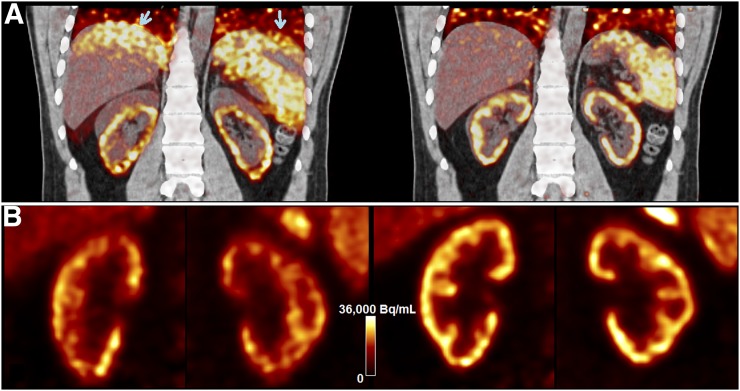
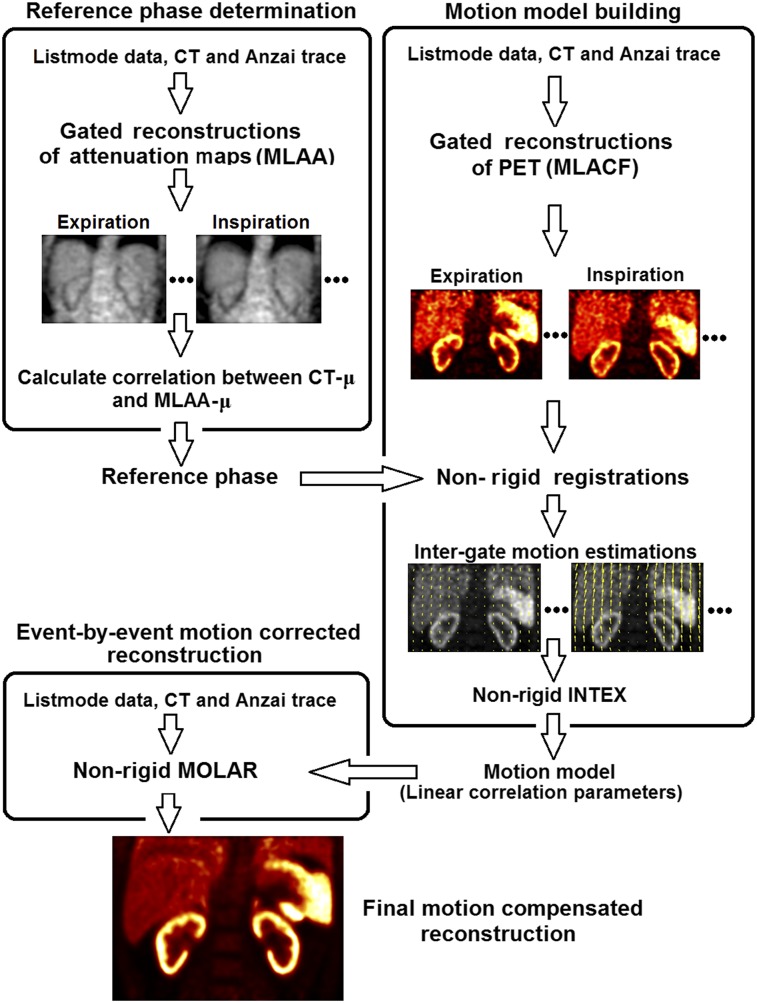
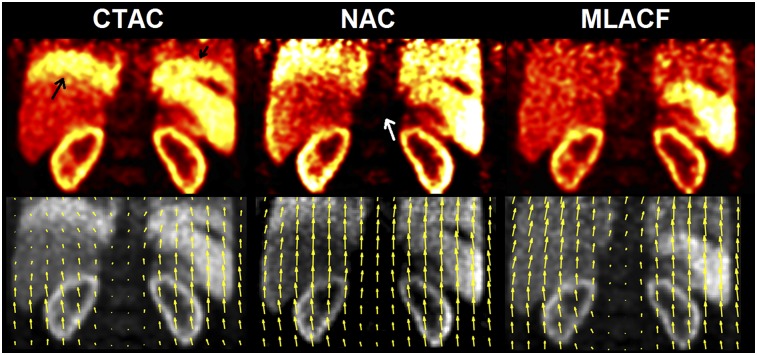
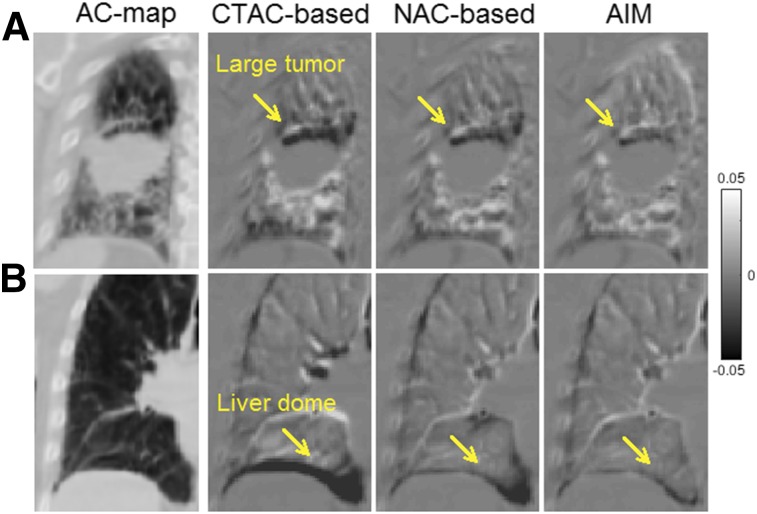
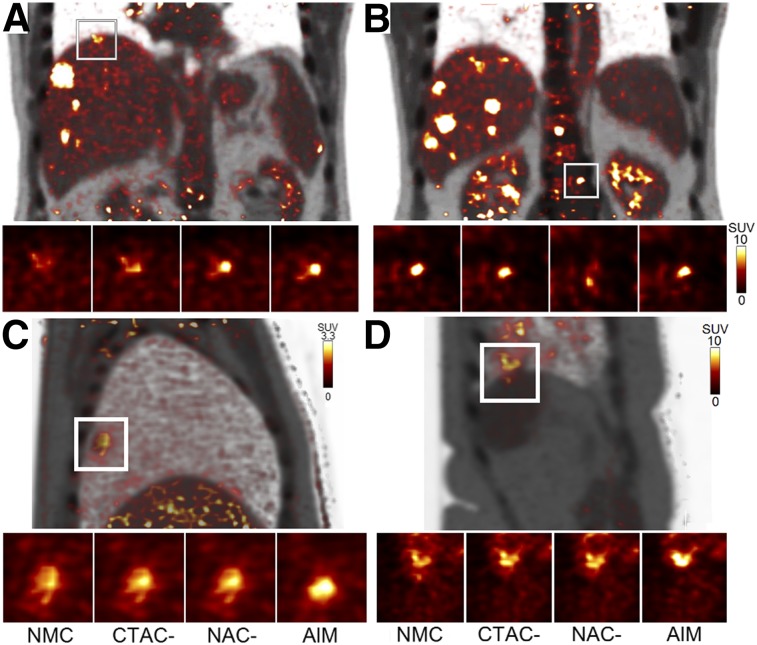
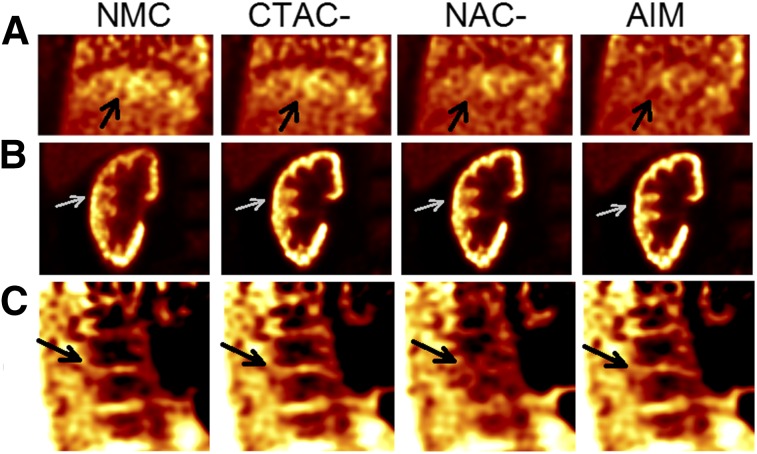
Respiratory motion degrades the detection and quantification capabilities of PET/CT imaging. Moreover, mismatch between a fast helical CT image and a time-averaged PET image due to respiratory motion results in additional attenuation correction artifacts and inaccurate localization. Current motion compensation approaches typically have 3 limitations: the mismatch among respiration-gated PET images and the CT attenuation correction (CTAC) map can introduce artifacts in the gated PET reconstructions that can subsequently affect the accuracy of the motion estimation; sinogram-based correction approaches do not correct for intragate motion due to intracycle and intercycle breathing variations; and the mismatch between the PET motion compensation reference gate and the CT image can cause an additional CT-mismatch artifact. In this study, we established a motion correction framework to address these limitations. Methods: In the proposed framework, the combined emission-transmission reconstruction algorithm was used for phase-matched gated PET reconstructions to facilitate the motion model building. An event-by-event nonrigid respiratory motion compensation method with correlations between internal organ motion and external respiratory signals was used to correct both intracycle and intercycle breathing variations. The PET reference gate was automatically determined by a newly proposed CT-matching algorithm. We applied the new framework to 13 human datasets with 3 different radiotracers and 323 lesions and compared its performance with CTAC and non-attenuation correction (NAC) approaches. Validation using 4-dimensional CT was performed for one lung cancer dataset. Results: For the 10 18F-FDG studies, the proposed method outperformed (P < 0.006) both the CTAC and the NAC methods in terms of region-of-interest-based SUVmean, SUVmax, and SUV ratio improvements over no motion correction (SUVmean: 19.9% vs. 14.0% vs. 13.2%; SUVmax: 15.5% vs. 10.8% vs. 10.6%; SUV ratio: 24.1% vs. 17.6% vs. 16.2%, for the proposed, CTAC, and NAC methods, respectively). The proposed method increased SUV ratios over no motion correction for 94.4% of lesions, compared with 84.8% and 86.4% using the CTAC and NAC methods, respectively. For the 2 18F-fluoropropyl-(+)-dihydrotetrabenazine studies, the proposed method reduced the CT-mismatch artifacts in the lower lung where the CTAC approach failed and maintained the quantification accuracy of bone marrow where the NAC approach failed. For the 18F-FMISO study, the proposed method outperformed both the CTAC and the NAC methods in terms of motion estimation accuracy at 2 lung lesion locations. Conclusion: The proposed PET/CT respiratory event-by-event motion-correction framework with motion information derived from matched attenuation-corrected PET data provides image quality superior to that of the CTAC and NAC methods for multiple tracers.
Keywords: PET; event-by-event; matched attenuation correction; non-rigid; respiratory motion correction.
© 2018 by the Society of Nuclear Medicine and Molecular Imaging.
Figures
References
-
- Xu Q, Yuan K, Ye D. Respiratory motion blur identification and reduction in ungated thoracic PET imaging. Phys Med Biol. 2011;56:4481–4498. - PubMed
-
- Goerres GW, Burger C, Kamel E, et al. Respiration-induced attenuation artifact at PET/CT: technical considerations. Radiology. 2003;226:906–910. - PubMed
-
- Osman MM, Cohade C, Nakamoto Y, Marshall LT, Leal JP, Wahl RL. Clinically significant inaccurate localization of lesions with PET/CT: frequency in 300 patients. J Nucl Med. 2003;44:240–243. - PubMed
-
- Nehmeh SA, Erdi YE, Ling CC, et al. Effect of respiratory gating on quantifying PET images of lung cancer. J Nucl Med. 2002;43:876–881. - PubMed
Publication types
MeSH terms
Grants and funding
LinkOut - more resources
Full Text Sources
Other Literature Sources
