


Cerebrospinal Fluid and Plasma Levels of Inflammation Differentially Relate to CNS Markers of Alzheimer's Disease Pathology and Neuronal Damage
- PMID: 29439331
- PMCID: PMC6007886
- DOI: 10.3233/JAD-170602
Cerebrospinal Fluid and Plasma Levels of Inflammation Differentially Relate to CNS Markers of Alzheimer's Disease Pathology and Neuronal Damage
Abstract
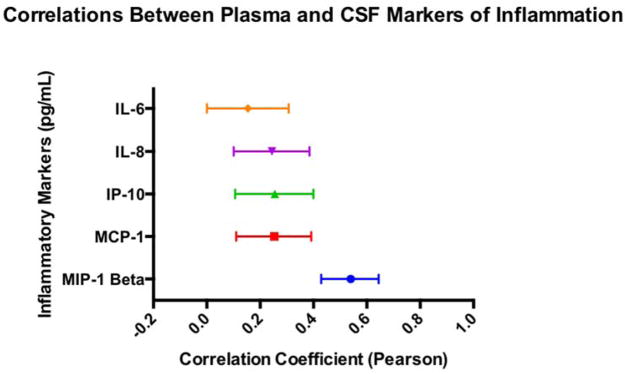
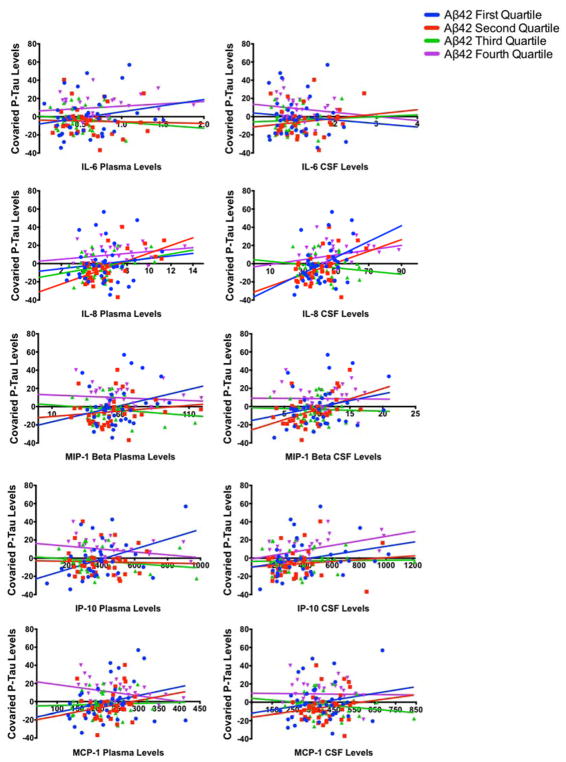
Inflammatory markers have been shown to predict neurocognitive outcomes in aging adults; however, the degree to which peripheral markers mirror the central nervous system remains unknown. We investigated the association between plasma and cerebrospinal fluid (CSF) markers of inflammation, and explored whether these markers independently predict CSF indicators of Alzheimer's disease (AD) pathology or neuronal damage. Plasma and CSF samples were analyzed for inflammatory markers in a cohort of asymptomatic older adults (n = 173). CSF samples were analyzed for markers of AD pathology (Aβ42, phosphorylated tau [p-tau], sAβPPβ) or neuronal damage (total tau; neurofilament light chain) (n = 147). Separate linear models for each analyte were conducted with CSF and plasma levels entered simultaneously as predictors and markers of AD pathology or neuronal damage as outcome measures. Strong associations were noted between CSF and plasma MIP-1β levels, and modest associations were observed for remaining analytes. With respect to AD pathology, higher levels of plasma and CSF IL-8, CSF MIP-1β, and CSF IP-10 were associated with higher levels of p-tau. Higher levels of CSF IL-8 were associated with higher levels of CSF Aβ42. Higher CSF sAβPPβ levels were associated with higher plasma markers only (IL-8; MCP-1). In terms of neuronal injury, higher levels of plasma and CSF IL-8, CSF IP-10, and CSF MIP-1β were associated with higher levels of CSF total tau. Exploratory analyses indicated that CSF Aβ42 modifies the relationship between plasma inflammatory levels and CSF tau levels. Results suggest that both plasma and CSF inflammatory markers independently relay integral information about AD pathology and neuronal damage.
Keywords: Aging; Alzheimer’s disease; biomarkers; neuroinflammation; preclinical AD; systemic inflammation.
Conflict of interest statement
The authors have no other disclosures or conflicts of interest.
Figures
References
-
- Heppner FL, Ransohoff RM, Becher B. Immune attack: the role of inflammation in Alzheimer disease. Nat Rev Neurosci. 2015;16:358–372. - PubMed
-
- Blasko I, Stampfer-Kountchev M, Robatscher P, Veerhuis R, Eikelenboom P, Grubeck-Loebenstein B. How chronic inflammation can affect the brain and support the development of Alzheimer’s disease in old age: the role of microglia and astrocytes. Aging Cell. 2004;3:169–176. - PubMed
-
- Wyss-Coray T. Inflammation in Alzheimer disease: driving force, bystander or beneficial response? Nat Med. 2006;12:1005–1015. - PubMed
-
- Galimberti D, Fenoglio C, Scarpini E. Inflammation in neurodegenerative disorders: friend or foe? Curr Aging Sci. 2008;1:30–41. - PubMed
Publication types
MeSH terms
Substances
Grants and funding
LinkOut - more resources
Full Text Sources
Other Literature Sources
Medical
Miscellaneous
