


The factors affecting household transmission dynamics and community compliance with Ebola control measures: a mixed-methods study in a rural village in Sierra Leone
- PMID: 29439682
- PMCID: PMC5812186
- DOI: 10.1186/s12889-018-5158-6
The factors affecting household transmission dynamics and community compliance with Ebola control measures: a mixed-methods study in a rural village in Sierra Leone
Abstract
Background: Little is understood of Ebola virus disease (EVD) transmission dynamics and community compliance with control measures over time. Understanding these interactions is essential if interventions are to be effective in future outbreaks. We conducted a mixed-methods study to explore these factors in a rural village that experienced sustained EVD transmission in Kailahun District, Sierra Leone.
Methods: We reconstructed transmission dynamics using a cross-sectional survey conducted in April 2015, and cross-referenced our results with surveillance, burial, and Ebola Management Centre (EMC) data. Factors associated with EVD transmission were assessed with Cox proportional hazards regression. Following the survey, qualitative semi-structured interviews explored views of community informants and households.
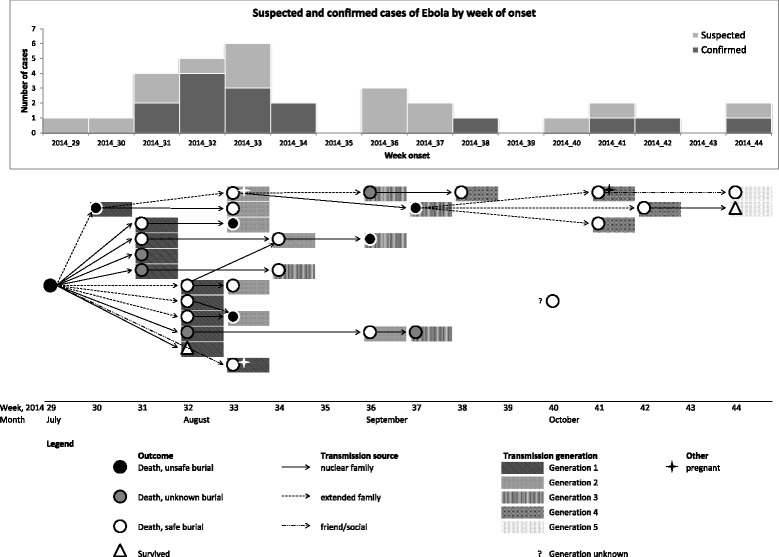
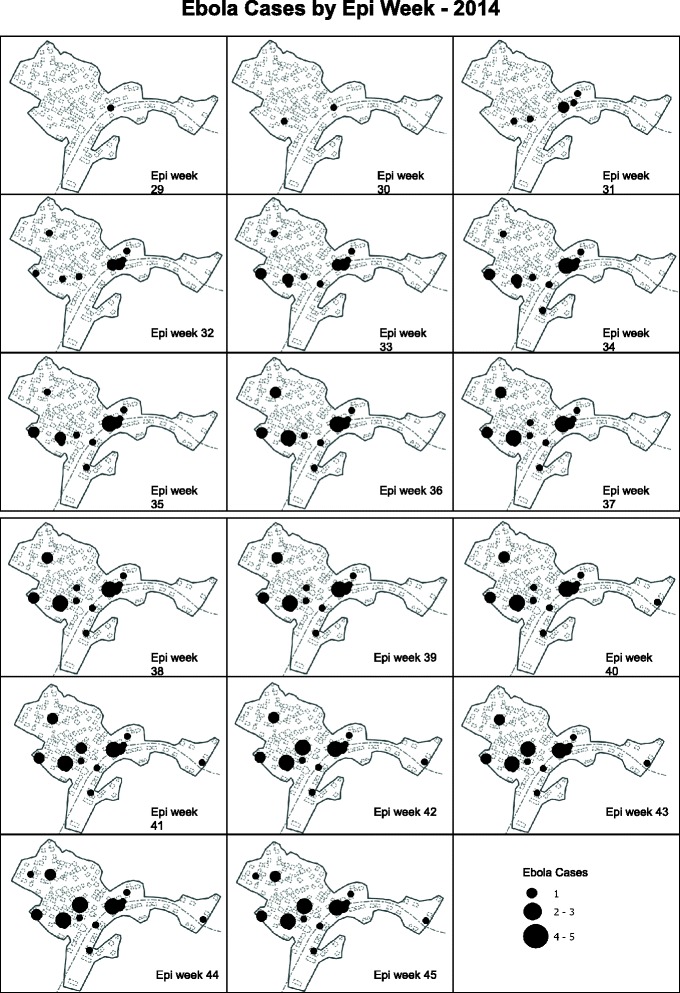
Results: All households (n = 240; 1161 individuals) participated in the survey. 29 of 31 EVD probable/confirmed cases died (93·5% case fatality rate); six deaths (20·6%) had been missed by other surveillance systems. Transmission over five generations lasted 16 weeks. Although most households had ≤5 members there was a significant increase in risk of Ebola in households with > 5 members. Risk of EVD was also associated with older age. Cases were spatially clustered; all occurred in 15 households. EVD transmission was better understood when the community experience started to concord with public health messages being given. Perceptions of contact tracing changed from invading privacy and selling people to ensuring community safety. Burials in plastic bags, without female attendants or prayer, were perceived as dishonourable. Further reasons for low compliance were low EMC survival rates, family perceptions of a moral duty to provide care to relatives, poor communication with the EMC, and loss of livelihoods due to quarantine. Compliance with response measures increased only after the second generation, coinciding with the implementation of restrictive by-laws, return of the first survivor, reduced contact with dead bodies, and admission of patients to the EMC.
Conclusions: Transmission occurred primarily in a few large households, with prolonged transmission and a high death toll. Return of a survivor to the village and more effective implementation of control strategies coincided with increased compliance to control measures, with few subsequent cases. We propose key recommendations for management of EVD outbreaks based on this experience.
Keywords: Community perception; Ebola virus disease; Transmission dynamics.
Conflict of interest statement
Authors’ information
GC, JG, FT, DC, KL are associated with the Manson Unit, Médecins Sans Frontières (MSF).
KL is associated with the National Centre for Epidemiology and Population Health, Research School of Population Health, Australian National University.
JD, CM, EL, RK, KK are associated with Médecins Sans Frontières (MSF) Amsterdam.
FJ is associated with the Department of Veterinary Medicine, University of Cambridge.
JS, ML are associated with the District Health Management Team, Ministry of Health and Sanitation, Kailahun, Sierra Leone.
BS is associated with Médecins Sans Frontières (MSF) London.
HW is associated with MRC Tropical Epidemiology Group, Faculty of Epidemiology and Population Health, London School of Hygiene and Tropical Medicine.
GDT is associated with the Centre for Primary Care and Public Health, Queen Mary University of London.
Ethics approval and consent to participate
The study protocol was approved by the Ethics Review Board of MSF, the Internal Review Board of the Sierra Leone MoHS, and The London School of Hygiene & Tropical Medicine (LSHTM). Verbal consent for participation was obtained from the head of each household after a briefing about the aim of the survey, the questions and duration of the questionnaire, and the option to end the interview at any time if wished.
Consent for publication
Not applicable
Competing interests
The authors declare that they have no competing interests.
Publisher’s Note
Springer Nature remains neutral with regard to jurisdictional claims in published maps and institutional affiliations.
Figures
References
-
- Sierra Leone: How Kailahun district kicked Ebola out [Internet]. 2014 [cited 10 Apr 2017]. Available from: http://www.who.int/features/2014/kailahun-beats-ebola/en/
-
- Sierra Leone: Kailahun District Profile (3 December 2015) [Internet]. 2015 [cited 10 Apr 2017]. Available from: http://reliefweb.int/sites/reliefweb.int/files/resources/district_profil....
-
- Ebola in Sierra Leone: A slow start to an outbreak that eventually outpaced all others [Internet]. 2015 [cited 10 Jan 2017]. Available from: http://www.who.int/csr/disease/ebola/one-year-report/sierra-leone/en/.
Publication types
MeSH terms
Grants and funding
LinkOut - more resources
Full Text Sources
Other Literature Sources
Medical
Miscellaneous
