


RTS,S malaria vaccine efficacy and immunogenicity during Plasmodium falciparum challenge is associated with HLA genotype
- PMID: 29439870
- PMCID: PMC5843576
- DOI: 10.1016/j.vaccine.2018.01.069
RTS,S malaria vaccine efficacy and immunogenicity during Plasmodium falciparum challenge is associated with HLA genotype
Abstract
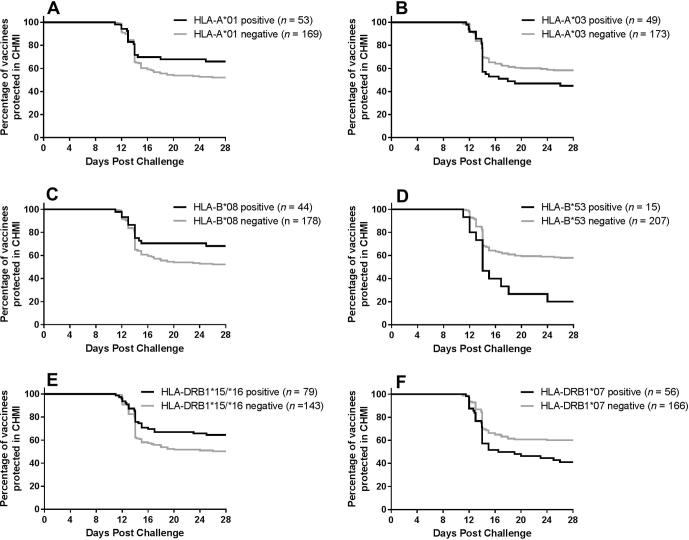
Although RTS,S remains the most advanced malaria vaccine, the factors influencing differences in vaccine immunogenicity or efficacy between individuals or populations are still poorly characterised. The analyses of genetic determinants of immunogenicity have previously been restricted by relatively small sample sizes from individual trials. Here we combine data from six Phase II RTS,S trials and evaluate the relationship between HLA allele groups and RTS,S-mediated protection in controlled human malaria infections (CHMI), using multivariate logistic or linear regression. We observed significant associations between three allele groups (HLA-A∗01, HLA-B∗08, and HLA-DRB1∗15/∗16) and protection, while another three allele groups (HLA-A∗03, HLA-B∗53, and HLA-DRB1∗07) were significantly associated with lack of protection. It is noteworthy that these 'protective' allele groups are thought to be at a lower prevalence in sub-Saharan African populations than in the UK or USA where these Phase II trials occurred. Taken together, the analyses presented here give an indication that HLA genotype may influence RTS,S-mediated protective efficacy against malaria infection.
Keywords: Antibody; HLA; Malaria; Protection; RTS,S.
Copyright © 2018 The Authors. Published by Elsevier Ltd.. All rights reserved.
Figures
References
-
- WHO. World Malaria Report 2015. 2015.
-
- European Medicines Agency. Summary of opinion: Mosquirix. EMA/CHMP/464758/2015. http://www.ema.europa.eu/ema/index.jsp?curl=pages/medicines/document_lis....
-
- Regules J.A., Cicatelli S.B., Bennett J.W., Paolino K.M., Twomey P.S., Moon J.E. Fractional third and fourth dose of RTS, S/AS01 malaria candidate vaccine: a phase 2a controlled human malaria infection and immunogenicity study. J Infect Dis. 2016 - PubMed
-
- Posteraro B., Pastorino R., Di Giannantonio P., Ianuale C., Amore R., Ricciardi W. The link between genetic variation and variability in vaccine responses: systematic review and meta-analyses. Vaccine. 2014;32(15):1661–1669. - PubMed
Publication types
MeSH terms
Substances
Grants and funding
LinkOut - more resources
Full Text Sources
Other Literature Sources
Medical
Research Materials
Miscellaneous
