. 2018 Mar 27;62(4):e02329-17.
doi: 10.1128/AAC.02329-17. Print 2018 Apr.

In Vitro Study of the Susceptibility of Clinical Isolates of Trichomonas vaginalis to Metronidazole and Secnidazole

Affiliations

In Vitro Study of the Susceptibility of Clinical Isolates of Trichomonas vaginalis to Metronidazole and Secnidazole

Arindam P Ghosh et al. Antimicrob Agents Chemother. .

Abstract

Nitroimidazoles (metronidazole [MTZ] and tinidazole [TNZ]) are the only drugs recommended for treatment of Trichomonas vaginalis infections. MTZ resistance occurs in 4% to 10% of cases of vaginal trichomoniasis (R. D. Kirkcaldy et al., Emerg Infect Dis 18:939-943, 2012; J. R. Schwebke and F. J. Barrientes, Antimicrob Agents Chemother 50:4209-4210, 2006) and TNZ resistance in 1% of cases (J. R. Schwebke and F. J. Barrientes, Antimicrob Agents Chemother 50:4209-4210, 2006). Emerging nitroimidazole-resistant trichomoniasis is concerning, because few alternatives to standard therapy exist. We assessed the prevalence of in vitro aerobic MTZ and secnidazole resistance among T. vaginalis isolates collected in 2015 to 2016 from 100 women in Birmingham, Alabama, with positive cultures. Archived specimens were treated with secnidazole or MTZ (0.2 to 400 μg/ml) for 48 h, according to U.S. Centers for Disease Control and Prevention protocols. Ninety-six (96%) of the 100 clinical Trichomonas isolates tested demonstrated lower minimum lethal concentrations for secnidazole than for MTZ, suggesting that secnidazole has better in vitro activity than MTZ.

Keywords: Trichomonas vaginalis; metronidazole; nitroimidazoles; secnidazole.


Figures

FIG 1
FIG 1
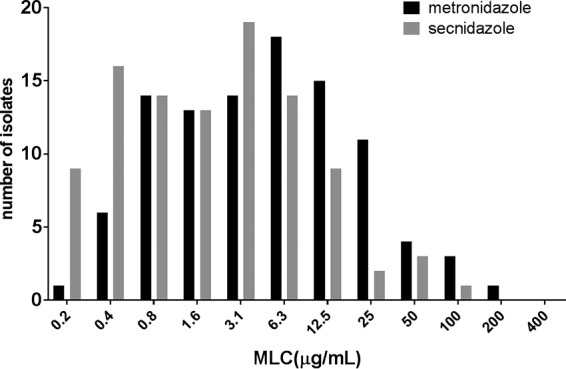
Distribution of secnidazole and MTZ MLCs for 100 clinical isolates. Susceptibility to MTZ and secnidazole was defined as MLCs of <25 μg/ml, low-level resistance as MLCs of 50 to 100 μg/ml, moderate-level resistance as MLCs of 200 μg/ml, and high-level resistance as MLCs of >400 μg/ml.
FIG 2
FIG 2
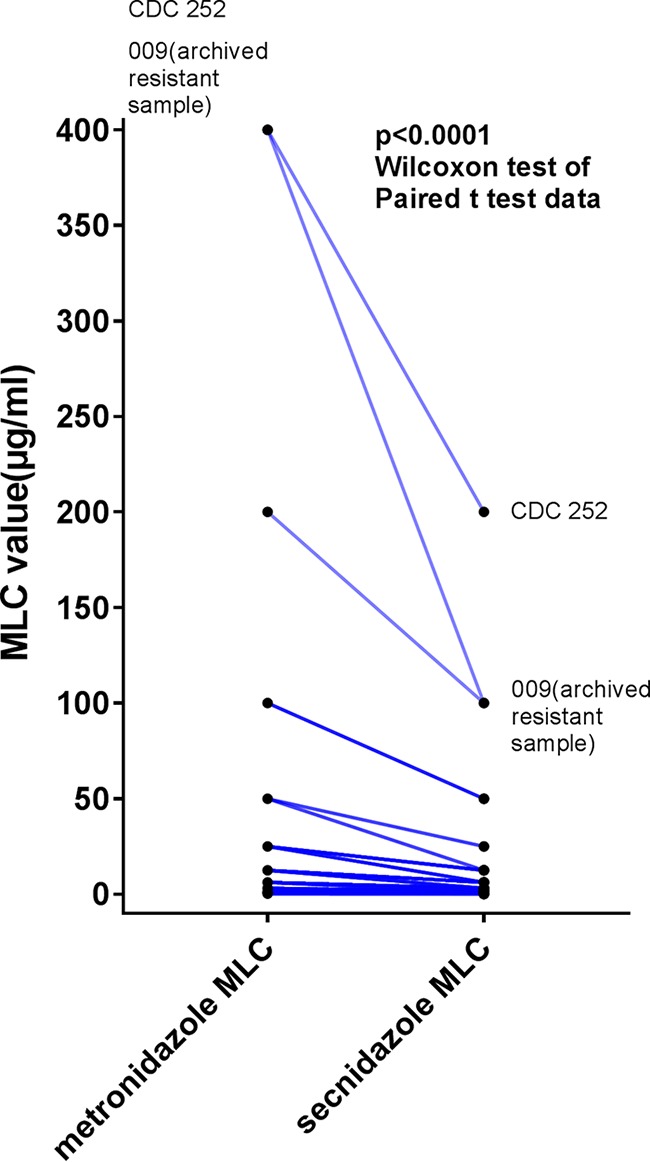
Comparison of MTZ and secnidazole activities in 100 Trichomonas vaginalis isolates. The MLCs for each drug were determined as described in the text. The MLCs for MTZ were consistently higher than for those for secnidazole (P < 0.0001, Wilcoxon signed-rank test).
FIG 3
FIG 3
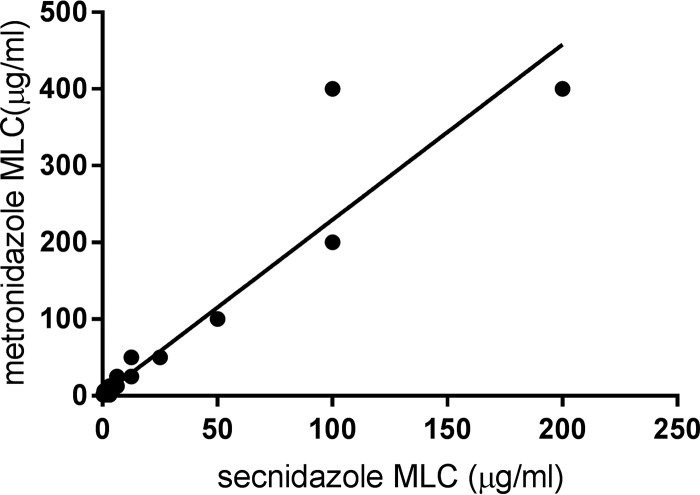
Regression analyses of MLCs for MTZ and secnidazole. The diagonal line represents the line of identity, indicating equal concentrations of the two drugs. The MLCs for MTZ were strongly correlated with the MLCs for secnidazole (r = 0.9496; P < 0.0001).

References

    1. Kissinger P. 2015. Trichomonas vaginalis: a review of epidemiologic, clinical and treatment issues. BMC Infect Dis 15:307. doi:10.1186/s12879-015-1055-0. - DOI - PMC - PubMed
    1. Harp DF, Chowdhury I. 2011. Trichomoniasis: evaluation to execution. Eur J Obstet Gynecol Reprod Biol 157:3–9. doi:10.1016/j.ejogrb.2011.02.024. - DOI - PMC - PubMed
    1. Sutton M, Sternberg M, Koumans EH, McQuillan G, Berman S, Markowitz L. 2007. The prevalence of Trichomonas vaginalis infection among reproductive-age women in the United States, 2001–2004. Clin Infect Dis 45:1319–1326. doi:10.1086/522532. - DOI - PubMed
    1. Sena AC, Miller WC, Hobbs MM, Schwebke JR, Leone PA, Swygard H, Atashili J, Cohen MS. 2007. Trichomonas vaginalis infection in male sexual partners: implications for diagnosis, treatment, and prevention. Clin Infect Dis 44:13–22. doi:10.1086/511144. - DOI - PubMed
    1. Allsworth JE, Ratner JA, Peipert JF. 2009. Trichomoniasis and other sexually transmitted infections: results from the 2001–2004 National Health and Nutrition Examination Surveys. Sex Transm Dis 36:738–744. doi:10.1097/OLQ.0b013e3181b38a4b. - DOI - PMC - PubMed

Publication types

MeSH terms