. 2018 Jan 15;32(2):96-111.
doi: 10.1101/gad.309583.117. Epub 2018 Feb 9.

Dynamic EBF1 occupancy directs sequential epigenetic and transcriptional events in B-cell programming

Affiliations

Dynamic EBF1 occupancy directs sequential epigenetic and transcriptional events in B-cell programming

Rui Li et al. Genes Dev. .

Abstract

B-cell fate determination requires the action of transcription factors that operate in a regulatory network to activate B-lineage genes and repress lineage-inappropriate genes. However, the dynamics and hierarchy of events in B-cell programming remain obscure. To uncouple the dynamics of transcription factor expression from functional consequences, we generated induction systems in developmentally arrested Ebf1-/- pre-pro-B cells to allow precise experimental control of EBF1 expression in the genomic context of progenitor cells. Consistent with the described role of EBF1 as a pioneer transcription factor, we show in a time-resolved analysis that EBF1 occupancy coincides with EBF1 expression and precedes the formation of chromatin accessibility. We observed dynamic patterns of EBF1 target gene expression and sequential up-regulation of transcription factors that expand the regulatory network at the pro-B-cell stage. A continuous EBF1 function was found to be required for Cd79a promoter activity and for the maintenance of an accessible chromatin domain that is permissive for binding of other transcription factors. Notably, transient EBF1 occupancy was detected at lineage-inappropriate genes prior to their silencing in pro-B cells. Thus, persistent and transient functions of EBF1 allow for an ordered sequence of epigenetic and transcriptional events in B-cell programming.

Keywords: B-cell programming; DNA methylation; EBF1; IRF4; Pax5; chromatin.


Figures

Figure 1.
Figure 1.
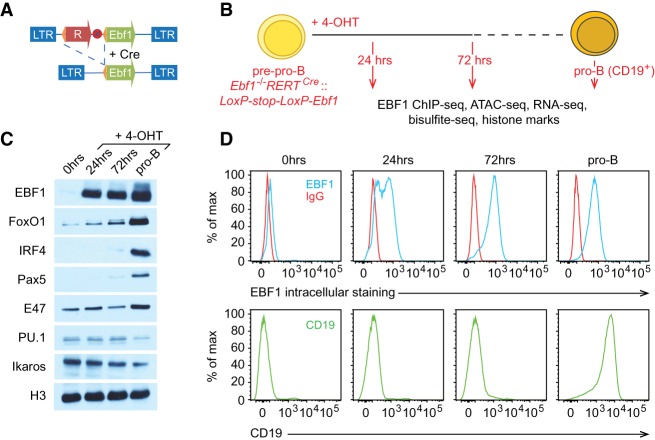
Generation of an inducible EBF1 expression system in Ebf1−/− pre-pro-B cells. (A) Schematic presentation of a 4-OHT-inducible retroviral EBF1 expression cassette. The retroviral loxP-Stop-loxP-Ebf1 construct contains a dsRed or tailless mCD8a reporter gene (R) and stop codon (red circle labeled with X) cassette that is flanked by loxP sites (orange triangles) and followed by an Ebf1 cDNA (green box). (LTR) Long terminal repeat. (B) Sorted pre-pro-B cells from the fetal livers of Ebf1−/− RERTCre mice were transduced with loxP-Stop-loxP-Ebf1 retrovirus. EBF1 expression was induced by the addition of 2 µM 4-OHT, and cells were analyzed at the 24- and 72-h time points and at the CD19+ pro-B-cell stage. (C) Immunoblot analysis to detect the expression of transcription factors before and after EBF1 induction. (D) Flow cytometric analysis of intracellular EBF1 expression and the B-cell surface marker CD19 in Ebf1−/− RERTCre::LoxP-Stop-LoxP-Ebf1 pre-pro-B cells before and after 4-OHT treatment.
Figure 2.
Figure 2.
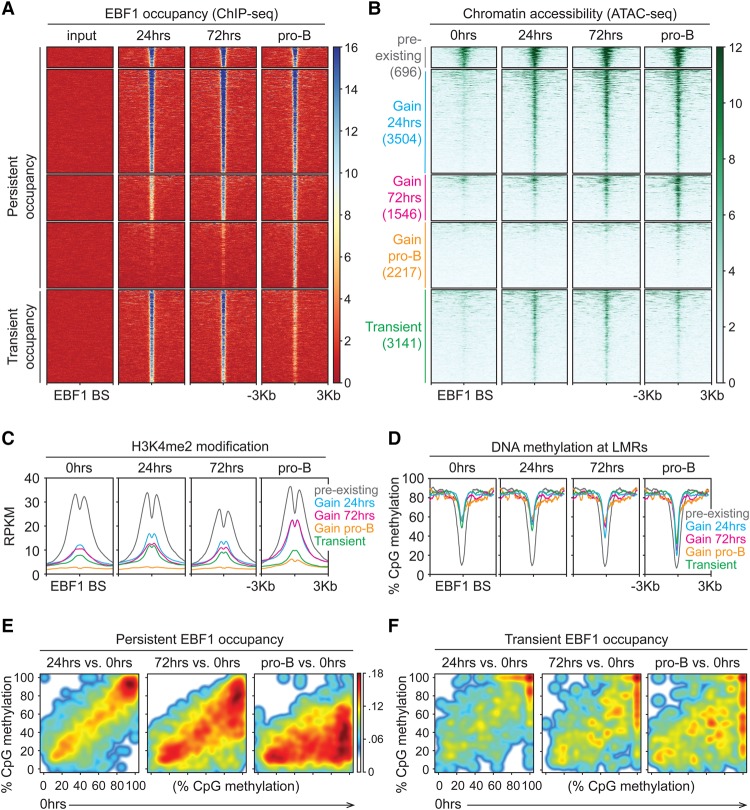
Persistent and transient EBF1 occupancy triggers sequential changes in the epigenome. (A,B) EBF1 occupancy and chromatin accessibility in Ebf1−/−RERTCre::LoxP-Stop-LoxP-Ebf1 pre-pro-B cells before and after 4-OHT treatment. (A) ChIP-seq analysis to detect EBF1 occupancy. A region around ±3 kb of EBF1-binding sites (BS) is shown. The EBF1 peaks are organized into two groups—persistent and transient—in which the peaks detected at 24 and/or 72 h are present or absent at the pro-B-cell stage. The peaks are grouped into five clusters based on the dynamics of EBF1 occupancy and chromatin accessibility. (B) ATAC-seq (assay for transposase-accessible chromatin [ATAC] using sequencing) analysis to determine chromatin accessibility. ATAC signals are centered around ±3 kb of EBF1-occupied sites and grouped into five clusters as indicated. The “pre-existing” cluster comprises sites that are accessible before induction and are occupied by EBF1 at 24 h after induction. The other clusters contain regions that are inaccessible before EBF1 induction and gain or lose accessibility coinciding with EBF1 occupancy. The heat map density is represented as RPKM (reads per kilobase per million reads) mean score. (C) Dynamics of H3K4me2 modification centered on EBF1-occupied sites of the ATAC clusters described above. (D) Dynamics of DNA methylation centered on EBF1-occupied sites that are associated with low methylated regions (LMRs). (E,F) Cloud maps presenting the levels of CpG methylation in ±100-base-pair windows of persistent (E) and transient (F) EBF1-occupied sites that are associated with LMRs. The levels at 24 and 72 h after EBF1 induction and at the pro-B-cell stage are compared with the levels before EBF1 induction (0 h).
Figure 3.
Figure 3.
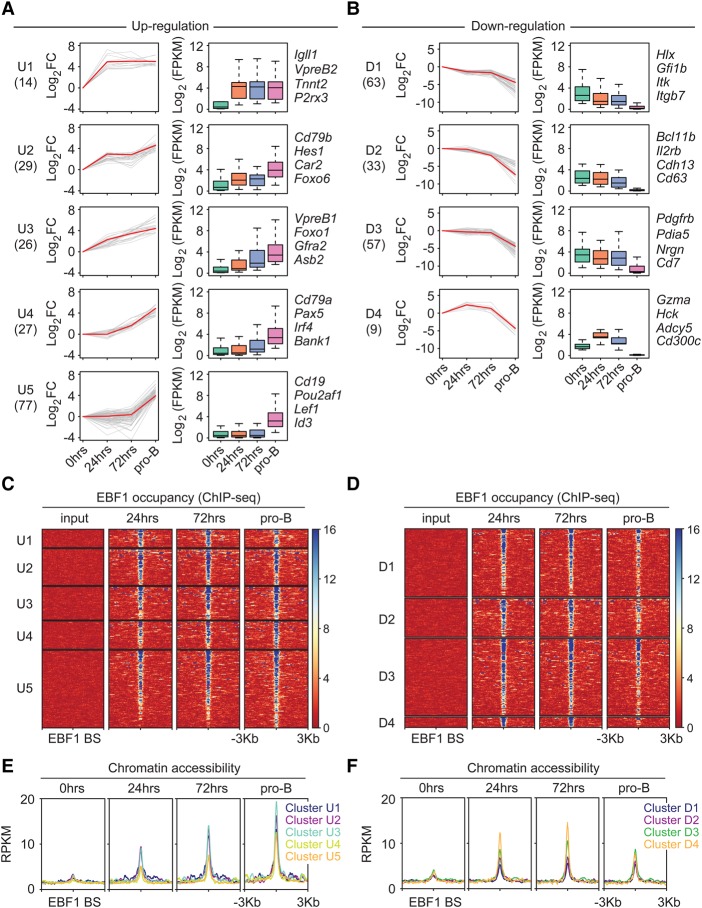
Time-resolved analysis of transcript levels of genes containing EBF1-occupied sites within ±25 kb of transcription start sites before and after EBF1 induction (A,B). Up-regulated and down-regulated genes that change transcript levels >10-fold between 0 h and the pro-B stage are shown in A and B, respectively. Genes that are regulated by twofold to 10-fold are shown in Supplemental Figure S4, A and B. Individual transcript levels are shown in Supplemental Table S1 (>10-fold changes) and Supplemental Table S2 (twofold to 10-fold changes). Genes are organized into different clusters based on expression pattern using Short Time-series Expression Miner (STEM) (Ernst and Bar-Joseph 2006). Line plots (left panels) and box plots (right panels) are used to show fold changes (log2 scale) and absolute expression levels (log2 scale), respectively. Representative genes of each cluster are listed at the right. In each line plot, one representative gene is highlighted in red. (FC) Fold change; (FPKM) fragments per kilobase per million reads. (C,D) Dynamics of EBF1 occupancy around ±3 kb of EBF1 peaks that are associated with up-regulated genes (C) and down-regulated genes (D). Clusters correspond to the RNA-seq analysis. (E,F) ATAC signals around ±3 kb of EBF1 peaks associated with up-regulated genes (E) and down-regulated genes (F).
Figure 4.
Figure 4.
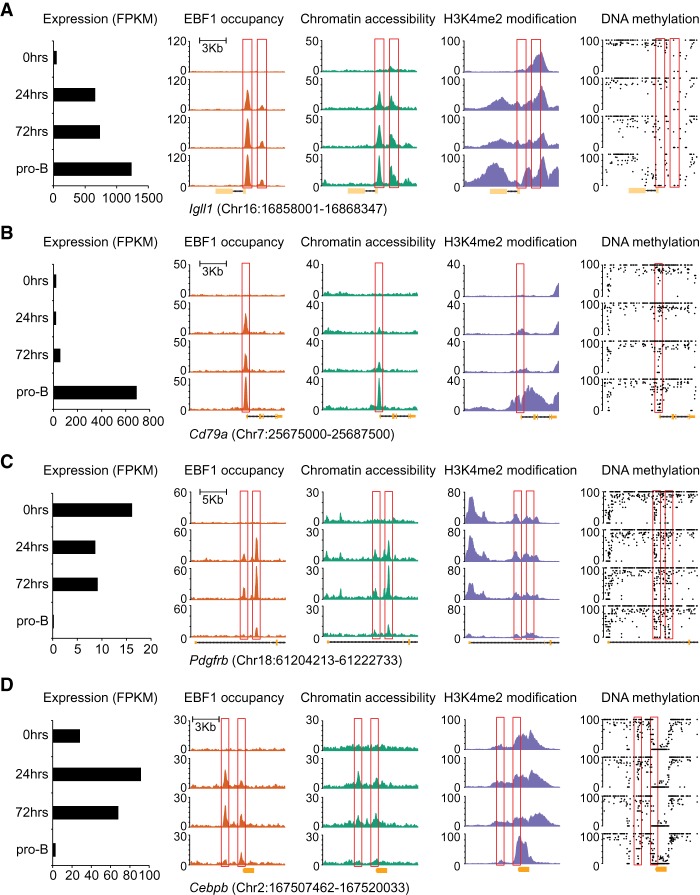
Gene-specific analysis of the dynamics of RNA expression, EBF1 occupancy, chromatin accessibility, H3K4me2 modification, and DNA methylation after EBF1 induction. Representative genes include Igll1 of cluster U1 (A), Cd79a of cluster U4 (B), Pdgfrb of cluster D3 (C), and Cebpb of cluster D4 (D). The positions of EBF1-bound sites are highlighted with red boxes. The scale of the Y-axis represents RPKM in ChIP-seq and ATAC-seq tracks and percentage in the DNA methylation tracks, in which each black dot represents one CpG.
Figure 5.
Figure 5.
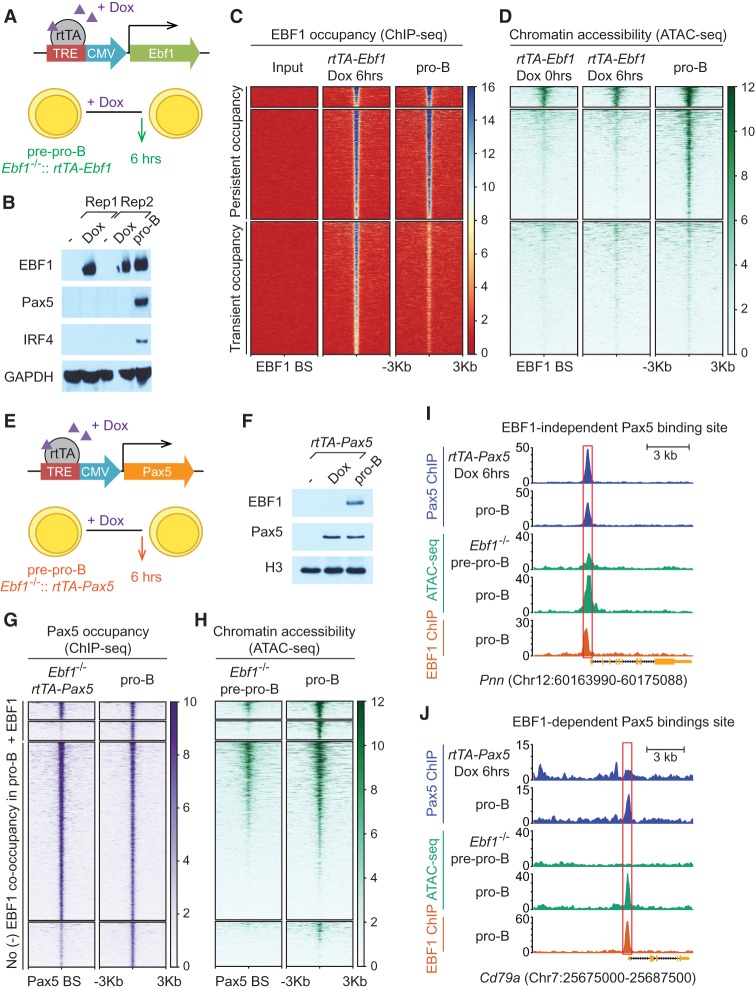
EBF1-induced chromatin accessibility is required for Pax5 occupancy at a set of B-lineage-specific genes. (A) Scheme of a “Tet-on”-based doxycycline-inducible EBF1 expression construct, rtTA-Ebf1. Ebf1−/− pre-pro-B cells were transduced with rtTA-Ebf1 retrovirus. Cells were treated with doxycycline (Dox) for 6 h to induce EBF1 expression. (rtTA) Tetracycline-controlled transactivator rtTA-advanced; (TRE) tetracycline response element. (B) Immunoblot analysis of cell lysates from Ebf1−/−::rtTA-Ebf1 pre-pro-B cells at 0 or 6 h after 1 µg/mL doxycycline treatment and from CD19-positive pro-B cells to detect the expression of EBF1, Pax5, and IRF4. (Rep) Replicate. (C,D) ChIP-seq analysis (C) and ATAC-seq analysis (D) to detect EBF1 occupancy and chromatin accessibility before (0 h) and after (6 h) doxycycline treatment. EBF1 peaks and ATAC signals are centered around ±3 kb of EBF1-bound sites and grouped into three clusters according to the persistence or transience of EBF1 occupancy and pre-existing or de novo accessibility. (E) Scheme of a “Tet-on”-based doxycycline-inducible Pax5 construct (rtTA-Pax5). (F) Immunoblot analysis to detect the expression of EBF1 and Pax5 in cell lysates from Ebf1−/−::rtTA-Pax5 pre-pro-B cells at 0 or 6 h after doxycycline treatment and from pro-B cells. (G) Pax5 occupancy in Ebf1−/−::rtTA-Pax5 pre-pro-B cells (6 h after doxycycline treatment) and in pro-B cells centered on Pax5-bound sites identified in pro-B cells. The top two clusters are co-occupied by EBF1 in EBF1-expressing pro-B cells. The bottom two clusters lack EBF1 co-occupancy in pro-B cells. (H) Chromatin accessibility in Ebf1−/− pre-pro-B cells and pro-B cells centered on Pax5-bound sites identified in the pro-B-cell sample. Pax5 peaks and ATAC signals are grouped into four clusters according to the presence or absence of EBF1 co-occupancy in pro-B cells and according to Pax5 occupancy in Ebf1−/− pre-pro-B cells and EBF1-expressing pro-B cells. (I,J) Pax5 occupancy in Ebf1−/−:rtTA-Pax5 pre-pro-B cells (6 h after doxycycline treatment) and in pro-B cells, chromatin accessibility in Ebf1−/− pre-pro-B cells and pro-B cells, and EBF1 occupancy in pro-B cells at the EBF1-independent Pax5 target Pnn locus (I) and EBF1-dependent Pax5 target Cd79a locus (J).
Figure 6.
Figure 6.
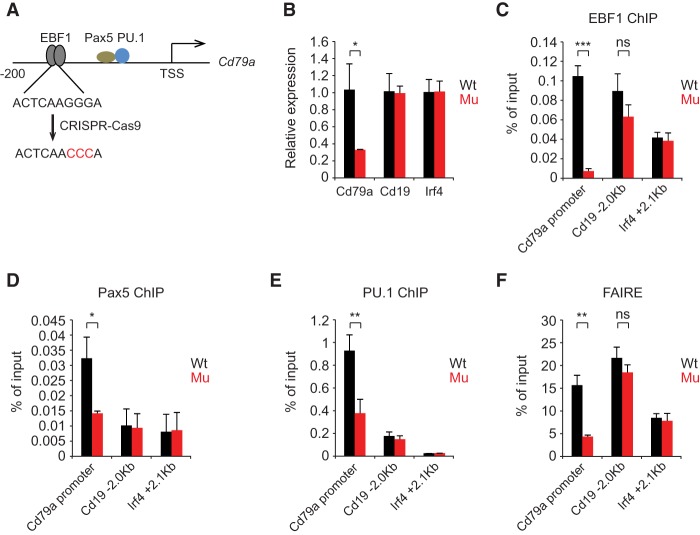
EBF1-induced chromatin accessibility is required for the maintenance of Cd79a promoter activity and occupancy by Pax5 and PU.1. (A) Scheme of CRISPR/Cas9-mediated mutagenesis of the EBF1-binding sites in the Cd79a promoter. The relative positions of transcription factor-binding sites relative to the TSS are indicated. (B) qRT–PCR analysis of the indicated genes in wild type and mutant 38B9 cells carrying point mutations in the EBF1-binding site on both alleles. Transcript levels of the Cd19 and Irf4 genes served as a control. Transcript levels were normalized. (CE) Quantitative ChIP analysis to detect occupancy of EBF1 (C), Pax5 (D), and PU.1 (E) at the Cd79a promoter and other regulatory regions of the Cd19 and Irf4 genes. (F) Chromatin accessibility analysis of EBF1-binding sites at Cd79a, Cd19, and Irf4 loci in wild-type and mutant 38B9 cells. (FAIRE) Formaldehyde-assisted isolation of regulatory elements. Error bars represent the standard deviation of three biological replicates. Statistical significance between wild-type and mutant cells was measured by an unpaired two-tail Student's t-test. (*) P < 0.05; (**) P < 0.01; (***) P < 0.001.

Comment in

References

    1. Adolfsson J, Mansson R, Buza-Vidas N, Hultquist A, Liuba K, Jensen CT, Bryder D, Yang L, Borge OJ, Thoren LA, et al. 2005. Identification of Flt3+ lympho-myeloid stem cells lacking erythro-megakaryocytic potential a revised road map for adult blood lineage commitment. Cell 121: 295–306. - PubMed
    1. Bain G, Maandag EC, Izon DJ, Amsen D, Kruisbeek AM, Weintraub BC, Krop I, Schlissel MS, Feeney AJ, van Roon M, et al. 1994. E2A proteins are required for proper B cell development and initiation of immunoglobulin gene rearrangements. Cell 79: 885–892. - PubMed
    1. Banerjee A, Northrup D, Boukarabila H, Jacobsen SE, Allman D. 2013. Transcriptional repression of Gata3 is essential for early B cell commitment. Immunity 38: 930–942. - PMC - PubMed
    1. Barozzi I, Simonatto M, Bonifacio S, Yang L, Rohs R, Ghisletti S, Natoli G. 2014. Coregulation of transcription factor binding and nucleosome occupancy through DNAa features of mammalian enhancers. Mol Cell 54: 844–857. - PMC - PubMed
    1. Benner C, Isoda T, Murre C. 2015. New roles for DNA cytosine modification, eRNA, anchors, and superanchors in developing B cell progenitors. Proc Natl Acad Sci 112: 12776–12781. - PMC - PubMed

Publication types