


Evaluation of California's 'Tobacco 21' law
- PMID: 29440328
- PMCID: PMC6252367
- DOI: 10.1136/tobaccocontrol-2017-054088
Evaluation of California's 'Tobacco 21' law
Abstract
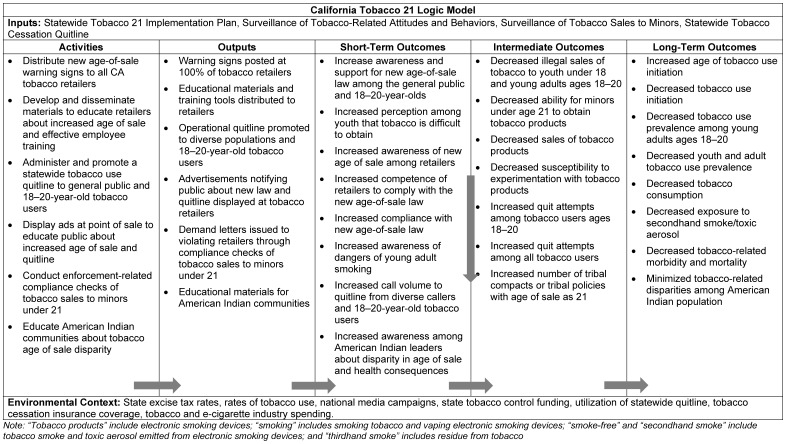
Introduction: California's law raising the minimum tobacco sales age to 21 went into effect on 9 June 2016. This law, known as 'Tobacco 21' or 'T21', also expanded the definition of tobacco to include electronic smoking devices. This paper describes the T21 evaluation plan and initial evaluation results.
Methods: An evaluation plan and logic model were created to evaluate T21. A tobacco retailer poll was conducted 7 months after the law went into effect to assess awareness, support and implementation; an online survey of California adults was fielded to provide data on tobacco use and attitudinal changes before and after T21 implementation; and tobacco purchase surveys were conducted to assess the retailer violation rate (RVR). Multivariate models estimated the odds of RVR and odds of being aware, agreeing with and observing advertisements related to T21.
Results: Seven months after the T21 effective date, 98.6% of retailers were aware of the law and 60.6% supported the law. Furthermore, 66.2% of retailers agreed that people who start smoking before 21 would become addicted to tobacco products. The RVR using youth decoys under age 18 statistically decreased from 10.3% before T21 to 5.7% after T21 (P=0.002). Furthermore, the RVR using young adult decoys ages 18-19 was 14.2% (95% CI 9.3% to 19.1%) for traditional tobacco and 13.1% (95% CI 10.2% to 16.1%) for electronic smoking devices.
Conclusions: Survey findings suggest that the high awareness and support for the law may have contributed to reducing illegal tobacco sales to youth under 18 and achieving widespread retailer conformity with the new law disallowing sales to young adults under 21.
Keywords: public opinion; public policy; surveillance and monitoring.
© Article author(s) (or their employer(s) unless otherwise stated in the text of the article) 2018. All rights reserved. No commercial use is permitted unless otherwise expressly granted.
Conflict of interest statement
Competing interests: None declared.
References
-
- California Department of Public Health. Behavioral risk factor surveillance system, 1988–2015. Sacramento, CA: California Department of Public Health.
-
- U.S. Census Bureau. Annual state resident population estimates for 6 race groups (5 race alone groups and two or more races) by age, sex, and hispanic origin: April 1, 2010 to July 1, 2016. Suitland, MD: U.S. Census Bureau, 2017.
-
- California Tobacco Control Program. California Tobacco 21 Law 2016. https://www.cdph.ca.gov/Programs/CCDPHP/DCDIC/CTCB/Pages/Tobacco21.aspx (accessed 10 Aug 2017).
MeSH terms
LinkOut - more resources
Full Text Sources
Other Literature Sources
Medical
