


Comment
doi: 10.1073/pnas.1722598115.
Unique parasite aDNA in moa coprolites from New Zealand suggests mass parasite extinctions followed human-induced megafauna extinctions
Affiliations
- PMID: 29440435
- PMCID: PMC5816219
- DOI: 10.1073/pnas.1722598115
Item in Clipboard
Comment
Unique parasite aDNA in moa coprolites from New Zealand suggests mass parasite extinctions followed human-induced megafauna extinctions
Proc Natl Acad Sci U S A.
.
No abstract available
Conflict of interest statement
The authors declare no conflict of interest.
Figures
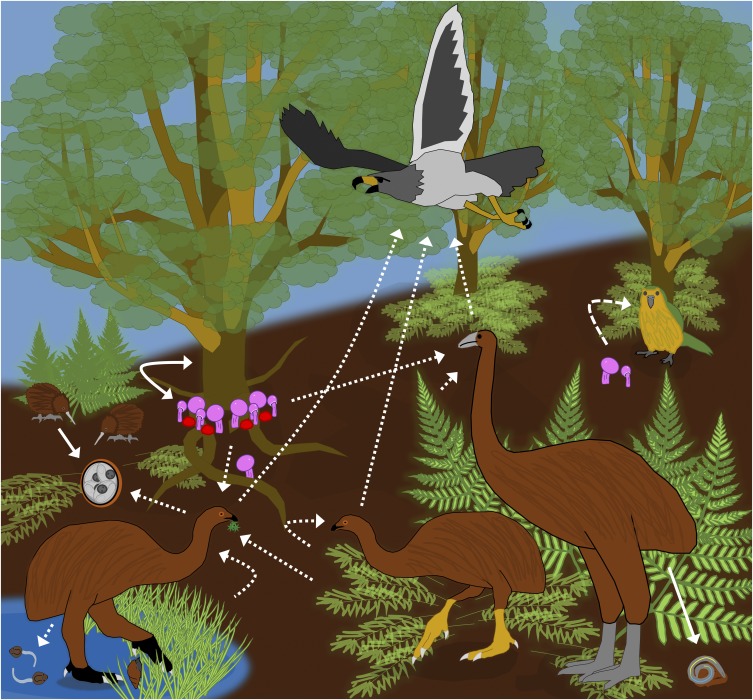
The ancient Zealandia food web was much different from that in present-day New Zealand, and it included several ecological interactions that Boast et al. (1) revealed by sequencing aDNA from moa coprolites. For instance, the upland moa (M. didiformis) ate moss, ferns, mycorrhizal fungi that require animal-assisted dispersal, and aquatic vegetation. The upland moa also accidentally ate (and was infected by) aquatic trematode larvae (Notocotylidae) and apicomplexan parasites (Eimeriidae), which still exist in extant kiwi. Other parasites that once infected moas, like several heterakoid nematode species, have not been seen since the moa extinctions. Dashed arrows indicate interactions lost since the moa extinctions.
Comment on
-
Coprolites reveal ecological interactions lost with the extinction of New Zealand birds.Proc Natl Acad Sci U S A. 2018 Feb 13;115(7):1546-1551. doi: 10.1073/pnas.1712337115. Proc Natl Acad Sci U S A. 2018. PMID: 29440415 Free PMC article.
References
-
- Worthy TH, Scofield RP. Twenty-first century advances in knowledge of the biology of moa (Aves: Dinornithiformes): A new morphological analysis and moa diagnoses revised. N Z J Zool. 2012;39:87–153.
-
- Wood JR, Wilmshurst JM. Late Quaternary terrestrial vertebrate coprolites from New Zealand. Quat Sci Rev. 2014;98:33–44.
-
- Cole TL, Wood JR. The ancient DNA revolution: The latest era in unearthing New Zealand’s faunal history. N Z J Zool. 2017;44:1–30.
-
- Cooper A, Poinar HN. Ancient DNA: Do it right or not at all. Science. 2000;289:1139. - PubMed
Publication types
MeSH terms
LinkOut - more resources
Full Text Sources
Other Literature Sources
