


Blood biomarkers of Hikikomori, a severe social withdrawal syndrome
- PMID: 29440704
- PMCID: PMC5811600
- DOI: 10.1038/s41598-018-21260-w
Blood biomarkers of Hikikomori, a severe social withdrawal syndrome
Abstract
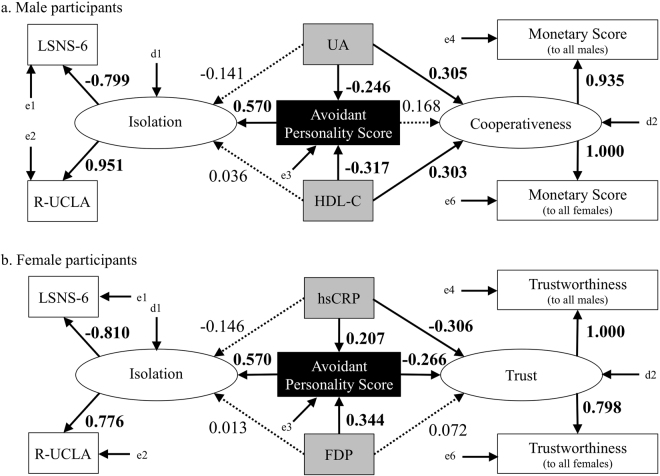
Hikikomori, a severe form of social withdrawal syndrome, is a growing social issue in Japan and internationally. The pathophysiology of hikikomori has not yet been elucidated and an effective treatment remains to be established. Recently, we revealed that avoidant personality disorder is the most common comorbidity of hikikomori. Thus, we have postulated that avoidant personality is the personality underpinning hikikomori. First, we herein show relationships between avoidant personality traits, blood biomarkers, hikikomori-related psychological features, and behavioural characteristics assessed by a trust game in non-hikikomori volunteers. Avoidant personality traits were negatively associated with high-density lipoprotein cholesterol (HDL-C) and uric acid (UA) in men, and positively associated with fibrin degeneration products (FDP) and high sensitivity C-reactive protein (hsCRP) in women. Next, we recruited actual individuals with hikikomori, and compared avoidant personality traits, blood biomarkers, and psychological features between individuals with hikikomori and age-matched healthy controls. Individuals with hikikomori had higher avoidant personality scores in both sexes, and showed lower serum UA levels in men and lower HDL-C levels in women compared with healthy controls. This is the first report showing possible blood biomarkers for hikikomori, and opens the door to clarify the underlying biological pathophysiology of hikikomori.
Conflict of interest statement
The authors declare no competing interests.
Figures
References
Publication types
MeSH terms
Substances
LinkOut - more resources
Full Text Sources
Other Literature Sources
Research Materials
