. 2018 Feb 13;9(2):215.
doi: 10.1038/s41419-017-0092-6.

Effect of mitochondrial uncouplers niclosamide ethanolamine (NEN) and oxyclozanide on hepatic metastasis of colon cancer

Affiliations

Effect of mitochondrial uncouplers niclosamide ethanolamine (NEN) and oxyclozanide on hepatic metastasis of colon cancer

Amer Alasadi et al. Cell Death Dis. .

Abstract

Metabolism of cancer cells is characterized by aerobic glycolysis, or the Warburg effect. Aerobic glycolysis reduces pyruvate flux into mitochondria, preventing a complete oxidation of glucose and shunting glucose to anabolic pathways essential for cell proliferation. Here we tested a new strategy, mitochondrial uncoupling, for its potential of antagonizing the anabolic effect of aerobic glycolysis and for its potential anticancer activities. Mitochondrial uncoupling is a process that facilitates proton influx across the mitochondrial inner membrane without generating ATP, stimulating a futile cycle of acetyl- CoA oxidation. We tested two safe mitochondrial uncouplers, NEN (niclosamide ethanolamine) and oxyclozanide, on their metabolic effects and anti-cancer activities. We used metabolomic NMR to examine the effect of mitochondrial uncoupling on glucose metabolism in colon cancer MC38 cells. We further tested the anti-cancer effect of NEN and oxyclozanide in cultured cell models, APCmin/+ mouse model, and a metastatic colon cancer mouse model. Using a metabolomic NMR approach, we demonstrated that mitochondrial uncoupling promotes pyruvate influx to mitochondria and reduces various anabolic pathway activities. Moreover, mitochondrial uncoupling inhibits cell proliferation and reduces clonogenicity of cultured colon cancer cells. Furthermore, oral treatment with mitochondrial uncouplers reduces intestinal polyp formation in APCmin/+ mice, and diminishes hepatic metastasis of colon cancer cells transplanted intrasplenically. Our data highlight a unique approach for targeting cancer cell metabolism for cancer prevention and treatment, identified two prototype compounds, and shed light on the anti-cancer mechanism of niclosamide.


Conflict of interest statement

SJ is founder of Mito BioPharm, which has a license right from Rutgers University for developing safe mitochondrial uncouplers for treating cancer and metabolic diseases. GTM is founder of Nexomics Biosciences, a contract structural biology research organization. The remaining authors declare that they have no competing financial interests.

Figures

Fig. 1
Fig. 1. NEN and oxyclozanide uncouple mitochondria in cultured cells
a Schematic representation showing mitochondrial uncoupling process. b Chemical structure of NEN. c Chemical structure of oxyclozanide. d Oxygen Consumption Rate (OCR) of cultured cells with sequential addition of oligomycin (final concentration 2.5 μM) and NEN (final concentration 2.0 μM), as indicated. e, f determination of minimal efficacious concentrations of NEN e and oxyclozanide f for mitochondrial uncoupling in murine colon cancer MC38 cells, scale bars, 200 μm. MC38 cells were treated with various concentrations of NEN or oxyclozanide while the control group was treated with vehicle DMSO for 2 h, followed staining with (TMRE) for 10 min. g, h quantification of TMRE staining by flow cytometry analyses. Results shown are representative data from three independent experiments.
Fig. 2
Fig. 2. NEN inhibits the anabolic effect of aerobic glycolysis on colon cancer cell
a Schematic of pathways and molecules measured in metabolomic NMR experiment. b Relative PDH/PC ratio determined by the ratio of glutamate13Cγ-1H2 vs. glutamate13Cβ− 1H2. c Relative lactate level determined by measuring lactate13Cα−1H3. d Pentose phosphate pathway (PPP) rate determined by measuring UDP/UTP13C labeling at ribose C2 position. e Relative serine level determined by measuring serine13Cγ-1H3. f Relative glycine level determined by measuring glycine13Cα-1H3. g relative glutamine level determined by measuring13Cγ-1H2. For b–g MC38 cells were grown in medium containing 50%12C + 50% U-13C glucose, treating with 2 μM NEN or vehicle DMSO for 6 or 12 h as indicated. The cell metabolites were extracted using cold methanol-chloroform extraction process. Abbreviations: G6P, glucose-6-phosphate; 3PG, 3- phosphoglycerate; PHGDH, phosphoglycerate dehydrogenase; 6PG, 6- phosphogluconate; Ru5P, ribulose-5-phosphate; R5P, ribose-5- phosphate; ACoA, acetyl coenzyme A; GlcNAc, N-acetyl-glucosamine; OAA, oxaloacetate; ICT, isocitrate; AKG, a-ketoglutarate; SUC, succinate; FUM, fumarate; MAL, malate. PDH, pyruvate dehydrogenase; PC, pyruvate carboxylase; Glu, glutamine. Results are showed as means ± SD values from three independent experiments and statistical significance (P) was determined by student t- test: *P < 0.05; **P < 0.01; vs. DMSO control
Fig. 3
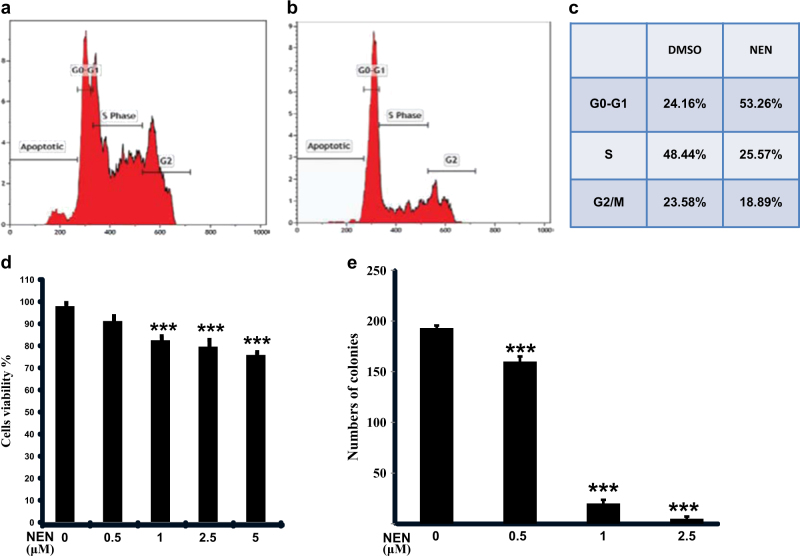
Fig. 3. NEN affects cell cycle progression and reduces colony formation of colon cancer cells
a–c Cell cycle profile of MC38 cells treated with DMSO vehicle (a) or 2.0 μM NEN (b) for 24 h, with percentage of cells in each phase summarized in c. d Cell viability of MC38 cells after a 24 h treatment with NEN at various concentrations, detected by trypan blue exclusion assay. e Clonogenicity of MC38 cells, cells were grown in medium containing NEN at various concentrations, as indicated, for 2 weeks, and the colonies formed were counted. Results from D-E are shown as means ± SD from three independent experiments and statistical significance (P) between the control and treated cells was determined by student t-test: ***P < 0.001
Fig. 4
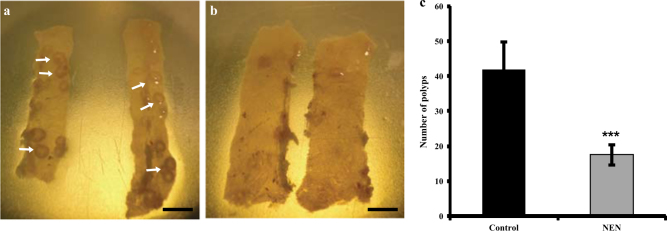
Fig. 4. Oral NEN treatment reduces intestinal polyps in APCmin/+ mice
a, b Representative pictures of intestine fragments from control or NEN fed mice, respectively. Arrows point to areas containing polyps. Scale bars, 5 mm. c Quantification of intestinal polyps in control or NEN fed mice (n = 10 in each group). Mice at age of 2 months fed either normal chow diet or diet containing 1500 ppm NEN for 8 weeks. Polyps in intestine of each mouse were counted. Results shown as means ± SD. Statistical significance (P) was determined by student-t test between the control and NEN fed mice: ***P < 0.001. The data are representative results from two independent experiments
Fig. 5
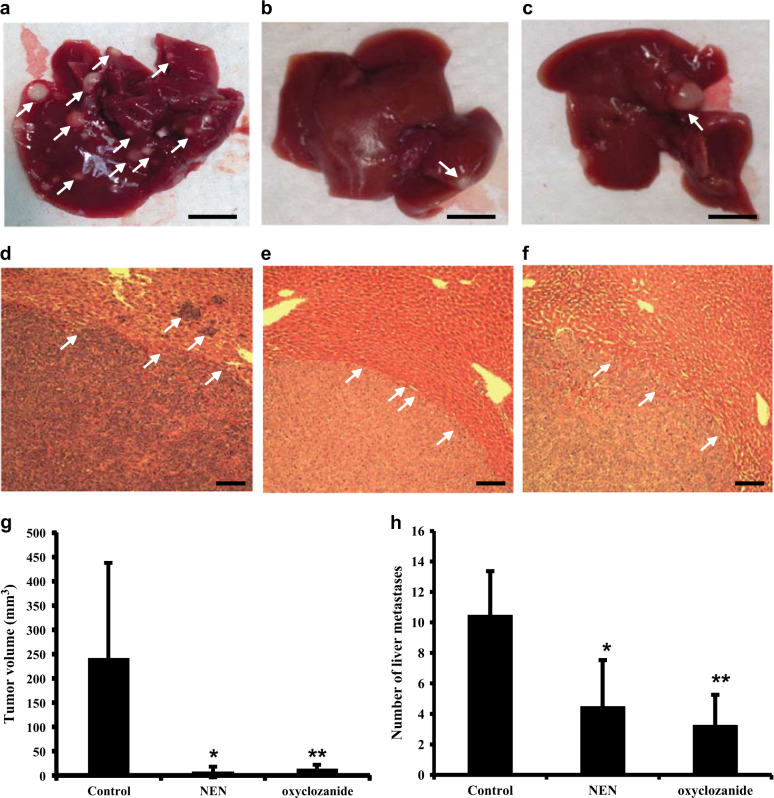
Fig. 5. Effect of NEN and oxyclozanide on liver metastasis of colon cancer cells
a–c Representative liver pictures (scale bars, 10 mm) showing the tumor nodules from mice fed normal chow (a) or diet containing 2000 ppm NEN, or diet containing 800 ppm oxyclozanide. Arrows point to area containing a tumor nodule. d–f Representative hematoxylin and eosin (H & E), (scale bars, 200 μm), staining of histological section of metastatic tumors mice fed normal diet (d), diet containing NEN (e), or diet containing oxyclozanide (f). Arrows point to boundary between tumous and normal tissues. g–h, average metastatic tumor volume (g) or number of node (h) per mouse in animals with indicated treatment. MC38 cells were injected into male NSG mice intrasplenically and randomized into 3 groups (n = 10 per group). The mice were fed normal chow, or chow containing 2000 ppm NEN, or chow containing 800 ppm oxyclozanide for 3 weeks, before euthanization and characterization of metastatic hepatic cancer. Numbers are presented by means ± SD. P value between control and each treated group was determined by student t-test: *P < 0.05 and **P < 0.01. The data show representative results from two independent experiments
Fig. 6
Fig. 6. NEN and oxyclozanide activate AMPK and downregulate mTOR in vitro and in vivo
a–c Immunoblot analyses of MC38 cells without or with treatment of NEN or oxyclozanide for 2 h with indicated antibodies. d–e Immunoblot analyses of mouse liver tissues from mice fed normal chow, or chow containing 2000 ppm NEN, or chow containing 800 ppm oxyclozanide for 3 weeks, with indicated antibodies. The data are representative results from two independent experiments

References

    1. Warburg O. On the origin of cancer cells. Science. 1956;123:309–314. doi: 10.1126/science.123.3191.309. - DOI - PubMed
    1. Warburg O, Minami S. Versuche an Überlebendem Carcinom-gewebe. J. Mol. Med. 1923;2:776–777.
    1. Vander Heiden MG, Cantley LC, Thompson CB. Understanding the Warburg effect: the metabolic requirements of cell proliferation. Science. 2009;324:1029–1033. doi: 10.1126/science.1160809. - DOI - PMC - PubMed
    1. Lunt SY, Vander Heiden MG. Aerobic glycolysis: meeting the metabolic requirements of cell proliferation. Annu. Rev. Cell. Dev. Biol. 2011;27:441–464. doi: 10.1146/annurev-cellbio-092910-154237. - DOI - PubMed
    1. Levine AJ, Puzio-Kuter AM. The control of the metabolic switch in cancers by oncogenes and tumor suppressor genes. Science. 2010;330:1340–1344. doi: 10.1126/science.1193494. - DOI - PubMed

Publication types