Immunogenicity of Fractional-Dose Vaccine during a Yellow Fever Outbreak - Final Report
- PMID: 29443626
- PMCID: PMC7064153
- DOI: 10.1056/NEJMoa1710430
Immunogenicity of Fractional-Dose Vaccine during a Yellow Fever Outbreak - Final Report
Abstract
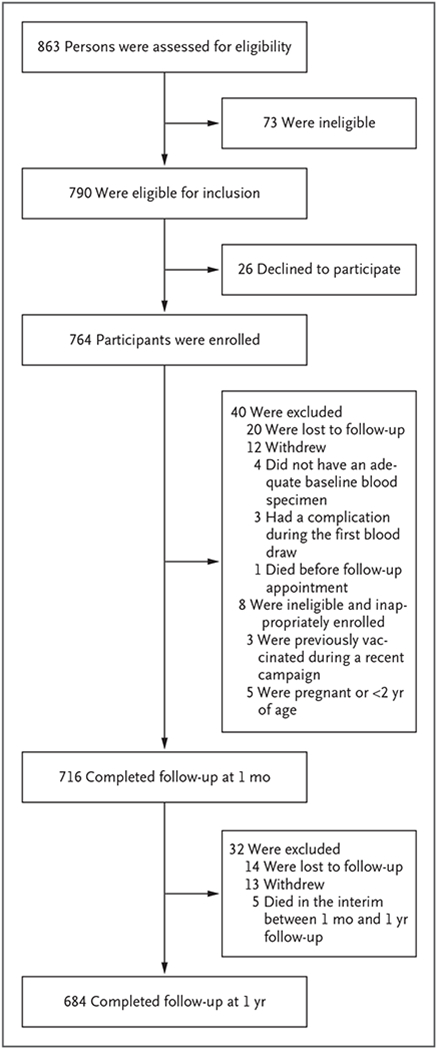
Background: In 2016, the response to a yellow fever outbreak in Angola and the Democratic Republic of Congo led to a global shortage of yellow fever vaccine. As a result, a fractional dose of the 17DD yellow fever vaccine (containing one fifth [0.1 ml] of the standard dose) was offered to 7.6 million children 2 years of age or older and nonpregnant adults in a preemptive campaign in Kinshasa. The goal of this study was to assess the immune response to the fractional dose in a large-scale campaign.
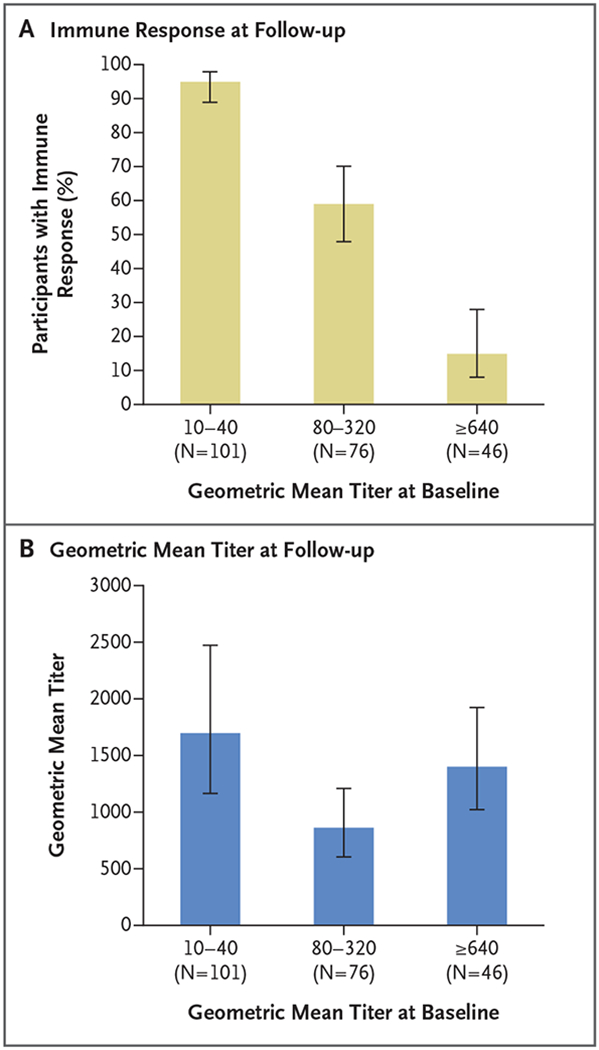
Methods: We recruited participants in four age strata at six vaccination sites. We assessed neutralizing antibody titers against yellow fever virus in blood samples obtained before vaccination and at 1 month and 1 year after vaccination, using a plaque reduction neutralization test with a 50% cutoff (PRNT50). Participants with a PRNT50 titer of 10 or higher were considered to be seropositive. Those with a baseline titer of less than 10 who became seropositive at follow-up were classified as having undergone seroconversion. Participants who were seropositive at baseline and who had an increase in the titer by a factor of 4 or more at follow-up were classified as having an immune response.
Results: Among 716 participants who completed the 1-month follow-up, 705 (98%; 95% confidence interval [CI], 97 to 99) were seropositive after vaccination. Among 493 participants who were seronegative at baseline, 482 (98%; 95% CI, 96 to 99) underwent seroconversion. Among 223 participants who were seropositive at baseline, 148 (66%; 95% CI, 60 to 72) had an immune response. Lower baseline titers were associated with a higher probability of having an immune response (P<0.001). Among 684 participants who completed the 1-year follow-up, 666 (97%; 95% CI, 96 to 98) were seropositive for yellow fever antibody. The distribution of titers among the participants who were seronegative for yellow fever antibody at baseline varied significantly among age groups at 1 month and at 1 year (P<0.001 for both comparisons).
Conclusions: A fractional dose of the 17DD yellow fever vaccine was effective at inducing seroconversion in participants who were seronegative at baseline. Titers remained above the threshold for seropositivity at 1 year after vaccination in nearly all participants who were seropositive at 1 month after vaccination. These findings support the use of fractional-dose vaccination for outbreak control. (Funded by the U.S. Agency for International Development and the Centers for Disease Control and Prevention.).
Copyright © 2018 Massachusetts Medical Society.
Figures
References
-
- Staples JE, Monath TP, Gershman M, Barrett ADT. Yellow fever. In: Plotkin SA, Orenstein WA, Offit PA, Edwards KM, eds. Vaccines. 7th ed. Philadelphia: Elsevier Saunders, 2018: 1181–267.
-
- Vaccines and vaccination against yellow fever: WHO position paper — June 2013. Wkly Epidemiol Rec 2013; 88: 269–83. - PubMed
Publication types
MeSH terms
Substances
Grants and funding
LinkOut - more resources
Full Text Sources
Other Literature Sources
Medical