


Bioactive Films Containing Alginate-Pectin Composite Microbeads with Lactococcus lactis subsp. lactis: Physicochemical Characterization and Antilisterial Activity
- PMID: 29443907
- PMCID: PMC5855796
- DOI: 10.3390/ijms19020574
Bioactive Films Containing Alginate-Pectin Composite Microbeads with Lactococcus lactis subsp. lactis: Physicochemical Characterization and Antilisterial Activity
Abstract
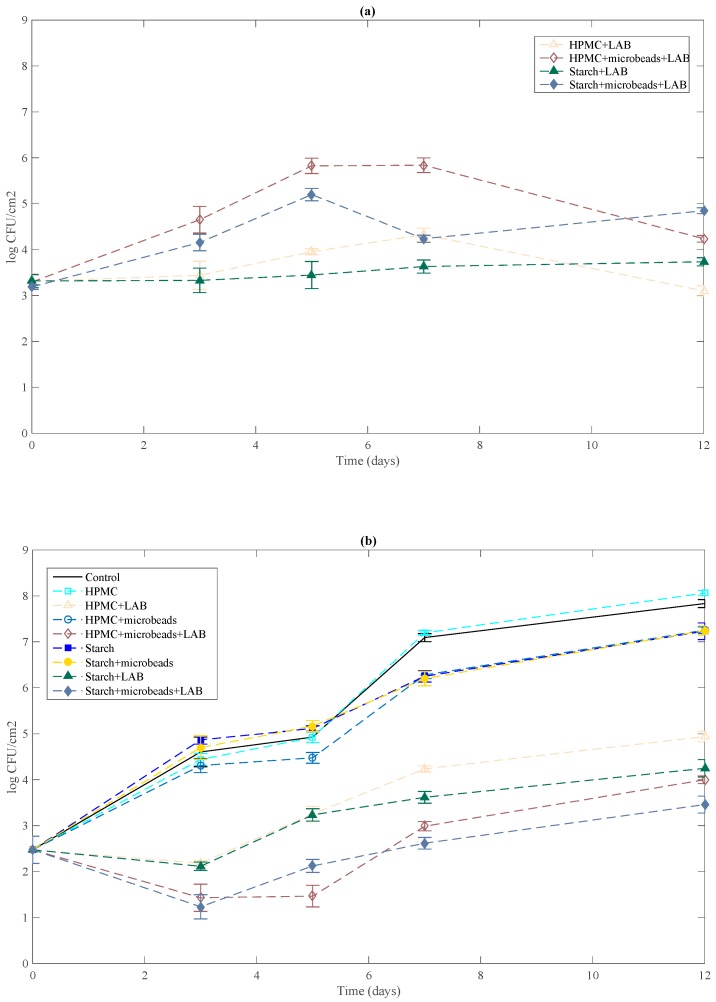
Novel bioactive films were developed from the incorporation of Lactococcus lactis into polysaccharide films. Two different biopolymers were tested: cellulose derivative (hydroxylpropylmethylcellulose (HPMC)) and corn starch. Lactic acid bacteria (LAB) free or previously encapsulated in alginate-pectin composite hydrogel microbeads were added directly to the film forming solution and films were obtained by casting. In order to study the impact of the incorporation of the protective culture into the biopolymer matrix, the water vapour permeability, oxygen permeability, optical and mechanical properties of the dry films were evaluated. Furthermore, the antimicrobial effect of bioactive films against Listeria monocytogenes was studied in synthetic medium. Results showed that the addition of LAB or alginate-pectin microbeads modified slightly films optical properties. In comparison with HPMC films, starch matrix proves to be more sensitive to the addition of bacterial cells or beads. Indeed, mechanical resistance of corn starch films was lower but barrier properties were improved, certainly related to the possible establishment of interactions between alginate-pectin beads and starch. HPMC and starch films containing encapsulated bioactive culture showed a complete inhibition of listerial growth during the first five days of storage at 5 °C and a reduction of 5 logs after 12 days.
Keywords: biopolymer; corn starch; hydrogel microbeads; hydroxypropylmethylcellulose; mechanical properties.
Conflict of interest statement
The authors declare no conflicts of interest.
Figures
References
-
- Alzamora S.M., Tapia M.S., López-Malo A. Minimally Processed Fruits and Vegetables: Fundamental Aspects and Applications. Aspen Publishers, Inc.; Frederick, MD, USA: 2000.
-
- Gialamas H., Zinoviadou K.G., Biliaderis C.G., Koutsoumanis K.P. Development of a novel bioactive packaging based on the incorporation of Lactobacillus sakei into sodium-caseinate films for controlling Listeria monocytogenes in foods. Food Res. Int. 2010;43:2402–2408. doi: 10.1016/j.foodres.2010.09.020. - DOI
-
- Sánchez-González L., Saavedra-Quintero J., Chiralt A. Physical properties and antilisterial activity of bioactive edible films containing Lactobacillus plantarum. Food Hydrocoll. 2013;33:92–98. doi: 10.1016/j.foodhyd.2013.02.011. - DOI
-
- Sánchez-González L., Saavedra-Quintero J., Chiralt A. Antilisterial and physical properties of biopolymer films containing lactic acid bacteria. Food Control. 2014;35:200–206. doi: 10.1016/j.foodcont.2013.07.001. - DOI
-
- Krochta J.M., Mulder-Johnston C. Edible and biodegradable polymer films: Challenges and opportunities. Food Technol. 1997;51:61–74.
MeSH terms
Substances
LinkOut - more resources
Full Text Sources
Other Literature Sources
Medical
Molecular Biology Databases
Miscellaneous
