


doi: 10.1038/nchembio.2572.
The ABCs of PTMs
Affiliations
- PMID: 29443972
- PMCID: PMC5979263
- DOI: 10.1038/nchembio.2572
Item in Clipboard
The ABCs of PTMs
Nat Chem Biol.
.
Abstract
Post-translational modifications (PTMs) are ubiquitous in all forms of life and often modulate critical protein functions. Recent chemical and biological advances have finally enabled scientists to precisely modify proteins at physiologically-relevant positions ushering in a new era of protein studies.
Conflict of interest statement
The authors declare no competing financial interests.
Figures
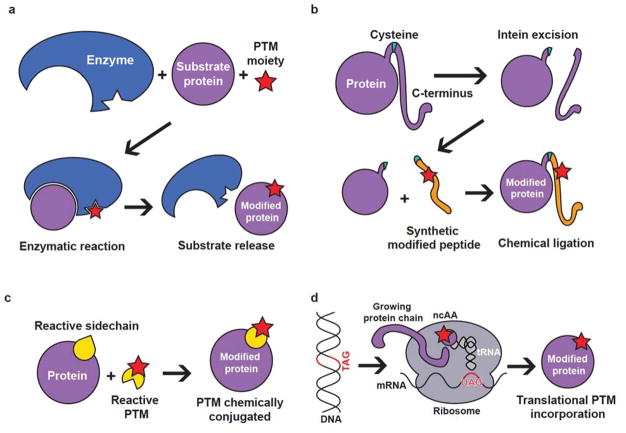
Methods to synthesize recombinant proteins containing PTMs. (a) In vitro reaction using an enzyme capable of catalyzing the transfer of a PTM of interest to a substrate. The enzyme responsible for the PTM must be known and it must be able to be isolated in its active form, which is often difficult to achieve via heterologous expression. (b) Native chemical ligation. This technique allows generation of a protein containing a desired PTM, but normally the modification must occur near a protein terminus. (c) Conjugation using a reactive sidechain. This technique can be used to generate a protein with a nearly-identical modified sidechain by placing a cysteine at a desired position and performing an in vitro reaction. However, proteins with multiple accessible cysteines will be prone to off-target reactions. (d) Genetically encoded ribosomal incorporation using an orthogonal translation system to insert a pre-modified amino acid at position of interest. This system relies on the development of an orthogonal translation system to insert a noncanonical amino acid in response to the UAG codon, which may not be possible for certain large PTMs that cannot be accommodated by the translational machinery.
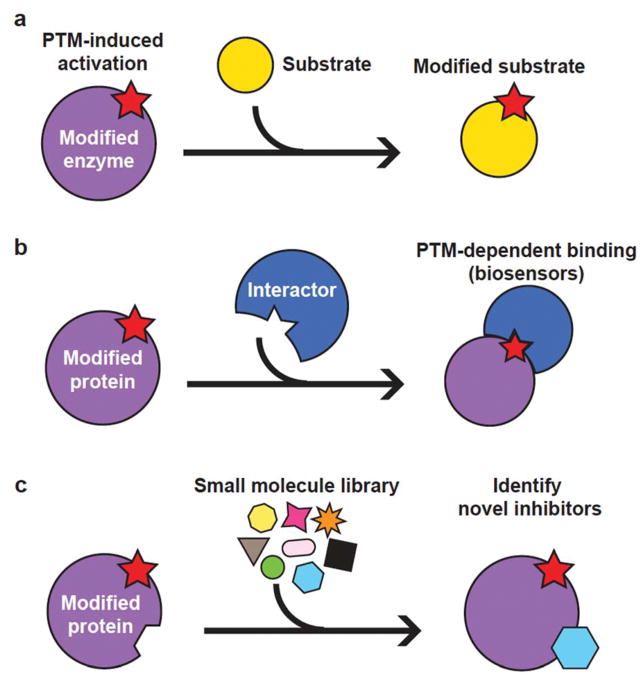
Basic applications of modified recombinant proteins. (a) Assay to assess the effect of a PTM on enzyme activity. Kinetic comparisons of unmodified and various modified forms of the enzyme can be performed to elucidate the effect of PTMs at specific positions. (b) Identification of PTM-dependent interactors, or development of new PTM biosensors. Modified proteins can be used as scaffolds for identifying or evolving new PTM-dependent binding interactions. (c) Drug screens to identify inhibitors of PTM-activated proteins. Modified proteins are important reagents to identify candidate small molecule inhibitors that specifically target only modified forms of a protein of interest. Modified proteins are often implicated in disease and can serve as excellent therapeutic targets.
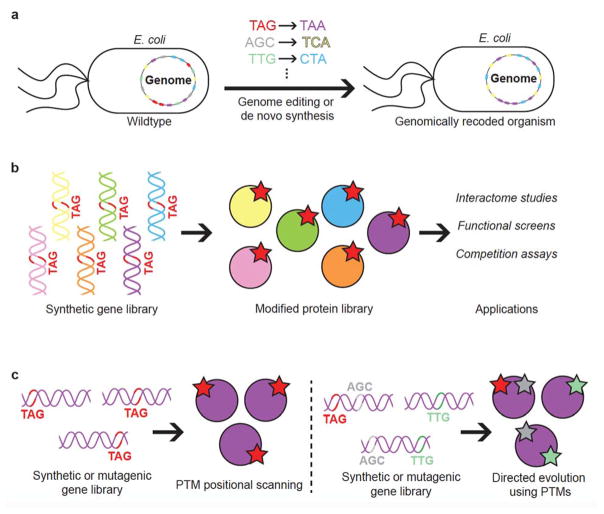
Future of PTM studies. (a) Extensively recoded organisms with more unassigned codons will allow for multi-PTM insertion. By reducing the redundancy of the genetic code and creating more unassigned codons, this creates the opportunity to dramatically rewrite the genetic code such that numerous codons are given entirely new meanings, allowing for the study of the effects of multiple classes of PTMs that exist simultaneously within the same protein molecule. (b) Gene pools to allow synthesis of modified protein libraries to assess behavior within complex populations. PTM-omics studies will be made possible by allowing the incorporation of PTMs in large-scale recombinant human protein collections. High-throughput screens will determine which library members are most functionalized by the PTM of interest. (c) Synthetic gene libraries used to identify PTM sites that affect protein function, or multiple ncAA incorporation in organisms with multiple available codons to perform combinatorial studies. These types of gene libraries will allow us to further explore the relationship between protein structure and function.
References
-
- Hutchison CA, et al. Science. 2016;351
-
- Nielsen AAK, et al. Science. 2016;352
-
- Bodenmiller B, Mueller LN, Mueller M, Domon B, Aebersold R. Nature Methods. 2007;4:231–237. - PubMed
MeSH terms
Substances
Grants and funding
LinkOut - more resources
Full Text Sources
Other Literature Sources
Miscellaneous
