


Short Communication: Dolutegravir-Based Regimens Are Active in Integrase Strand Transfer Inhibitor-Naive Patients with Nucleoside Reverse Transcriptase Inhibitor Resistance
- PMID: 29444582
- PMCID: PMC5899294
- DOI: 10.1089/AID.2017.0184
Short Communication: Dolutegravir-Based Regimens Are Active in Integrase Strand Transfer Inhibitor-Naive Patients with Nucleoside Reverse Transcriptase Inhibitor Resistance
Abstract
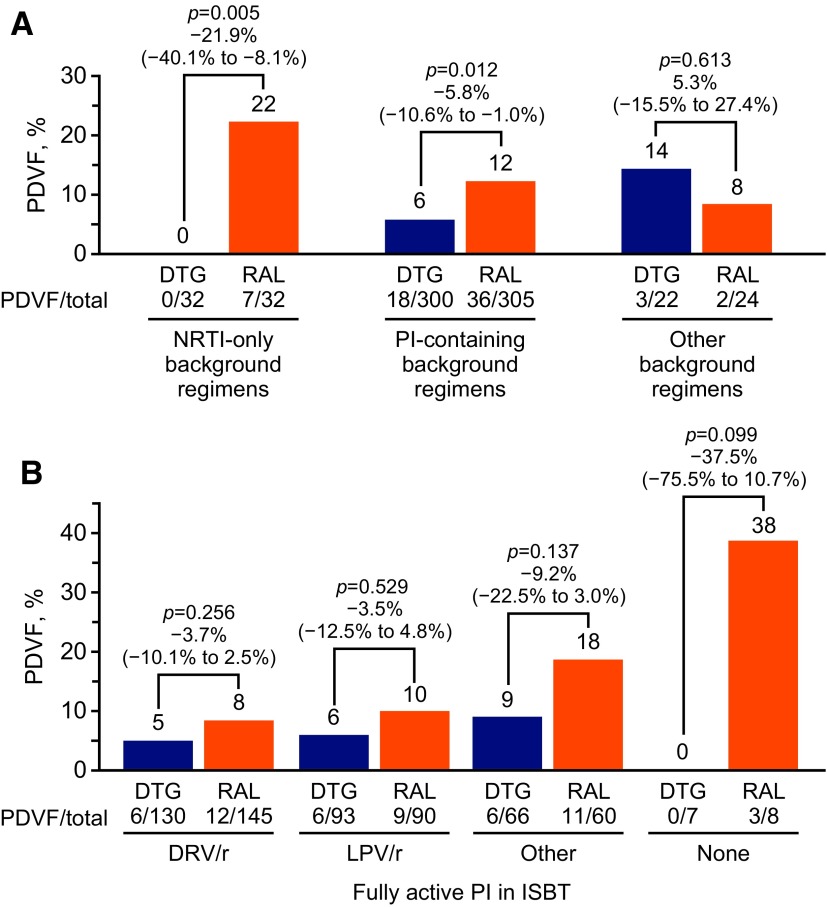
In the SAILING study, dolutegravir demonstrated superior virologic efficacy compared with raltegravir in treatment-experienced, integrase strand transfer inhibitor (INSTI)-naive patients with HIV-1 who harbored resistance to ≥2 antiretroviral drug classes. Significantly fewer dolutegravir-treated patients demonstrated virologic failure with treatment-emergent resistance than raltegravir-treated patients through 48 weeks. Investigator-selected background therapy (ISBT) included at least one fully active agent, selected on the basis of resistance analysis. Genotypic and phenotypic resistance testing were performed on baseline and time-of-failure samples from patients with protocol-defined virologic failure (PDVF). A post hoc analysis of SAILING (N = 715; 354 dolutegravir, 361 raltegravir) assessed efficacy in subpopulations defined by ISBT activity, resistance profiles, and treatment history. When ISBT contained only nucleoside reverse transcriptase inhibitors (NRTIs), PDVF occurred in 0% (0/32) of dolutegravir-treated patients and 21.9% (7/32) of raltegravir-treated patients (p = .005). In patients harboring M184 V whose ISBT contained lamivudine or emtricitabine plus a second NRTI, 0% (0/13) of dolutegravir- and 33.3% (4/12) of raltegravir-treated patients (p = .026) experienced PDVF. Among patients receiving protease inhibitor (PI)-containing ISBT, 6.0% (18/300) of dolutegravir-treated patients versus 11.8% (36/305) of raltegravir-treated patients (p = .012) experienced PDVF. Darunavir/ritonavir was part of ISBT in 130 dolutegravir-treated patients and 145 raltegravir-treated patients; 6 (4.6%) and 12 (8.3%), respectively, experienced PDVF (difference -3.7%; 95% confidence interval: -10.1% to 2.5%; p = .256). There was no or less virologic failure in treatment-experienced, INSTI-naive subjects receiving dolutegravir versus raltegravir, even when the ISBT was suboptimal or NRTI resistance was present at baseline. These findings are not explained by the use of PI/ritonavir-containing ISBT.
Keywords: HIV-1; antiretroviral resistance; combination antiretroviral therapy; dolutegravir; integrase inhibitor; raltegravir.
Figures
Comment in
-
Dolutegravir Monotherapy's Virological Efficacy in a Highly Treatment-Experienced Patient.AIDS Res Hum Retroviruses. 2019 Apr;35(4):359-360. doi: 10.1089/AID.2018.0117. Epub 2019 Jan 22. AIDS Res Hum Retroviruses. 2019. PMID: 30525872 No abstract available.
References
-
- Blanco JL, Whitlock G, Milinkovic A, et al. : HIV integrase inhibitors: A new era in the treatment of HIV. Expert Opin Pharmacother 2015;16:1313–1324 - PubMed
-
- Panel on Antiretroviral Guidelines for Adults and Adolescents: Guidelines for the Use of Antiretroviral Agents in HIV-1-Infected Adults and Adolescents. Department of Health and Human Services; Available at www.aidsinfo.nih.gov/ContentFiles/AdultandAdolescentGL.pdf, accessed June19, 2017
-
- Cahn P, Pozniak AL, Mingrone H, et al. : Extended SAILING Study Team: Dolutegravir versus raltegravir in antiretroviral-experienced, integrase-inhibitor-naive adults with HIV: Week 48 results from the randomised, double-blind, non-inferiority SAILING study. Lancet 2013;382:700–708 - PubMed
-
- Chan IS, Zhang Z: Test-based exact confidence intervals for the difference of two binomial proportions. Biometrics 1999;55:1202–1209 - PubMed
-
- Walmsley SL, Antela A, Clumeck N, et al. : SINGLE Investigators: Dolutegravir plus abacavir-lamivudine for the treatment of HIV-1 infection. N Engl J Med 2013;369:1807–1818 - PubMed
Publication types
MeSH terms
Substances
LinkOut - more resources
Full Text Sources
Other Literature Sources
Medical
Research Materials
Miscellaneous
