


Evaluation of hospital outcomes: the relation between length-of-stay, readmission, and mortality in a large international administrative database
- PMID: 29444713
- PMCID: PMC5813333
- DOI: 10.1186/s12913-018-2916-1
Evaluation of hospital outcomes: the relation between length-of-stay, readmission, and mortality in a large international administrative database
Abstract
Background: Hospital mortality, readmission and length of stay (LOS) are commonly used measures for quality of care. We aimed to disentangle the correlations between these interrelated measures and propose a new way of combining them to evaluate the quality of hospital care.
Methods: We analyzed administrative data from the Global Comparators Project from 26 hospitals on patients discharged between 2007 and 2012. We correlated standardized and risk-adjusted hospital outcomes on mortality, readmission and long LOS. We constructed a composite measure with 5 levels, based on literature review and expert advice, from survival without readmission and normal LOS (best) to mortality (worst outcome). This composite measure was analyzed using ordinal regression, to obtain a standardized outcome measure to compare hospitals.
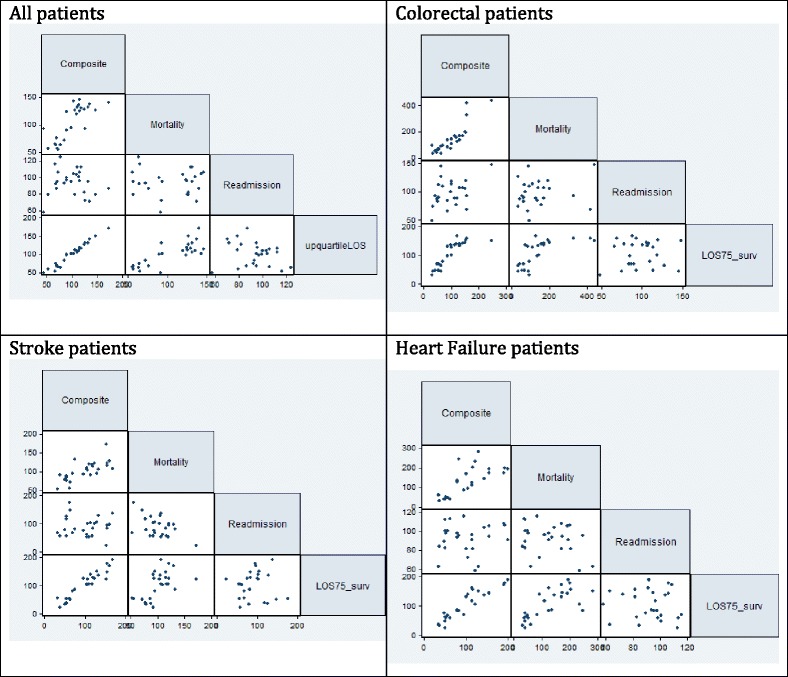
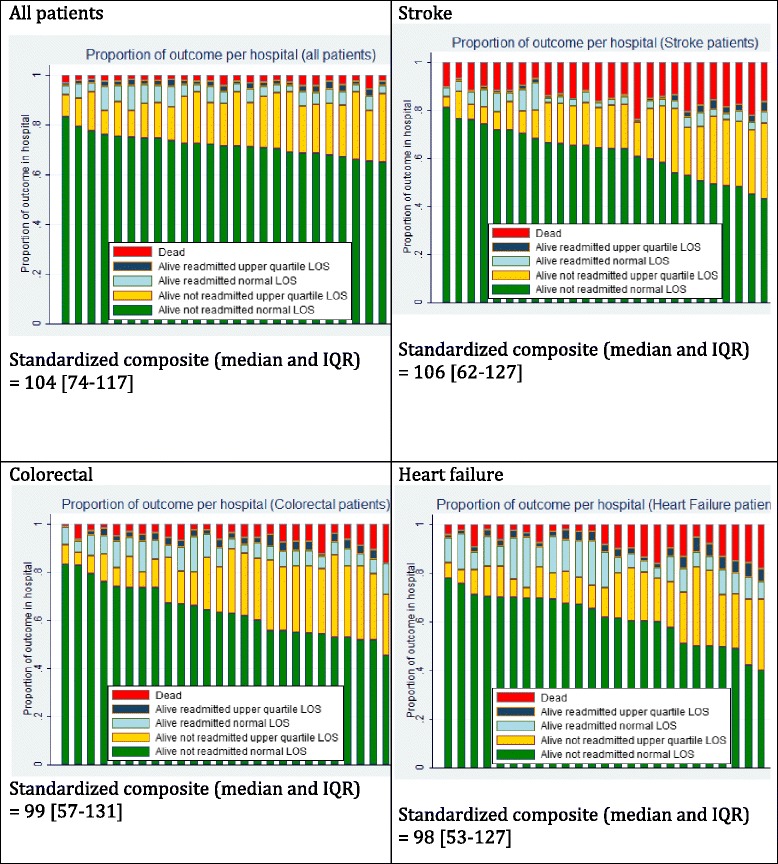
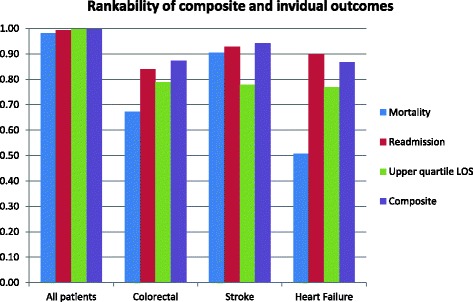
Results: Overall, we observed a 3.1% mortality rate, 7.8% readmission rate (in survivors) and 20.8% long LOS rate among 4,327,105 admissions. Mortality and LOS were correlated at the patient and the hospital level. A patient in the upper quartile LOS had higher odds of mortality (odds ratio = 1.45, 95% confidence interval 1.43-1.47) than those in the lowest quartile. Hospitals with a high standardized mortality had higher proportions of long LOS (r = 0.79, p < 0.01). Readmission rates did not correlate with either mortality or long LOS rates. The interquartile range of the standardized ordinal composite outcome was 74-117. The composite outcome had similar or better reliability in ranking hospitals than individual outcomes.
Conclusions: Correlations between different outcome measures are complex and differ between hospital- and patient-level. The proposed composite measure combines three outcomes in an ordinal fashion for a more comprehensive and reliable view of hospital performance than its component indicators.
Keywords: Administrative data; Benchmarking; Composite outcomes; Ordinal models; Outcomes; Quality of care.
Conflict of interest statement
Ethics approval and consent to participate
Permission of Dr. Foster Global Comparators was needed to access and use the data from the Global Comparators Project. Ethical approval is obtained within the Global Comparators Project.
Consent for publication
Not applicable.
Competing interests
The authors declare that they have no competing interest.
Publisher’s Note
Springer Nature remains neutral with regard to jurisdictional claims in published maps and institutional affiliations.
Figures
References
MeSH terms
LinkOut - more resources
Full Text Sources
Other Literature Sources
