Persistent inequalities in Hospice at Home provision
- PMID: 29444775
- PMCID: PMC7456670
- DOI: 10.1136/bmjspcare-2017-001367
Persistent inequalities in Hospice at Home provision
Abstract
Objective: To describe the nature and scope of a new Hospice at Home (H@H) service and to identify its equality of provision.
Methods: Case note review of patients supported by a H@H service for 1 year from September 2012 to August 2013 (n=321). Descriptive analysis to report frequencies and proportions of quantitative data extracted from service logs, referral forms and care records; thematic analysis of qualitative data from care record free text.
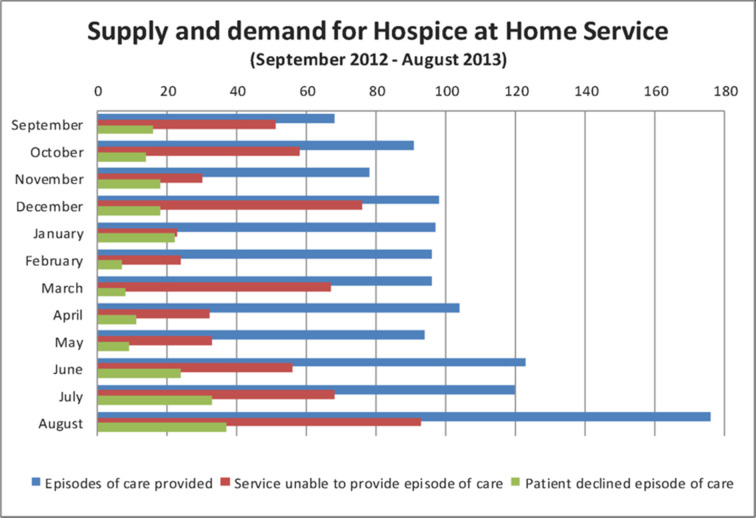
Results: Demand outstripped supply. Twice as many night care episodes were requested (n=1237) as were provided (n=613). Inequalities in access to the service related to underlying diagnosis and socioeconomic status. 75% of patients using the service had cancer (221/293 with documented diagnosis). Of those who died at home in the areas surrounding the hospice, 53% (163/311) of people with cancer and 11% (49/431) of those without cancer received H@H support. People who received H@H care were often more affluent than the population average for the area within which they lived. Roles of the service identified included: care planning/implementation, specialist end-of-life care assessment and advice, 'holding' complex patients until hospice beds become available and clinical nursing care.
Conclusion: There is significant unmet need and potentially large latent demand for the H@H service. People without cancer or of lower socioeconomic status are less likely to access the service. Action is needed to ensure greater and more equitable service provision in this and similar services nationally and internationally.
Keywords: health inequalities; home care services; hospice and palliative care nursing; palliative care; primary health care.
© Article author(s) (or their employer(s) unless otherwise stated in the text of the article) 2020. All rights reserved. No commercial use is permitted unless otherwise expressly granted.
Conflict of interest statement
Competing interests: This study was undertaken by the Palliative and End of Life Care Research Group of the University of Cambridge. It was part-funded by the Arthur Rank House Hospice Charity who part-fund the H@H service. LW, Mot and LMor are employed by the Arthur Rank Hospice Charity.
Figures
References
-
- Department of Health. End of life care strategy. 2008. https://www.gov.uk/government/publications/end-of-life-care-strategy-pro...
-
- Murtagh FEM BC, Petkova H, Sleeman KE, et al. Understanding place of death for patients with non malignant conditions: a systematic review. London: National Institute for Health Research, Queens Publisher, 2012.
MeSH terms
LinkOut - more resources
Full Text Sources
Other Literature Sources
Medical