. 2018 Feb 27;115(9):E2020-E2029.
doi: 10.1073/pnas.1719797115. Epub 2018 Feb 14.

Evolutionary stability of antibiotic protection in a defensive symbiosis

Affiliations

Evolutionary stability of antibiotic protection in a defensive symbiosis

Tobias Engl et al. Proc Natl Acad Sci U S A. .

Abstract

The increasing resistance of human pathogens severely limits the efficacy of antibiotics in medicine, yet many animals, including solitary beewolf wasps, successfully engage in defensive alliances with antibiotic-producing bacteria for millions of years. Here, we report on the in situ production of 49 derivatives belonging to three antibiotic compound classes (45 piericidin derivatives, 3 streptochlorin derivatives, and nigericin) by the symbionts of 25 beewolf host species and subspecies, spanning 68 million years of evolution. Despite a high degree of qualitative stability in the antibiotic mixture, we found consistent quantitative differences between species and across geographic localities, presumably reflecting adaptations to combat local pathogen communities. Antimicrobial bioassays with the three main components and in silico predictions based on the structure and specificity in polyketide synthase domains of the piericidin biosynthesis gene cluster yield insights into the mechanistic basis and ecoevolutionary implications of producing a complex mixture of antimicrobial compounds in a natural setting.

Keywords: Philanthus; Streptomyces philanthi; antibiotic resistance; defensive symbiosis; protective mutualism.


Conflict of interest statement

The authors declare no conflict of interest.

Figures
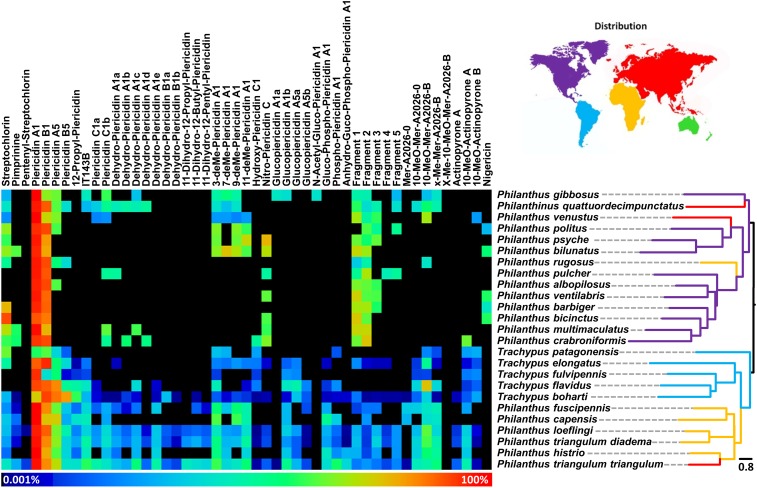
Fig. 1.
Fig. 1.
Composition of the symbiont-produced antimicrobial mixture in antennal extracts of 25 different beewolf species and subspecies. Colors indicate relative abundance of individual compounds in the antibiotic cocktail (columns). Host species (rows) are sorted based on the dendrogram displaying the chemical distances (Right). Branches in the dendrogram are colored according to the geographic origin of the host species (purple, North America; blue, South America; yellow, Africa; red, Eurasia).
Fig. 2.
Fig. 2.
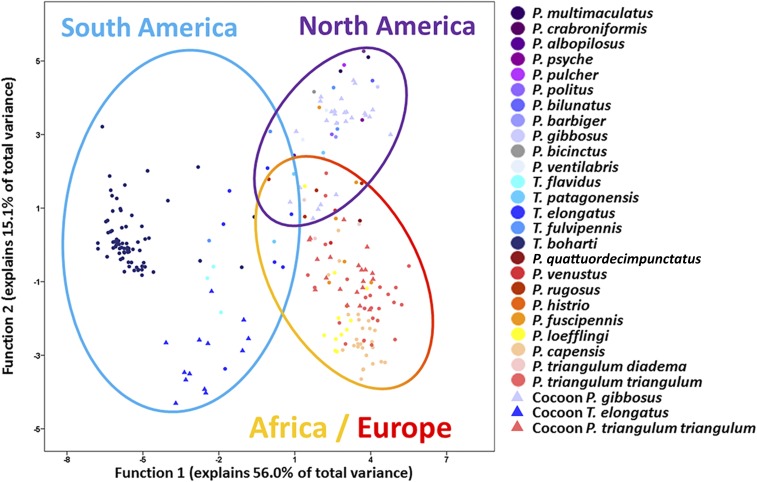
Discriminant analysis of the antibiotic mixtures produced by the symbionts of 25 different beewolf species and subspecies. The analysis is based on the 10 principal components extracted from the chemical composition of antennal (circles) and cocoon (triangles) extracts (n = 242 extracts, Wilk’s Λ = 7.6 × 10⁻⁵, df = 270, P < 0.001).
Fig. 3.
Fig. 3.
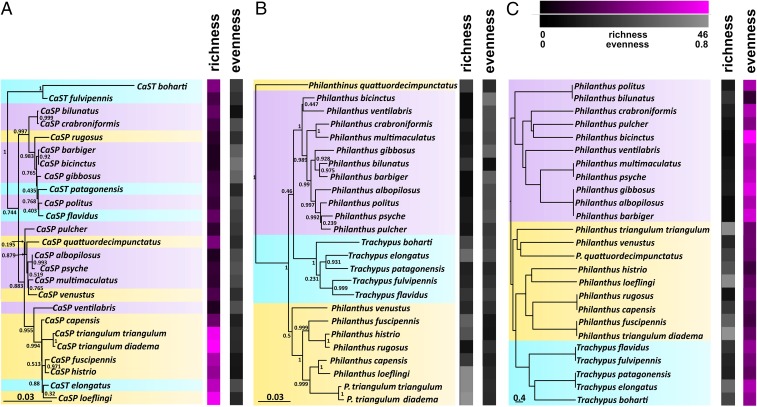
Phylogenetic and geographic influence on richness (number of compounds) and evenness (Shannon’s E) of the beewolf symbiont-produced antibiotic mixture. (A) Symbiont phylogeny, (B) host phylogeny, and (C) dendrogram based on a logarithmic distance matrix of sampling locations, all in comparison with heat maps displaying compound richness and evenness. Species are color-coded by sampling location (purple, North America; blue, South America; orange, Europe/Africa). Richness and evenness heat maps are presented in color if a significant phylogenetic (Blomberg’s K) or geographic (PGLS) influence was detected; otherwise, they are presented in gray. Branch numbers in the phylogenies are Bayesian posterior probability values.
Fig. 4.
Fig. 4.
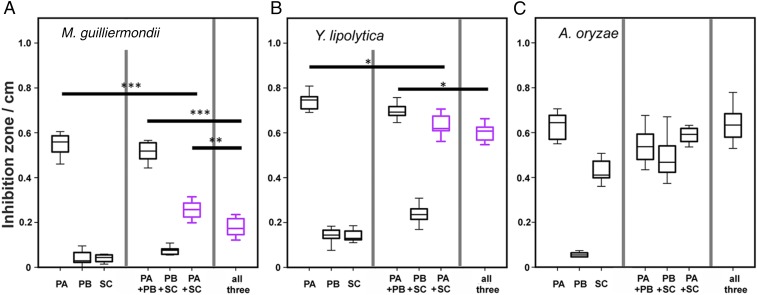
Bioactivity of different combinations of piericidin A1 (PA) and B1 (PB) and streptochlorin (SC) in agar diffusion assays against (A) M. guilliermondii, (B) Y. lipolytica, and (C) A. oryzae. Antagonistic effects (i.e., significantly lower inhibition zones of mixtures than one of the single substances) are highlighted by magenta boxes (according to ANOVA and Tukey HSD post hoc tests; *P < 0.05, **P < 0.01, ***P < 0.001).

References

    1. Davies J, Davies D. Origins and evolution of antibiotic resistance. Microbiol Mol Biol Rev. 2010;74:417–433. - PMC - PubMed
    1. Payne DJ. Microbiology. Desperately seeking new antibiotics. Science. 2008;321:1644–1645. - PubMed
    1. Taubes G. The bacteria fight back. Science. 2008;321:356–361. - PubMed
    1. Laxminarayan R, et al. Antibiotic resistance-the need for global solutions. Lancet Infect Dis. 2013;13:1057–1098. - PubMed
    1. World Health Organization . Antimicrobial Resistance: Global Report on Surveillance. WHO; Geneva: 2014.

Publication types