. 2018 Feb 14;8(1):3051.
doi: 10.1038/s41598-018-20190-x.

Hydroxynitrile lyases from cyanogenic millipedes: molecular cloning, heterologous expression, and whole-cell biocatalysis for the production of (R)-mandelonitrile

Affiliations

Hydroxynitrile lyases from cyanogenic millipedes: molecular cloning, heterologous expression, and whole-cell biocatalysis for the production of (R)-mandelonitrile

Takuya Yamaguchi et al. Sci Rep. .

Abstract

Hydroxynitrile lyases (HNLs), which are key enzymes in cyanogenesis, catalyze the cleavage of cyanohydrins into carbonyl compounds and hydrogen cyanide. Since HNLs also catalyze the reverse reaction, they are used industrially for the asymmetric synthesis of cyanohydrins, which are valuable building blocks of pharmaceuticals and fine chemicals. HNLs have been isolated from cyanogenic plants and bacteria. Recently, an HNL from the cyanogenic millipede Chamberlinius hualienensis was shown to have the highest specific activity for (R)-mandelonitrile synthesis, along with high stability and enantioselectivity. However, no HNLs have been isolated from other cyanogenic millipedes. We identified and characterized HNLs from 10 cyanogenic millipedes in the Paradoxosomatidae and Xystodesmidae. Sequence analyses showed that HNLs are conserved among cyanogenic millipedes and likely evolved from one ancestral gene. The HNL from Parafontaria tonominea was expressed in Escherichia coli SHuffle T7 and showed high specific activity for (R)-mandelonitrile synthesis and stability at a range of pHs and temperatures. The stability of millipede HNLs is likely due to disulfide bond(s). The E. coli cells expressing HNL produced (R)-mandelonitrile with 97.6% enantiomeric excess without organic solvents. These results demonstrate that cyanogenic millipedes are a valuable source of HNLs with high specific activity and stability.


Conflict of interest statement

The authors declare no competing interests.

Figures
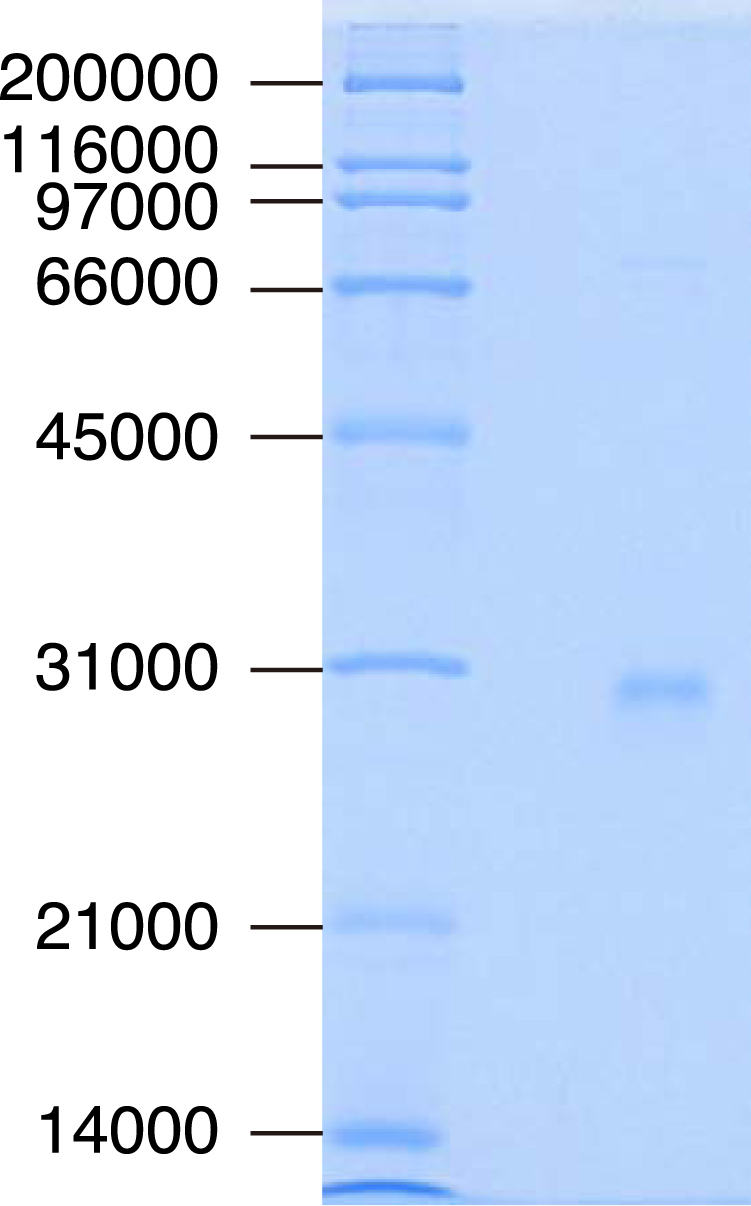
Figure 1
Figure 1
SDS-PAGE analysis of HNL purified from N. tambanus tambanus. HNL purified from N. tambanus tambanus was separated by 12% SDS-PAGE with Broad Range (Bio-Rad Laboratories) molecular weight markers. The full-length gel is presented in Fig. S4.
Figure 2
Figure 2
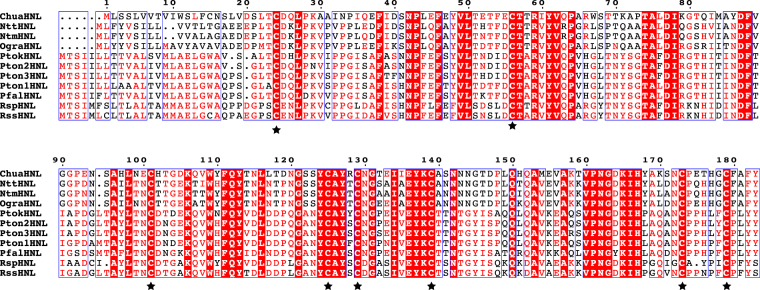
Amino acid sequence alignment of HNLs from millipedes. Multiple sequence alignment was visualized by ESPript 3 (http://espript.ibcp.fr/ESPript/ESPript/). Red background shows strictly conserved residues; red letters indicate residues well conserved within a group according to a Raisler matrix; and remainder are shown in black. Residues conserved between groups are boxed. Stars indicate Cys residues conserved among millipede HNLs.
Figure 3
Figure 3
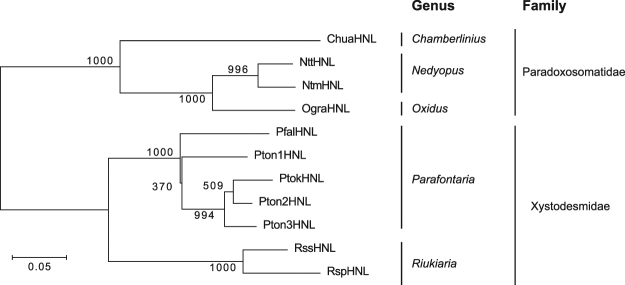
Phylogenetic analysis of HNLs from cyanogenic millipedes. Phylogenetic tree was constructed by the neighbor-joining method with 1000 bootstrap replicates. Bar indicates 5% divergence.
Figure 4
Figure 4
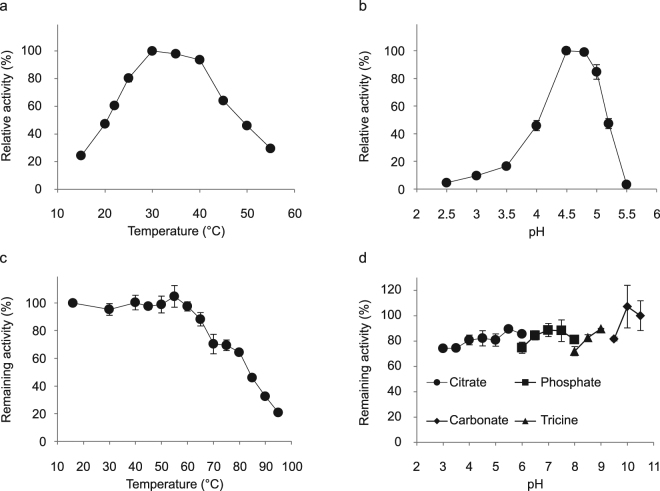
Effect of temperature and pH on recombinant Pton3HNL. (a) Optimum temperature. Reaction was performed at 15–55 °C for 5 min in 300 mM sodium citrate buffer, pH 4.2. (b) Optimum pH. Reaction was performed at 22 °C for 5 min in 300 mM sodium citrate buffer (pH 2.5–5.5). (c) Temperature stability. Remaining activity was measured after incubation of Pton3HNL at various temperatures (15–95 °C) in 10 mM potassium phosphate buffer, pH 7.0, for 60 min. (d) pH stability. Remaining activity was measured after incubation of Pton3HNL at 25 °C for 60 min with the following buffers: 100 mM sodium citrate buffer (pH 3.0–6.0); 100 mM potassium phosphate buffer (pH 6.0–8.0), 100 mM Tricine-NaOH buffer (pH 8.0–9.0), and 100 mM sodium carbonate buffer (pH 9.5–10.5). Values are mean ± SD; n = 3.
Figure 5
Figure 5
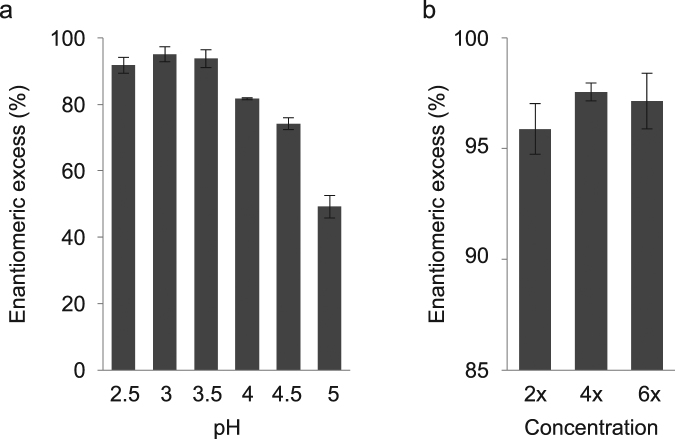
Synthesis of (R)-mandelonitrile using E. coli cells expressing Pton3HNL in aqueous solution. (a) Relationship between pH and enantiomeric excess (ee). E. coli cells harvested from 0.4 mL culture were reacted in 0.2 mL 300 mM sodium citrate buffer (pH 2.5–5.0) containing 50 mM benzaldehyde and 100 mM KCN at 22 °C for 5 min. (b) Relationship between cell amounts and ee. E. coli cells harvested from 0.4 (2×), 0.8 (4×), or 1.2 mL (6×) were reacted in 0.2 mL 0.3 M sodium citrate buffer, pH 3.0, containing 50 mM benzaldehyde and 100 mM KCN at 22 °C for 5 min.

References

    1. Zagrobelny M, Bak S, Møller BL. Cyanogenesis in plants and arthropods. Phytochemistry. 2008;69:1457–1468. doi: 10.1016/j.phytochem.2008.02.019. - DOI - PubMed
    1. Dadashipour M, Asano Y. Hydroxynitrile lyases: insights into biochemistry, discovery, and engineering. ACS Catal. 2011;1:1121–1149. doi: 10.1021/cs200325q. - DOI
    1. Purkarthofer T, Skranc W, Schuster C, Griengl H. Potential and capabilities of hydroxynitrile lyases as biocatalysts in the chemical industry. Appl. Microbiol. Biotechnol. 2007;76:309–320. doi: 10.1007/s00253-007-1025-6. - DOI - PubMed
    1. Gleadow RM, Møller BL. Cyanogenic glycosides: synthesis, physiology, and phenotypic plasticity. Annu. Rev. Plant Biol. 2014;65:155–185. doi: 10.1146/annurev-arplant-050213-040027. - DOI - PubMed
    1. Asano Y, et al. Screening for new hydroxynitrilases from plants. Biosci., Biotechnol., Biochem. 2005;69:2349–2357. doi: 10.1271/bbb.69.2349. - DOI - PubMed

Publication types

LinkOut - more resources