


Validating a breast cancer score in Spanish women. The MCC-Spain study
- PMID: 29445177
- PMCID: PMC5813036
- DOI: 10.1038/s41598-018-20832-0
Validating a breast cancer score in Spanish women. The MCC-Spain study
Erratum in
-
Author Correction: Validating a breast cancer score in Spanish women. The MCC-Spain study.Sci Rep. 2020 Apr 1;10(1):5980. doi: 10.1038/s41598-020-62511-z. Sci Rep. 2020. PMID: 32238823 Free PMC article.
Abstract
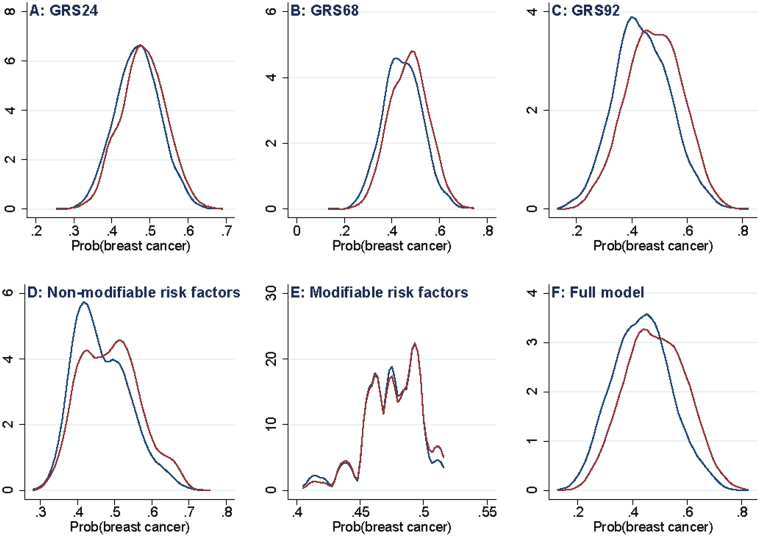
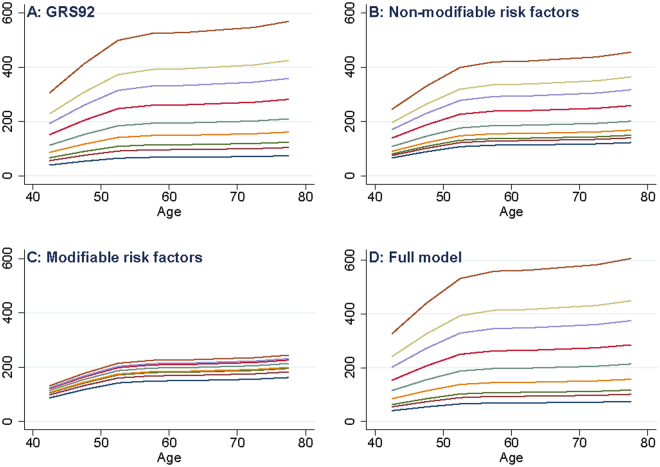
A breast-risk score, published in 2016, was developed in white-American women using 92 genetic variants (GRS92), modifiable and non-modifiable risk factors. With the aim of validating the score in the Spanish population, 1,732 breast cancer cases and 1,910 controls were studied. The GRS92, modifiable and non-modifiable risk factor scores were estimated via logistic regression. SNPs without available genotyping were simulated as in the aforementioned 2016 study. The full model score was obtained by combining GRS92, modifiable and non-modifiable risk factor scores. Score performances were tested via the area under the ROC curve (AUROC), net reclassification index (NRI) and integrated discrimination improvement (IDI). Compared with non-modifiable and modifiable factor scores, GRS92 had higher discrimination power (AUROC: 0.6195, 0.5885 and 0.5214, respectively). Adding the non-modifiable factor score to GRS92 improved patient classification by 23.6% (NRI = 0.236), while the modifiable factor score only improved it by 7.2%. The full model AUROC reached 0.6244. A simulation study showed the ability of the full model for identifying women at high risk for breast cancer. In conclusion, a model combining genetic and risk factors can be used for stratifying women by their breast cancer risk, which can be applied to individualizing genetic counseling and screening recommendations.
Conflict of interest statement
The authors declare no competing interests.
Figures
References
-
- Hankinson S., Tamimi R., Hunter D. Breast Cancer in Textbook of CancerEpidemiology (eds Adami HO., Hunter D., Trichopoulos D.) 403–445 (Oxford University Press, 2008).
