. 2018 Feb 14;8(1):3041.
doi: 10.1038/s41598-018-20707-4.

Daily circadian misalignment impairs human cognitive performance task-dependently

Affiliations

Daily circadian misalignment impairs human cognitive performance task-dependently

Sarah L Chellappa et al. Sci Rep. .

Abstract

Shift work increases the risk for human errors, such that drowsiness due to shift work has contributed to major industrial disasters, including Space Shuttle Challenger, Chernobyl and Alaska Oil Spill disasters, with extraordinary socio-economical costs. Overnight operations pose a challenge because our circadian biology inhibits cognitive performance at night. Yet how the circadian system modulates cognition over multiple days under realistic shift work conditions remains to be established. Importantly, because task-specific cognitive brain regions show different 24-h circadian dynamics, we hypothesize that circadian misalignment impacts cognition task-dependently. Using a biologically-driven paradigm mimicking night shift work, with a randomized, cross-over design, we show that misalignment between the circadian pacemaker and behavioral/environmental cycles increases cognitive vulnerability on sustained attention, cognitive throughput, information processing and visual-motor performance over multiple days, compared to circadian alignment (day shifts). Circadian misalignment effects are task-dependent: while they acutely impair sustained attention with recovery after 3-days, they progressively hinder daily learning. Individuals felt sleepier during circadian misalignment, but they did not rate their performance as worse. Furthermore, circadian misalignment effects on sustained attention depended on prior sleep history. Collectively, daily circadian misalignment may provide an important biological framework for developing countermeasures against adverse cognitive effects in shift workers.


Conflict of interest statement

FAJLS received speaker fees from Bayer Healthcare, Sentara Healthcare, Philips, Kellogg Company, and Vanda Pharmaceuticals. The other authors declare that they have no competing interests. C.J.M. reports receiving salary from Grünenthal Ltd, UK. This relationship is not related to the present article.

Figures
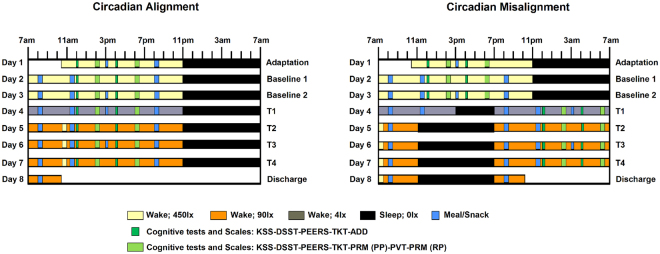
Figure 1
Figure 1
Within-subject, randomized, cross-over study design. Circadian alignment (A) and misalignment (B) protocols. For the former, scheduled sleep times were kept from 11PM to 7AM across all days, while for the latter these timings were inverted by 12 h after Baseline 2 (Day 3). T1-T4 corresponds to test days 1–4. During baseline days for both aligned and misaligned conditions, the Psychomotor Vigilance Task (PVT) and Probed Recall Memory (PRM) with Presentation phase (PP) and Recall phase (RP) were conducted at 2PM and 6PM, the Addition Task (ADD) at 12PM and 4PM, and the Unstable Tracking Task (TKT), Digit Symbol Substitution Task (DSST), Performance evaluation and effort scales (PEERS) and Karolinska Sleepiness Scale (KSS) at 12PM, 2PM, 4PM and 6PM. These timings were kept the same for the aligned protocol across all test days, while in the misaligned protocol they were inverted by 12 h for T1-T4.
Figure 2
Figure 2
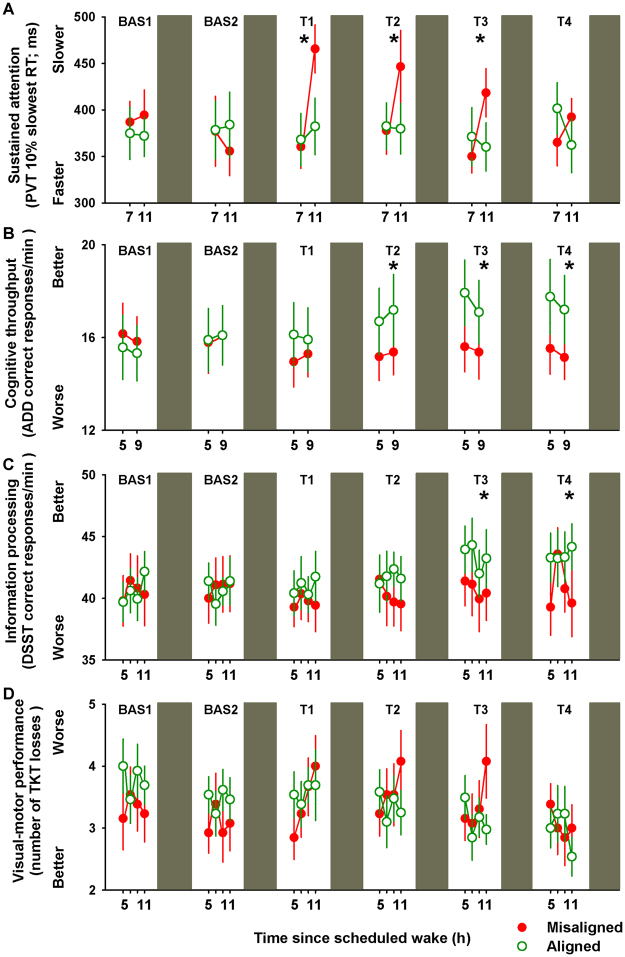
Daily dynamics of cognitive performance under circadian alignment/misalignment. (A) Sustained attention (PVT 10% slowest reaction times) worsened following acute circadian misalignment (T1), which lasted up to two days subsequent to it (T2 and T3). See also Figure S1. (B) Cognitive throughput (ADD number of correct responses/min) performance improved only under circadian alignment for test days 2–4 (T2-T4). (C) Information processing (number of correct DSST responses/min) performance improved only under circadian alignment during test days 3–4 (T3-T4). (D) Visual-motor performance (number of TKT losses) did not significantly differ between circadian alignment/misalignment. Green (open symbols) and red (closed symbols) lines correspond to, respectively, circadian alignment and misalignment conditions. Data correspond to mean ± standard error of the mean (n = 13), *p < 0.05 (see results for statistics).
Figure 3
Figure 3
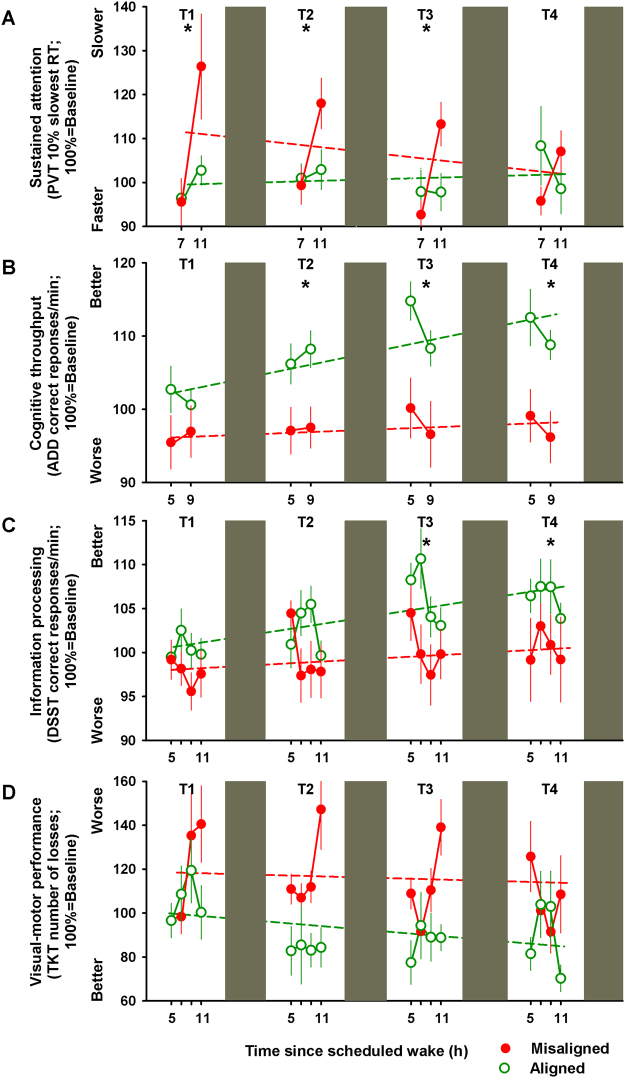
Individual baseline-adjusted cognitive performance across days of circadian alignment/misalignment. (A) Baseline-adjusted sustained attention (PVT 10% slowest reaction times) did not change under circadian alignment, while it was slower on the first day of misalignment with subsequent improvement across days. (B) Baseline-adjusted cognitive throughput (ADD) performance improved throughout days under circadian alignment, while no daily improvement was observed under misalignment. (C) Baseline-adjusted information processing (DSST) performance improved throughout days under circadian alignment, but not under misalignment. (D) Baseline-adjusted visual-motor performance (TKT) improved over days under alignment, but not misalignment. Green (open symbols) and red (closed symbols) lines correspond to, respectively, circadian alignment and misalignment conditions. Data correspond to mean ± standard error of the mean (n = 13) (see results for statistics).
Figure 4
Figure 4
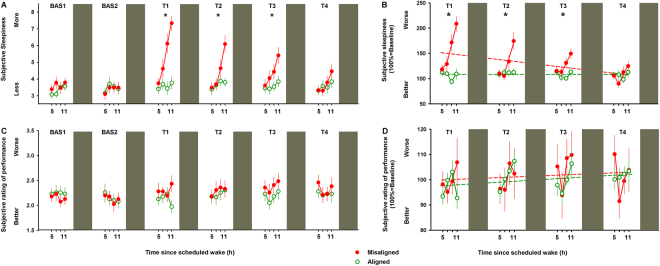
Daily dynamics of subjective ratings of sleepiness and performance under circadian alignment/misalignment. (A) Subjective sleepiness (KSS) indicated higher levels of sleepiness during acute circadian misalignment (T1), which lasted up to two subsequent days (T2-T3). (B) Baseline-adjusted subjective sleepiness significantly worsened by more than 2-fold on the first day of circadian misalignment with improvement across days, while it did not change under alignment. (C) Subjective ratings of performance (PEERS) did not differ between circadian alignment/misalignment. (D) Baseline-adjusted subjective ratings of performance did not change under circadian alignment/misalignment. Green (open symbols) and red (closed symbols) lines correspond to, respectively, circadian alignment and misalignment conditions. Data correspond to mean ± standard error of the mean (n = 13) *p < 0.05 (see results for statistics).
Figure 5
Figure 5
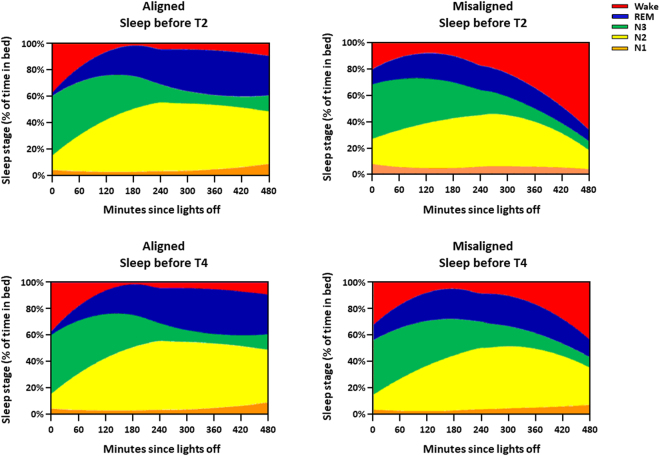
Circadian alignment/misalignment impacts the temporal dynamics of sleep structure. Graphical representation of the local regression analyses that included the interaction of “circadian alignment/misalignment condition”, “time after lights off” and “night”. Stacked areas represent the model-predicted cumulative proportion of each sleep stage (N1-N3, REM and Wake) occurring at each time of the sleep episode under a normally entrained circadian condition (left panels) and under circadian misalignment (right panels) after 1- and 3-days (T2 and T4, respectively) under these circadian conditions. Acute circadian misalignment significantly increased the time-course for the occurrence of wake as compared to circadian alignment (upper panel). After 3-days of misalignment, wake episodes during the last 2-h of scheduled sleep remained higher as compared to when the same individuals were under circadian alignment (bottom panel). Data correspond to mean over all participants (n = 13).

References

    1. United States Department of Labor. Workers on flexible and shift schedules in May 2004 (2005).
    1. McMenamin TM. A time to work: recent trends in shift work and flexible schedules. Mon Labor Rev. 2007;1:3–15.
    1. Drake CL, Roehrs T, Richardson G, Walsh JK, Roth T. Shift work sleep disorder: prevalence and consequences beyond that of symptomatic day workers. SLEEP. 2004;27:1453–1462. doi: 10.1093/sleep/27.8.1453. - DOI - PubMed
    1. Medicine. AAoS. The international classification of sleep disorders: diagnostic & coding manual. 2nd ed. Westchester, IL (ed. American Academy of Sleep Medicine) (2005).
    1. Vetter C, et al. Association Between Rotating Night Shift Work and Risk of Coronary Heart Disease Among Women. JAMA. 2016;315:1726–1734. doi: 10.1001/jama.2016.4454. - DOI - PMC - PubMed

Publication types