. 2018 Feb 14;8(1):3003.
doi: 10.1038/s41598-018-21376-z.

Development and application of a rapid Mycobacterium tuberculosis detection technique using polymerase spiral reaction

Affiliations

Development and application of a rapid Mycobacterium tuberculosis detection technique using polymerase spiral reaction

Wei Liu et al. Sci Rep. .

Abstract

Mycobacterium tuberculosis is an age-old bacterium that is difficult to eliminate. A simple and rapid diagnostic method is of great importance to prevent the spread of M. tuberculosis. Here, we developed a low-cost rapid M. tuberculosis nucleic acid detection technique, named GenePop, which enabled the storage and transport of M. tuberculosis diagnostic reagent at ambient temperatures, without the need for professional operations or expensive instrumentation. Using a vitrification method, we vitrified heat-unstable components onto the cap of a reaction tube, and placed heat-stable components at the bottom of the reaction tube by sealing them with paraffin wax. The all-in-one detection tube, when used together with our other invention-a multi-functional sample treatment tube pre-filled with a nucleic acid-releasing agent-only required three simple steps to yield results. A comparative analysis with a commercial qPCR kit for M. tuberculosis indicated that our new technique had a concordance rate of 91.6%, showing no cross-reactivity with 11 other bacteria. The complete operation time was only 65 min. It is suitable for use in field settings or by personnel in grass-root units, and is applicable in household activities, hence can be used in developing countries.


Conflict of interest statement

The authors declare no competing interests.

Figures
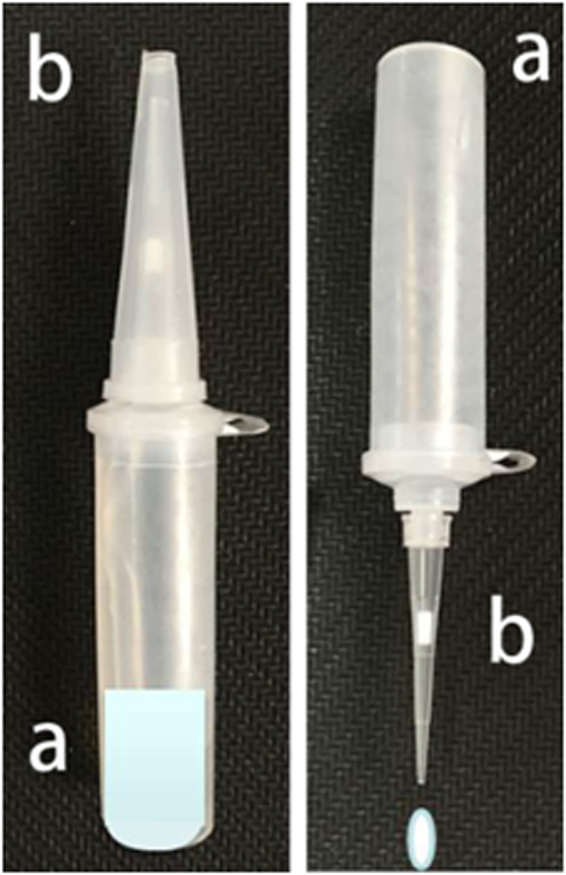
Figure 1
Figure 1
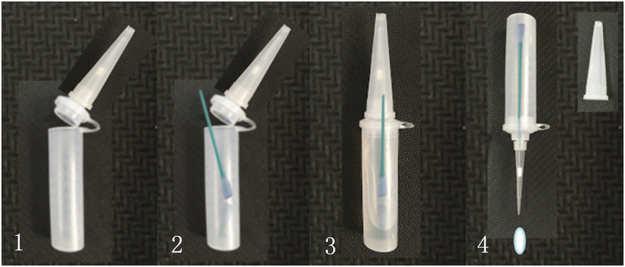
A multi-functional sample treatment device.
Figure 2
Figure 2
The operational procedure of a multi-functional sample treatment tube. 1. Open the hinged cover. 2. Place a cotton swab. 3. Heat the tube for lysis. 4. Remove the tip cover to squeeze out samples.
Figure 3
Figure 3
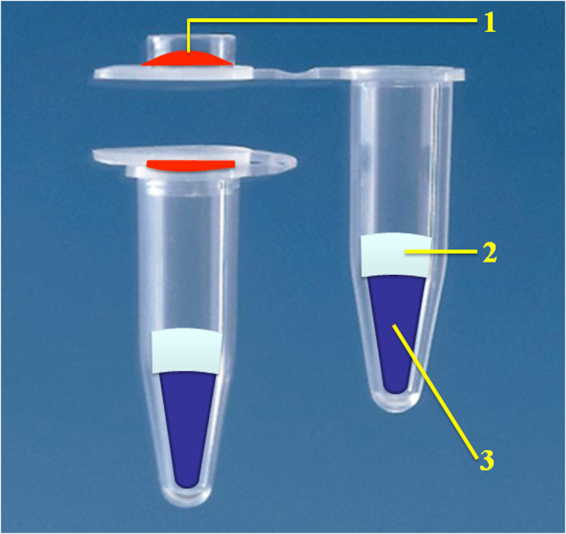
Schematic illustration of the all-in-one package. 1. Enzymes and other heat-unstable components. 2. Isolating substances to prevent contamination. 3. A heat-stable reaction system.
Figure 4
Figure 4
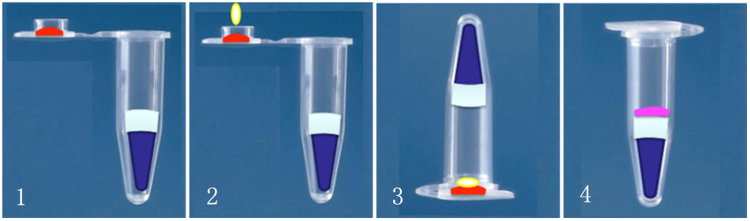
Operational steps of the all-in-one kit package. 1. Open the tube cover. 2. Add the sample to the cover. 3. Close the cover and reverse the tube. 4. Swing the sample liquid to the bottom.
Figure 5
Figure 5
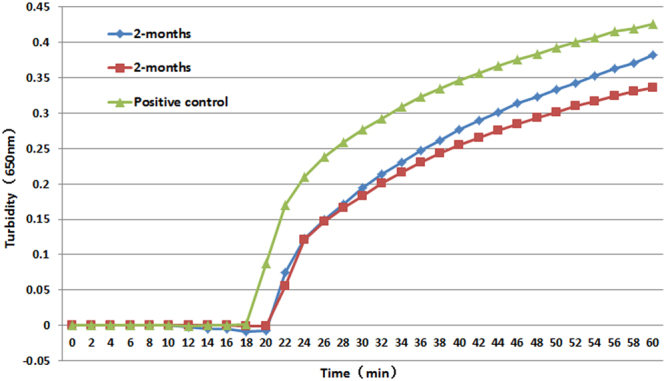
Thermal stability test for the all-in-one kit package at 50 °C. Two ‘2 months’ lines indicate two independent repeat tests.
Figure 6
Figure 6
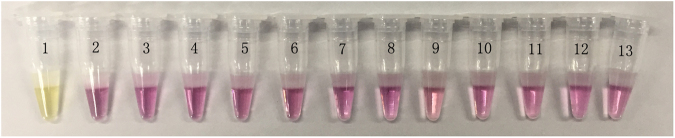
Specificity test results of the all-in-one kit for Mycobacterium tuberculosis. 1: M. tuberculosis; 2: Listeria monocytogenes; 3: Staphylococcus aureus; 4: Shigella flexneri; 5: Shigella sonnei; 6: Shigella dysenteriae CMCC(B)51105; 7: Salmonella typhimurium ATCC14028; 8: Salmonella enteritidis CMCC(B)50335; 9: Vibrio parahemolyticus ATCC17802; 10: Escherichia coli O157; 11: Escherichia coli NCTC12900; 12: Pseudomonas aeruginosa CMCC(B)10104; 13: negative control.
Figure 7
Figure 7
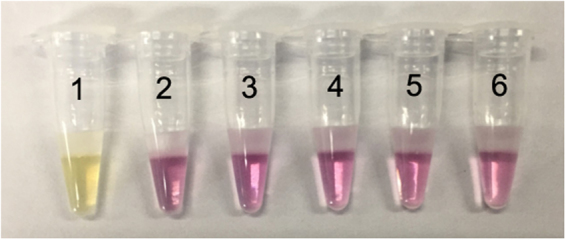
Specificity test results of the all-in-one kit for Mycobacterium tuberculosis. 1: M. tuberculosis; 2: Mycobacterium kansasii; 3: Mycobacterium scrofulaceum; 4: Mycobacterium avium-intracellulare; 5: Mycobacterium ulcerans; 6: negative control.
Figure 8
Figure 8
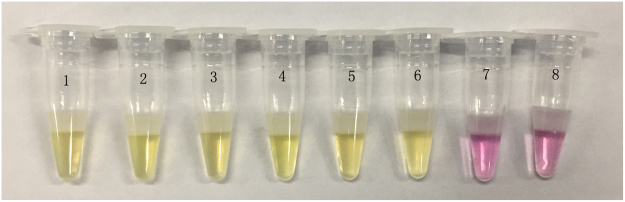
Detection limit test results of the all-in-one kit for M. tuberculosis. Nucleic acid concentrations in the tubes 1–7 were 92 ng/µL, 9.2 ng/µL, 920 pg/µL, 92 pg/µL, 9.2 pg/µL, 0.92 pg/µL, and 0.092 pg/µL, respectively, while the tube 8 was maintained as a negative control.
Figure 9
Figure 9
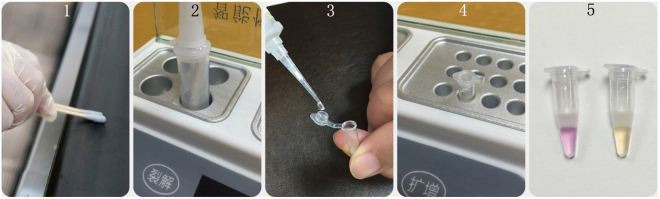
Operational steps of the novel kit for rapid nucleic acid test in field settings. 1. Use cotton swabs for sampling. 2. Heat the tube for DNA denaturation. 3. Squeeze out two droplets. 4. Amplify the DNA at a constant temperature. 5. Observe the results.

References

    1. Aryan E, et al. A novel and more sensitive loop-mediated isothermal amplification assay targeting IS6110 for detection of Mycobacterium tuberculosis complex. Microbiological Research. 2010;165:211–220. doi: 10.1016/j.micres.2009.05.001. - DOI - PubMed
    1. Lopez AD, Mathers CD, Ezzati M, Jamison DT, Murray CJ. Global and regional burden of disease and risk factors, 2001: systematic analysis of population health data. Lancet. 2006;367:1747–57. doi: 10.1016/S0140-6736(06)68770-9. - DOI - PubMed
    1. Brodie D, Schluger NW. The diagnosis of tuberculosis. Clin Chest Med. 2005;26:247–71. doi: 10.1016/j.ccm.2005.02.012. - DOI - PubMed
    1. van der Vliet GM, Schukkink RA, van Gemen B, Schepers P, Klatser PR. Nucleic acid sequence-based amplification(NASBA) for the identification of mycobacteria. J. Gen. Microbiol. 1993;139:2423–2429. doi: 10.1099/00221287-139-10-2423. - DOI - PubMed
    1. Keeler E, et al. Reducing the global burden of tuberculosis: the contribution of improved diagnostics. Nature. 2006;444:49–57. doi: 10.1038/nature05446. - DOI - PubMed

Publication types