


The relationship between social capital components and control of type 2 diabetes: A path analysis model
- PMID: 29445650
- PMCID: PMC5804475
- DOI: 10.18869/mjiri.31.21
The relationship between social capital components and control of type 2 diabetes: A path analysis model
Abstract
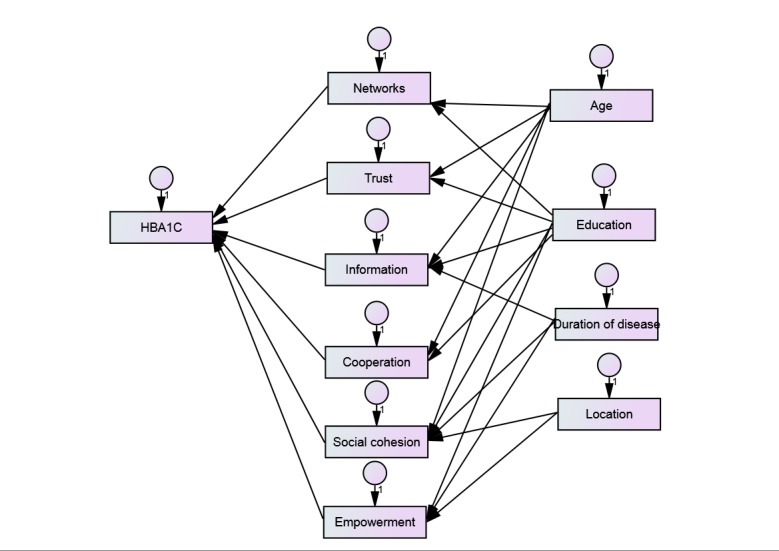
Background: Social capital is an important interpersonal organizational resource that may affect health behaviors and seems to be an important factor in chronic diseases. Considering the lack of evidence on this topic, in the present study, we aimed at investigating the association between components of social capital, socioeconomic condition, and controlling Type 2 diabetes mellitus in Iran. Methods: This study was conducted on 300 patients with Type 2 diabetes in Tehran, Iran. In this study, simple random sampling method was used for data collection. Path analysis model was used to examine the potential association between social capital components and to determine the factors that control Type 2 diabetes. Results: In the present study, most of the participants were female (70.7%) and married (78.7%). Path coefficients were calculated by a series of multiple regression analyses based on the conceptual model. The final model had a proper fit with Chi-square = 2.08 (DF = 1, P = 0.049), GFI = 0.542, AGFI = 0.915, NFI = 0.228, RFI = 0.284, IFI = 0.299, TLI = 0.292, CFI = 0.219, and RMSEA = 0.033. The Groups and networks (network) (β = 0.051, p = 0.036) and trust and solidarity (β = -0.018, p = 0.028) had a direct positive and negative effect on HbA1C, respectively. The results also revealed that education levels had a direct positive effect on groups and networks (network) (β = 0.118, p = 0.036), trust and solidarity (β = 0.082, p = 0.007), information and communication (β = 0.037, p = 0.027), and contribution in team works and public activities (β = 0.064, p = 0.003). In addition, education levels had an indirect positive effect on HbA1C through their effect on groups and networks (network), trust and solidarity, and information and communication. Conclusion: Social capital has a significant relationship with diabetes. Although it was not specified clearly which components of social capital were associated with diabetes, trust and solidarity showed a negative direct effect on HbA1C, respectively. Therefore, developing and implementing local and collective programs to build trust and increase the standards of social trust in patients with diabetes can be effective in controlling HbA1C.
Keywords: Blood glucose; Diabetes; Iran; Social capital.

References
-
- Chen L, Magliano DJ, Zimmet PZ. The worldwide epidemiology of type 2 diabetes mellitus—present and future perspectives. Nat Rev. 2012;8(4):228–36. - PubMed
-
- Dunstan DW, Zimmet PZ, Welborn TA, De Courten MP, Cameron AJ, Sicree RA. et al. The rising prevalence of diabetes and impaired glucose tolerance; the Australian diabetes, obesity and lifestyle study. Diabetes Care. 2002;25(5):829–34. - PubMed
-
- Danaei G, Finucane MM, Lu Y, Singh GM, Cowan MJ, Paciorek CJ. et al. National, regional, and global trends in fasting plasma glucose and diabetes prevalence since 1980: systematic analysis of health examination surveys and epidemiological studies with 370 country-years and 27 million participants. Lancet. 2011;378(9785):31–40. - PubMed
-
- Nyqvist F, Forsman AK, Giuntoli G, Cattan M. Social capital as a resource for mental well-being in older people: A systematic review. Aging Ment Health. 2013;17(4):394–410. - PubMed
-
- Glasgow RE, Toobert DJ. Social environment and regimen adherence among type II diabetic patients. Diabetes Care. 1988;11(5):377–86. - PubMed
LinkOut - more resources
Full Text Sources
Other Literature Sources
Miscellaneous