. 2018 Feb 14;8(1):25.
doi: 10.1186/s13613-018-0371-0.

Lung volumes and lung volume recruitment in ARDS: a comparison between supine and prone position

Affiliations

Lung volumes and lung volume recruitment in ARDS: a comparison between supine and prone position

Hernan Aguirre-Bermeo et al. Ann Intensive Care. .

Abstract

Background: The use of positive end-expiratory pressure (PEEP) and prone position (PP) is common in the management of severe acute respiratory distress syndrome patients (ARDS). We conducted this study to analyze the variation in lung volumes and PEEP-induced lung volume recruitment with the change from supine position (SP) to PP in ARDS patients.

Methods: The investigation was conducted in a multidisciplinary intensive care unit. Patients who met the clinical criteria of the Berlin definition for ARDS were included. The responsible physician set basal PEEP. To avoid hypoxemia, FiO2 was increased to 0.8 1 h before starting the protocol. End-expiratory lung volume (EELV) and functional residual capacity (FRC) were measured using the nitrogen washout/washin technique. After the procedures in SP, the patients were turned to PP and 1 h later the same procedures were made in PP.

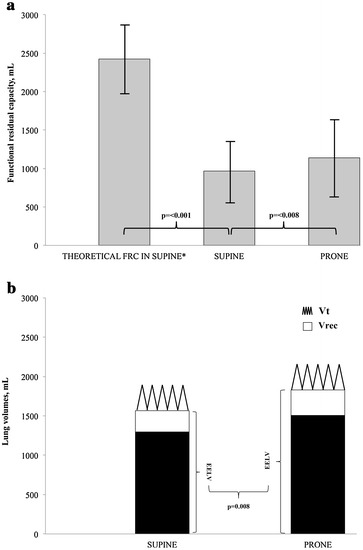
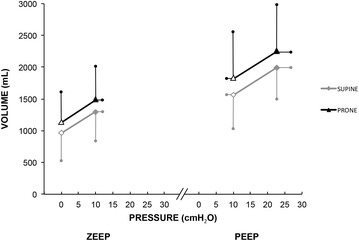
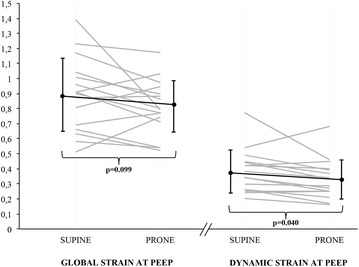
Results: Twenty-three patients were included in the study, and twenty were analyzed. The change from SP to PP significantly increased FRC (from 965 ± 397 to 1140 ± 490 ml, p = 0.008) and EELV (from 1566 ± 476 to 1832 ± 719 ml, p = 0.008), but PEEP-induced lung volume recruitment did not significantly change (269 ± 186 ml in SP to 324 ± 188 ml in PP, p = 0.263). Dynamic strain at PEEP decreased with the change from SP to PP (0.38 ± 0.14 to 0.33 ± 0.13, p = 0.040).

Conclusions: As compared to supine, prone position increases resting lung volumes and decreases dynamic lung strain.

Keywords: ARDS; Lung strain; Lung volumes; Mechanical ventilation; PEEP recruitment; Prone.


Figures
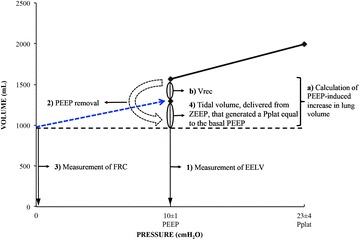
Fig. 1
Fig. 1
Lung volumes, measurements and calculations made in the study. The same procedures were carried out in supine and prone positions as follows: (1) measurement of end-expiratory lung volume (EELV): EELV is defined as the resting end-expiratory lung volume at PEEP. (2) Removal of PEEP and continuation of mechanical ventilation at zero end-expiratory pressure (ZEEP). (3) Measurement of functional residual capacity (FRC): FRC is defined as the resting lung volume at ZEEP. (4) Measurement of the tidal volume, delivered from ZEEP, that generated a Pplat equal to the basal PEEP. The same calculations were carried out in supine and prone positions as follows: (a) calculation of PEEP-induced increase in lung volume = EELV minus FRC. (b) Calculation of PEEP-induced lung volume recruitment (Vrec) = PEEP-induced increase in lung volume minus the Vt, delivered from ZEEP, that generated a Pplat equal to the basal PEEP. Blue line represents the compliance at ZEEP
Fig. 2
Fig. 2
Variation of lung volumes with the change of position. a Comparison of different values of functional residual capacity. b Comparison of EELV and Vrec in supine position and prone position. EELV, end-expiratory lung volume; Vrec, PEEP-induced lung volume recruitment; Vt, tidal volume. Data are presented in mean (ml) and SD. *According to the equation described by Ibañez and Raurich [30]
Fig. 3
Fig. 3
Variation in lung volumes in supine and prone positions. Clear triangles and clear rhombus are the resting lung volumes at ZEEP and at PEEP. Dark triangles and dark rhombus represent end-inspiratory lung volumes and end-inspiratory lung pressure (Pplat) at ZEEP and at PEEP. PEEP, positive end-expiratory pressure; ZEEP, zero end-expiratory pressure. Data are shown as mean and SD
Fig. 4
Fig. 4
Variation of individual values of global and dynamic strain at PEEP with the change of position. Dark lines represent mean and SD. PEEP, positive end-expiratory pressure

References

    1. Ware LB, Matthay MA. The acute respiratory distress syndrome. N Engl J Med. 2000;342:1334–1349. doi: 10.1056/NEJM200005043421806. - DOI - PubMed
    1. Gattinoni L, Pesenti A. The concept of “baby lung”. Intensive Care Med. 2005;31:776–784. doi: 10.1007/s00134-005-2627-z. - DOI - PubMed
    1. Gattinoni L, Taccone P, Carlesso E, Marini JJ. Prone position in acute respiratory distress syndrome. Rationale, indications, and limits. Am J Respir Crit Care Med. 2013;188:1286–1293. doi: 10.1164/rccm.201308-1532CI. - DOI - PubMed
    1. Pelosi P, Tubiolo D, Mascheroni D, Vicardi P, Crotti S, Valenza F, Gattinoni L. Effects of the prone position on respiratory mechanics and gas exchange during acute lung injury. Am J Respir Crit Care Med. 1998;157:387–393. doi: 10.1164/ajrccm.157.2.97-04023. - DOI - PubMed
    1. Richard JC, Bregeon F, Costes N, Bars DL, Tourvieille C, Lavenne F, Janier M, Bourdin G, Gimenez G, Guerin C. Effects of prone position and positive end-expiratory pressure on lung perfusion and ventilation. Crit Care Med. 2008;36:2373–2380. doi: 10.1097/CCM.0b013e31818094a9. - DOI - PubMed

LinkOut - more resources