. 2018 Feb 15;19(1):21.
doi: 10.1186/s13059-018-1396-2.

A standardized framework for representation of ancestry data in genomics studies, with application to the NHGRI-EBI GWAS Catalog

Affiliations

A standardized framework for representation of ancestry data in genomics studies, with application to the NHGRI-EBI GWAS Catalog

Joannella Morales et al. Genome Biol. .

Abstract

The accurate description of ancestry is essential to interpret, access, and integrate human genomics data, and to ensure that these benefit individuals from all ancestral backgrounds. However, there are no established guidelines for the representation of ancestry information. Here we describe a framework for the accurate and standardized description of sample ancestry, and validate it by application to the NHGRI-EBI GWAS Catalog. We confirm known biases and gaps in diversity, and find that African and Hispanic or Latin American ancestry populations contribute a disproportionately high number of associations. It is our hope that widespread adoption of this framework will lead to improved analysis, interpretation, and integration of human genomics data.

Keywords: Ancestry; Diversity; GWAS Catalog; Genome-wide association studies; Genomics; Population genetics.


Conflict of interest statement

Ethics approval and consent to participate

Not applicable.

Consent for publication

Not applicable.

Competing interests

PF is a member of the Scientific Advisory Board of Omicia, Inc.

Publisher’s Note

Springer Nature remains neutral with regard to jurisdictional claims in published maps and institutional affiliations.

Figures
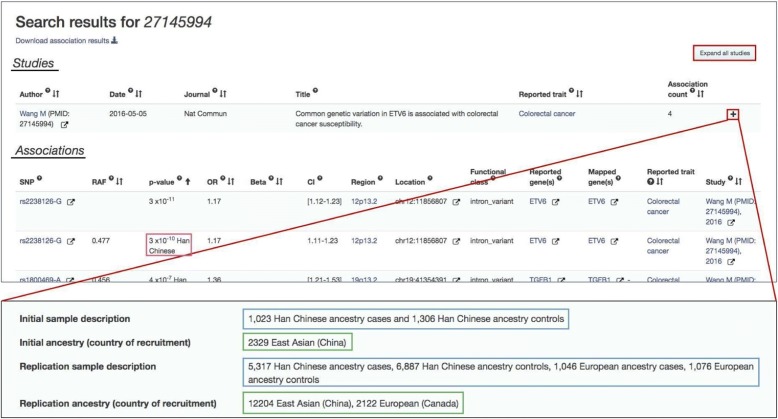
Fig. 1
Fig. 1
Representation of ancestry data in the GWAS Catalog search interface (https://www.ebi.ac.uk/gwas/). Ancestry-related data are found in the Studies and Associations tables (underlined in black) when searching the Catalog. This figure shows the results of a search for PubMed Identifier 27145994. The sample description can be found in the Studies table, either by pressing “Expand all Studies” or the “+” on the study of interest (highlighted in red). Sample ancestry is captured in two forms: (1) detailed description (highlighted in blue); and (2) ancestry category (highlighted in green). The latter follows the format: sample size, category, (country of recruitment). In cases where multiple ancestries are included in a study, the ancestry associated with a particular association is found as an annotation in the p value column in the Associations table (highlighted in pink)
Fig. 2
Fig. 2
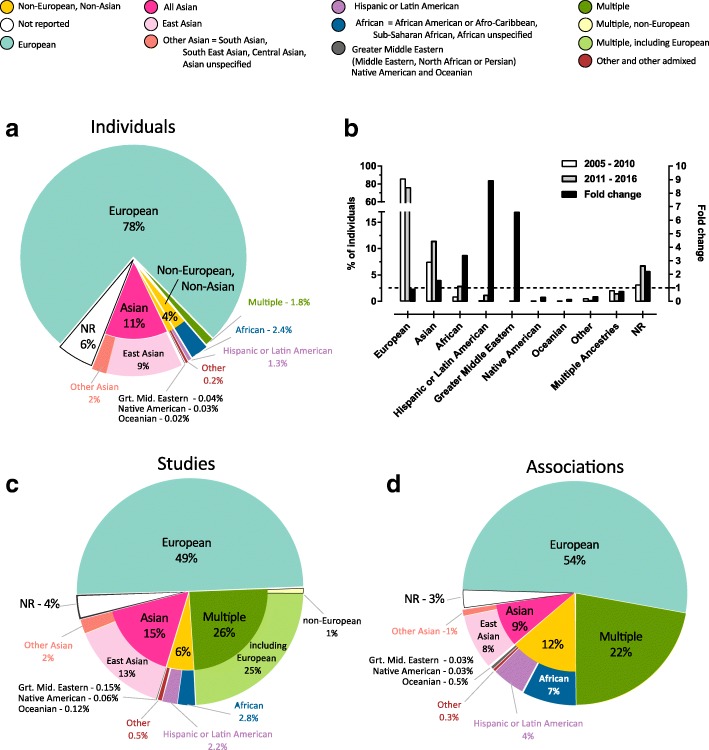
Ancestry category distribution in the GWAS Catalog. This figure summarizes the distribution of ancestry categories in percentages, of individuals (N = 110,291,046; a), individuals over time (N = 110,291,046; b), studies (N = 4,655; c), and associations (N = 60,970; d). The largest category in all panels is European (aqua). At the level of individuals (a), the largest non-European category is Asian (bright pink), with East Asian (light pink) accounting for the majority. Non-European, Non-Asian categories together (yellow) comprise 4 % of individuals, and for 6 % (white) of samples no ancestry category could be specified. b The distribution of individuals in percentages, included in the 915 studies published between 2005 and 2010 compared to the distribution of individuals included in the 2905 studies published between 2011 and 2016. d The disproportionate contribution of associations from African (blue) and Hispanic/Latin American (purple) categories, when compared to the percentage of individuals (a, blue, purple, respectively) and studies (b, blue, purple, respectively)

References

    1. Need AC, Goldstein DB. Next generation disparities in human genomics: concerns and remedies. Trends Genet. 2009;25:489–494. doi: 10.1016/j.tig.2009.09.012. - DOI - PubMed
    1. Popejoy AB, Fullerton SM. Genomics is failing on diversity. Nature. 2016;538:161–164. doi: 10.1038/538161a. - DOI - PMC - PubMed
    1. MacArthur J, Bowler E, Cerezo M, Gil L, Hall P, Hastings E, et al. The new NHGRI-EBI Catalog of published genome-wide association studies (GWAS Catalog) Nucleic Acids Res. 2017;45:D896–D901. doi: 10.1093/nar/gkw1133. - DOI - PMC - PubMed
    1. GWAS Catalog. http://www.ebi.ac.uk/gwas/. Accessed 4 Aug 2017.
    1. Welter D, MacArthur J, Morales J, Burdett T, Hall P, Junkins H, et al. The NHGRI GWAS Catalog, a curated resource of SNP-trait associations. Nucleic Acids Res. 2014;42:D1001–D1006. doi: 10.1093/nar/gkt1229. - DOI - PMC - PubMed

Publication types