


Editorial
doi: 10.1161/CIRCRESAHA.118.312566.
Pannexin Channel Inhibition: An Evolving Target to Lower Blood Pressure?
Affiliations
- PMID: 29449359
- PMCID: PMC5821142
- DOI: 10.1161/CIRCRESAHA.118.312566
Item in Clipboard
Editorial
Pannexin Channel Inhibition: An Evolving Target to Lower Blood Pressure?
Circ Res.
.
Abstract
More than 50 years after spironolactone has come on the market its mechanism of action continues to expand. In this issue of Circulation Research, Good et al. document the discovery that spironolactone is not only an inhibitor of the mineralocorticoid receptor, but also inhibits pannexin 1 channels.
Keywords: Editorials; aldosterone; eplerenone; spironolactone.
Figures
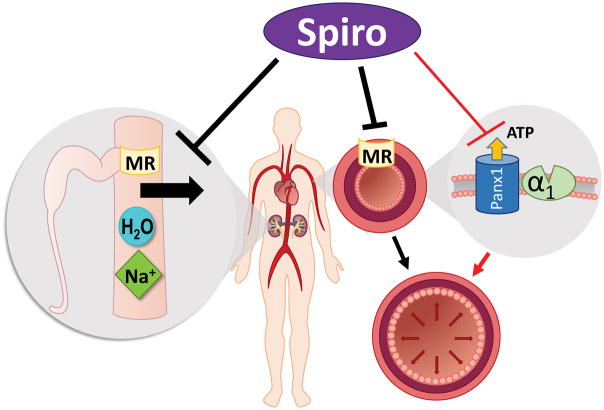
Multiple proposed actions of spironolactone (spiro) to lower blood pressure. The primary target is the mineralocorticoid receptor (MR) in the kidney which reduces sodium re-uptake from the distal tubule lumen causing increased sodium and water excretion (left). More recently MR inhibition in the vasculature is increasingly recognized to reduce vasoconstriction (middle), but has also been associated with additional benefits including e.g. anti-inflammatory and anti-fibrotic effects not depicted in the scheme. The new pathway proposed by Good et al. is marked with red arrows (right). Spironolactone blocks pannexin channels (Panx1) in SMCs which reduces ATP release during alpha adrenergic stimulation (α1). This subsequently diminishes alpha adrenergic vasoconstriction resulting in lower vascular tone.
Comment on
-
Pannexin 1 Channels as an Unexpected New Target of the Anti-Hypertensive Drug Spironolactone.Circ Res. 2018 Feb 16;122(4):606-615. doi: 10.1161/CIRCRESAHA.117.312380. Epub 2017 Dec 13. Circ Res. 2018. PMID: 29237722 Free PMC article.
References
-
- Calhoun DA, Jones D, Textor S, Goff DC, Murphy TP, Toto RD, White A, Cushman WC, White W, Sica D, Ferdinand K, Giles TD, Falkner B, Carey RM. Resistant hypertension: diagnosis, evaluation, and treatment. A scientific statement from the American Heart Association Professional Education Committee of the Council for High Blood Pressure Research. Hypertension. 2008;51:1403–19. - PubMed
-
- Whelton PK, Carey RM, Aronow WS, Casey DE, Jr, Collins KJ, Dennison Himmelfarb C, DePalma SM, Gidding S, Jamerson KA, Jones DW, MacLaughlin EJ, Muntner P, Ovbiagele B, Smith SC, Jr, Spencer CC, Stafford RS, Taler SJ, Thomas RJ, Williams KA, Sr, Williamson JD, Wright JT., Jr ACC/AHA/AAPA/ABC/ACPM/AGS/APhA/ASH/ASPC/NMA/PCNA Guideline for the Prevention, Detection, Evaluation, and Management of High Blood Pressure in Adults: Executive Summary: A Report of the American College of Cardiology/American Heart Association Task Force on Clinical Practice Guidelines. J Am Coll Cardiol 2017
-
- Williams B, MacDonald TM, Morant S, Webb DJ, Sever P, McInnes G, Ford I, Cruickshank JK, Caulfield MJ, Salsbury J, Mackenzie I, Padmanabhan S, Brown MJ British Hypertension Society’s PSG. Spironolactone versus placebo, bisoprolol, and doxazosin to determine the optimal treatment for drug-resistant hypertension (PATHWAY-2): a randomised, double-blind, crossover trial. Lancet. 2015;386:2059–2068. - PMC - PubMed
-
- Nguyen XN, Phan VK, Chau VM, Bui HT, Nguyen XC, Vu KT, Hoang le TA, Jo SH, Jang HD, Kwon YI, Kim YH. A new monoterpenoid glycoside from Myrica esculenta and the inhibition of angiotensin I-converting enzyme. Chem Pharm Bull (Tokyo) 2010;58:1408–10. - PubMed
Publication types
MeSH terms
Substances
Grants and funding
LinkOut - more resources
Full Text Sources
Other Literature Sources
Medical
