. 2018 May;103(5):865-873.
doi: 10.3324/haematol.2017.177212. Epub 2018 Feb 15.

Highly similar genomic landscapes in monoclonal B-cell lymphocytosis and ultra-stable chronic lymphocytic leukemia with low frequency of driver mutations

Affiliations

Highly similar genomic landscapes in monoclonal B-cell lymphocytosis and ultra-stable chronic lymphocytic leukemia with low frequency of driver mutations

Andreas Agathangelidis et al. Haematologica. 2018 May.

Abstract

Despite the recent discovery of recurrent driver mutations in chronic lymphocytic leukemia, the genetic factors involved in disease onset remain largely unknown. To address this issue, we performed whole-genome sequencing in 11 individuals with monoclonal B- cell lymphocytosis, both of the low-count and high-count subtypes, and 5 patients with ultra-stable chronic lymphocytic leukemia (>10 years without progression from initial diagnosis). All three entities were indistinguishable at the genomic level exhibiting low genomic complexity and similar types of somatic mutations. Exonic mutations were not frequently identified in putative chronic lymphocytic leukemia driver genes in all settings, including low-count monoclonal B-cell lymphocytosis. To corroborate these findings, we also performed deep sequencing in 11 known frequently mutated genes in an extended cohort of 28 monoclonal B-cell lymphocytosis/chronic lymphocytic leukemia cases. Interestingly, shared mutations were detected between clonal B cells and paired polymorphonuclear cells, strengthening the notion that at least a fraction of somatic mutations may occur before disease onset, likely at the hematopoietic stem cell level. Finally, we identified previously unreported non-coding variants targeting pathways relevant to B-cell and chronic lymphocytic leukemia development, likely associated with the acquisition of the characteristic neoplastic phenotype typical of both monoclonal B-cell lymphocytosis and chronic lymphocytic leukemia.


Figures

Figure 1.
Figure 1.
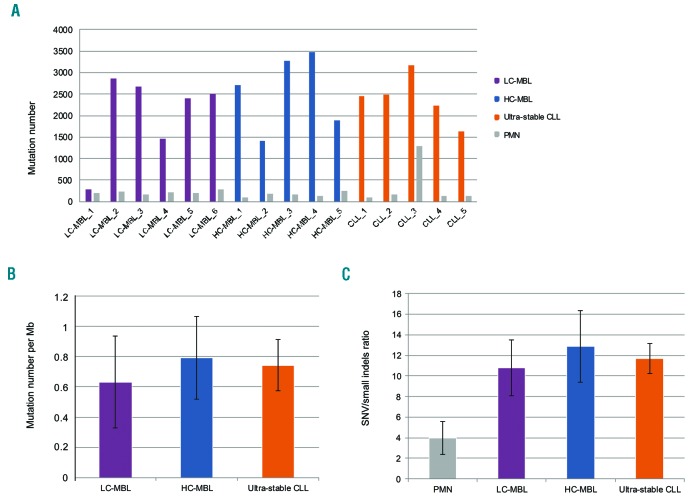
Somatic mutational analysis of ultra-stable chronic lymphocytic leukemia (CLL), high-count monoclonal B-cell lymphocytosis (HC-MBL), low-count monoclonal B-cell lymphocytosis (LC-MBL) and control polymorphonuclear (PMN) cell samples. (A) Total number of somatic mutations identified by whole-genome sequencing (WGS) in CLL cell samples from MBL, CLL and the respective PMN samples. All samples carried similar mutational loads with the exception of a single LC-MBL sample (LC-MBL_1) that displayed a very low number of mutation events; as can be seen, the corresponding PMN sample had a mutation load similar to the other PMN samples, where comparison of mutation profiles between the MBL and PMN sample showed few common hits, thus excluding the likelihood of contamination. Concerning PMN control samples, they were also characterized by high homogeneity regarding the mutational load. There was a single sample with a very high mutational load; detailed comparison against its respective CLL sample showed a high overlap of mutations indicating potential tumor cell contamination, hence this sample was removed from downstream analysis. (B) Average mutation rates ± Standard Deviation (SD) for LC-MBL, HC-MBL and CLL. Highly analogous mutation rates were observed in the HC-MBL (0.79 mutations per Mb) and CLL (0.74 mutations per Mb) samples, while LC-MBL samples had a slightly lower ratio (0.63 mutations per Mb). (C) Average SNV to small indels ratio ± SD for all sample groups. All 3 entities displayed similar ratios in clear contrast to the PMN samples where the ratio was much lower.
Figure 2.
Figure 2.
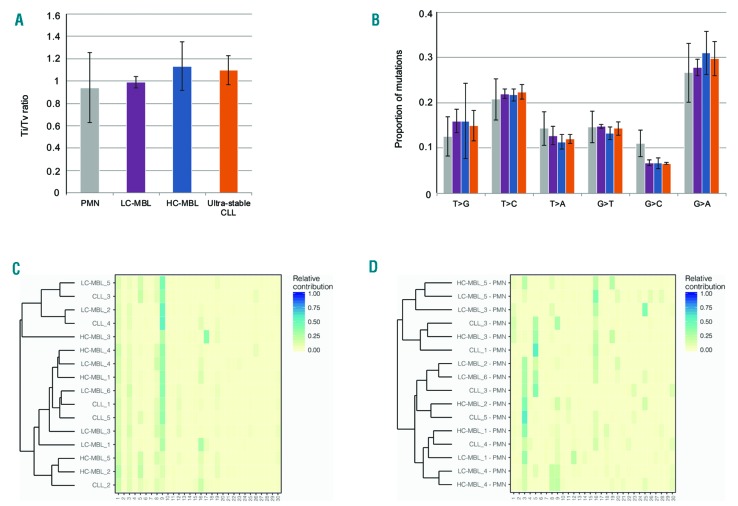
Detailed analysis of mutation types. (A) Transition to transversion (Ti/Tv) ratios were comparable in all monoclonal B-cell lymphocytosis (MBL)/chronic lymphocytic leukemia (CLL) samples and somewhat lower in the polymorphonuclear (PMN) cell samples. (B) Similar distribution of mutations among the 6 mutation classes for each MBL/CLL entity and PMN samples (average values ± Standard Deviation). Similar profiles were evident for all entities with the G>A mutation pre- dominating in all cases. (C) Mutational signatures that contribute to the somatic mutations observed in the MBL/CLL samples. (D) Mutational signatures that dominate in the PMN samples.
Figure 3.
Figure 3.
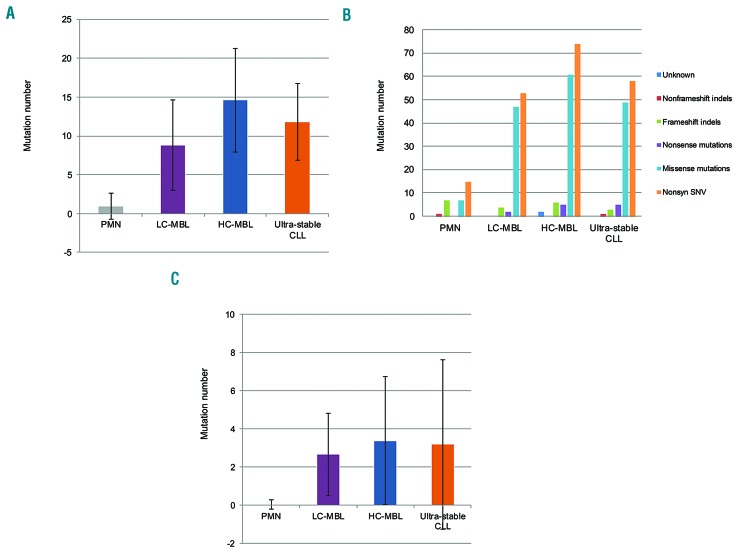
Exonic mutations in our monoclonal B- cell lymphocytosis (MBL)/chronic lymphocytic leukemia (CLL) cohort and polymorphonuclear (PMN) cell samples. (A) Average numbers of exonic non-synonymous mutations in MBL/CLL entities and PMN samples. (B) The vast majority of non-synonymous mutations were missense in all 3 MBL/CLL entities. PMN samples failed to show such predominance. (C) Average numbers of mutations with VAF≥50% for all 3 MBL/CLL entities were comparable. A single PMN sample carried a clonal mutation.
Figure 4.
Figure 4.
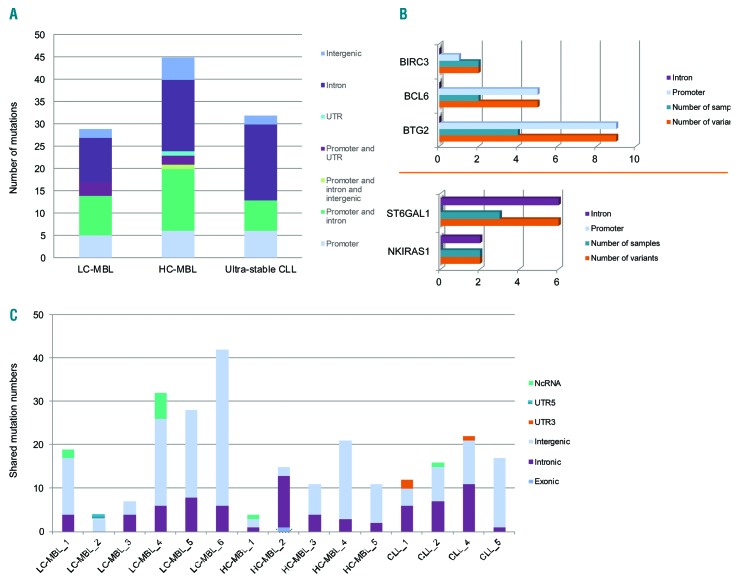
Analysis of non-coding variants and shared mutations between monoclonal B-cell lymphocytosis (MBL)/chronic lymphocytic leukemia (CLL) and polymorphonuclear (PMN) cell samples in the present cohort. (A) Topology of the 106 relevant non-coding variants identified in the present study. The majority concerned gene promoter sites. (B) Recurrent non-coding variants in genes relevant to CLL. The BIRC3, BCL6 and BTG2 genes are known to be associated with various types of cancer. (C) Topology of shared mutations between MBL/CLL and PMN samples. Intergenic mutations predominated, followed by intronic mutations.

Comment in

References

    1. Chiorazzi N, Rai KR, Ferrarini M. Chronic lymphocytic leukemia. N Engl J Med. 2005;352(8):804–815. - PubMed
    1. Parikh SA, Shanafelt TD. Prognostic factors and risk stratification in chronic lymphocytic leukemia. Semin Oncol. 2016; 43(2):233–240. - PubMed
    1. Scarfo L, Ferreri AJ, Ghia P. Chronic lymphocytic leukaemia. Crit Rev Oncol Hematol. 2016;104:169–182. - PubMed
    1. Fabbri G, Khiabanian H, Holmes AB, et al. Genetic lesions associated with chronic lymphocytic leukemia transformation to Richter syndrome. J Exp Med. 2013;210(11):2273–2288. - PMC - PubMed
    1. Fabbri G, Rasi S, Rossi D, et al. Analysis of the chronic lymphocytic leukemia coding genome: role of NOTCH1 mutational activation. J Exp Med. 2011;208(7):1389–1401. - PMC - PubMed

Publication types

Substances

LinkOut - more resources