. 2018 Feb 15;25(3):122-128.
doi: 10.1101/lm.046136.117. Print 2018 Mar.

Place learning overrides innate behaviors in Drosophila

Affiliations

Place learning overrides innate behaviors in Drosophila

Vincent Baggett et al. Learn Mem. .

Abstract

Animals in a natural environment confront many sensory cues. Some of these cues bias behavioral decisions independent of experience, and action selection can reveal a stimulus-response (S-R) connection. However, in a changing environment it would be a benefit for an animal to update behavioral action selection based on experience, and learning might modify even strong S-R relationships. How animals use learning to modify S-R relationships is a largely open question. Three sensory stimuli, air, light, and gravity sources were presented to individual Drosophila melanogaster in both naïve and place conditioning situations. Flies were tested for a potential modification of the S-R relationships of anemotaxis, phototaxis, and negative gravitaxis by a contingency that associated place with high temperature. With two stimuli, significant S-R relationships were abandoned when the cue was in conflict with the place learning contingency. The role of the dunce (dnc) cAMP-phosphodiesterase and the rutabaga (rut) adenylyl cyclase were examined in all conditions. Both dnc1 and rut2080 mutant flies failed to display significant S-R relationships with two attractive cues, and have characteristically lower conditioning scores under most conditions. Thus, learning can have profound effects on separate native S-R relationships in multiple contexts, and mutation of the dnc and rut genes reveal complex effects on behavior.


Figures

Figure 1.
Figure 1.
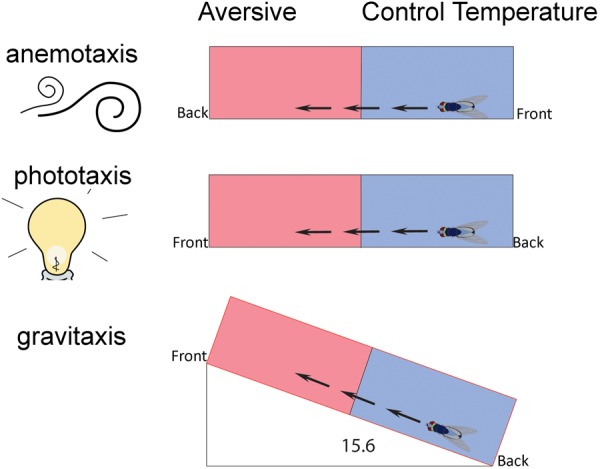
Flies were conditioned in the presence of stimuli that could act as potential attractive cues. In the anemotaxis experiments, an air source was provided at the back of the chambers. A fly with a potential preference for the air source is represented, with the arrows suggesting movement toward that source (front and back refer to either end of the chamber). Training associated the chamber end with the air source with 41°C. In the phototaxis experiments, a light source was provided at the front of the chambers. Training associated the lit end with the aversive temperature of 41°C. In the gravitaxis experiments, chambers were shifted at 7.8° and 15.6o from the horizon. Training associated the higher end with the aversive temperature of 41°C. Controls for each of these cues were without the potentially attractive cue. A second set of controls used the nonaversive temperature of 24°C as the “training” temperature. No conditioning was expected in these control conditions, and provided information about the attractiveness of the cues presented.
Figure 2.
Figure 2.
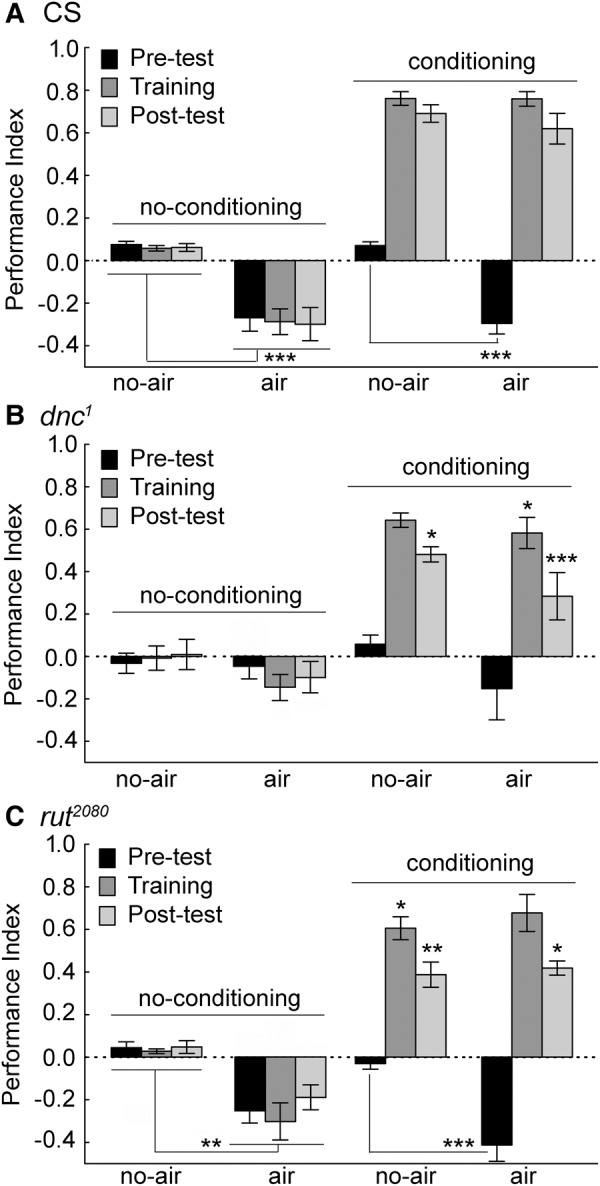
Flies were conditioned in the presence of an air source that could act as a potential attractive cue. (A) Wild-type flies have a preference for an air source. Under no-conditioning, wild-type CS flies show a preference for the side of the chamber with the air source compared to flies not exposed to an air source, evident in negative values (Wilks λ = 0.0378 F(33,313.0) = 20.3, P < 0.00001 for all groups and conditions. Duncan post hoc tests with significant differences are represented, (*) P < 0.05; (**) P < 0.01; (***) P < 0.001). Moreover, the pretest phase in a training experiment also shows a significant negative value compared to flies from the no-air group. In both training conditions, the Training and Post-test phases are strongly positive, but are not statistically distinguishable in the air and no-air groups. (B) There were no preferences for an air source in dnc1 flies compared to flies from the no-air group. Only the Post-test performance of dnc1 flies was significantly lower than that of CS flies in the absence of air. The dnc1 flies had a low Training and Post-test performance in the presence of air compared to CS flies. (C) The rut2080 flies had a significantly lower Training and Post-test performance in the absence of air compared to CS performance levels. Only the Post-test score in rut2080 flies was significantly lower than the CS flies levels in the air groups. The pretest preference was significantly lower in rut2080 flies in the air versus no-air groups. N = 16 trials for CS in each of the conditions; N’s = 8 trials for dnc1 and rut2080 in each of the conditions. Values are presented as means and error bars are SEMs.
Figure 3.
Figure 3.
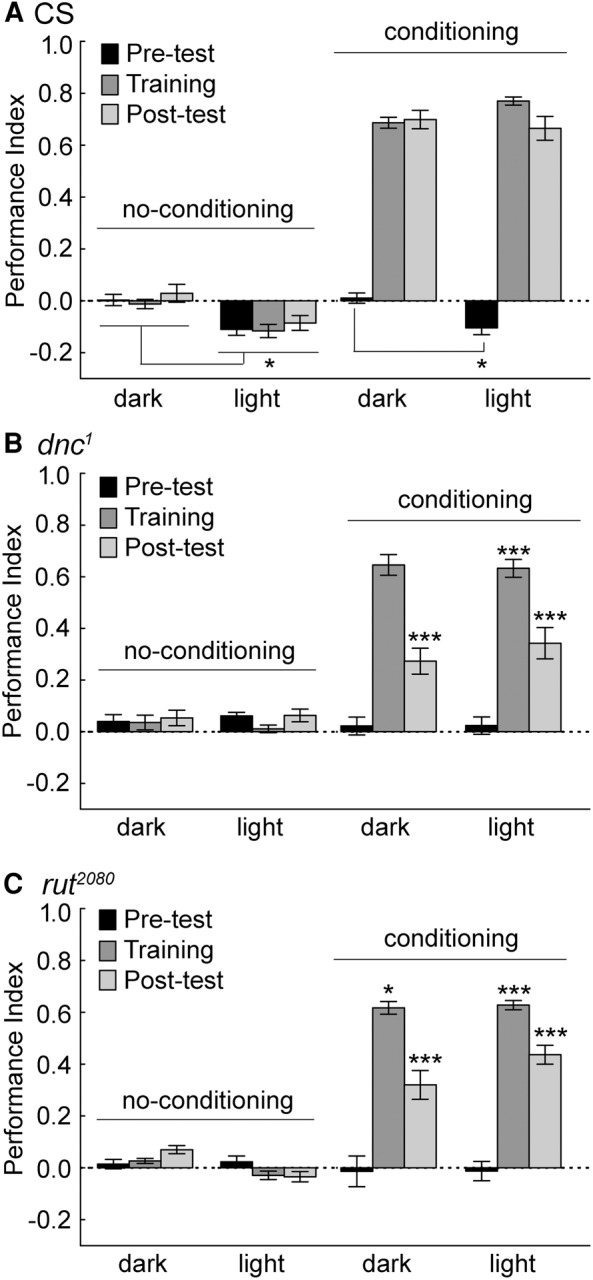
Flies were conditioned in the presence of a light stimulus that could act as a potential attractive cue. (A) In the phototaxis experiments, wild-type CS flies are attracted to the light cue in the absence of conditioning, evident in negative values (Wilks λ = 0.0122 F(33,357.2) = 37.5, P < 0.00001 for all groups and conditions. Duncan post hoc tests with significant differences are represented, (*) P < 0.05; (***) P < 0.001). This preference was also evident in the pretest phase of the conditioning experiment in the light compared to the dark. The learning and memory score during the training and post-test phases were statistically indistinguishable in the presence or absence of a lit chamber end. (B,C) Mutant dnc1 and rut2080 flies did not show a preference for the lit half of the chamber. Mutant dnc1 and rut2080 flies had statistically lower training and post-test performance compared to CS flies. The exception was the training performance of dnc1 flies in the dark. N = 16 trials for CS in each of the conditions; N’s = 8 trials for dnc1 and rut2080 in each of the conditions. Values are presented as means and error bars are SEMs.
Figure 4.
Figure 4.
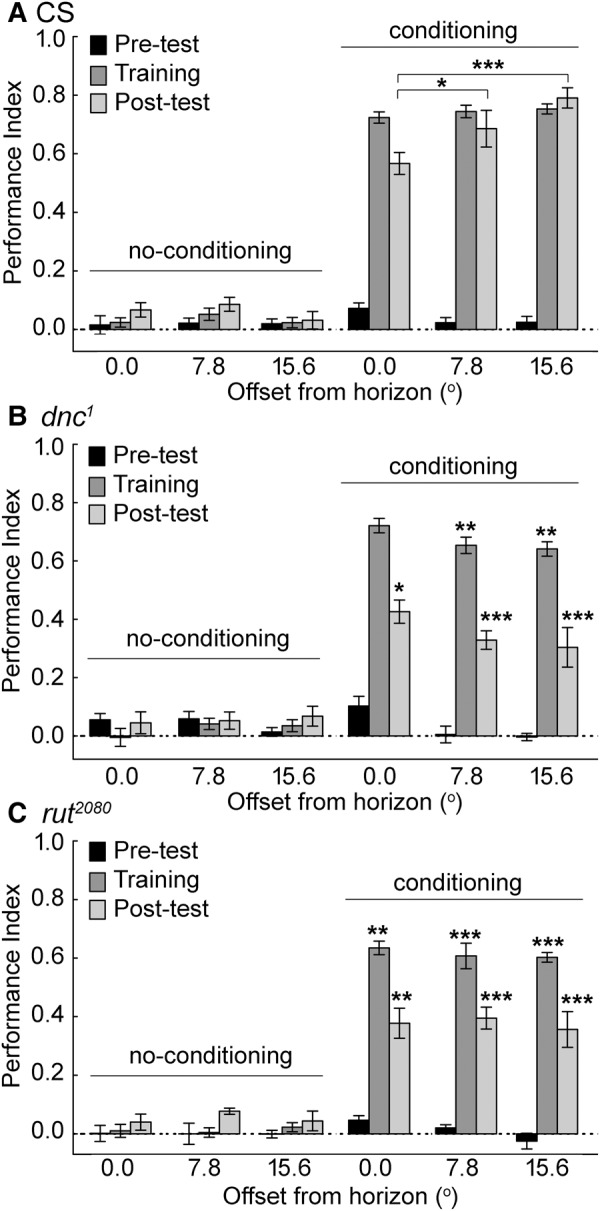
Wild-type CS, dnc1, and rut2080 flies were presented with gravitaxis cues and trained against a potential preference. (A) There were no obvious group average preferences for a chamber end that was raised up to 15.6°. Conditioning, however, led to high training and post-test scores compared to no-conditioning (Wilks λ = 0.0184 F(51,509.9) = 28.3, P < 0.00001 for all groups and conditions. Duncan post hoc tests with significant differences are represented, (*) P < 0.05; (**) P < 0.01; (***) P < 0.001). The post-test scores were higher with 15.6° compared to the 0.0°, and 7.8° compared to the 0.0°, conditions. (B) Mutant dnc1 flies showed no obvious preference for an elevated chamber end. The training and post-test performance was lower in dnc1 flies compared to CS flies, with the exception of the training score in control conditions. (C) Training and Post-test scores were lower in rut2080 flies compared to CS levels tested under the same conditions. N = 16 trials for CS in each of the conditions; N’s = 8 trials for dnc1 and rut2080 in each of the conditions. Values are presented as means and error bars are SEMs.

References

    1. Armstrong JD, Texada MJ, Munjaal R, Baker DA, Beckingham KM. 2006. Gravitaxis in Drosophila melanogaster: a forward genetic screen. Genes Brain Behav 5: 222–239. - PubMed
    1. Benzer S. 1967. Behavioral mutants of Drosophila isolated by countercurrent distribution. Proc Natl Acad Sci 58: 1112–1119. - PMC - PubMed
    1. Budick SA, Reiser MB, Dickinson MH. 2007. The role of visual and mechanosensory cues in structuring forward flight in Drosophila melanogaster. J Exp Biol 210: 4092–4103. - PubMed
    1. Chow DM, Frye MA. 2008. Context-dependent olfactory enhancement of optomotor flight control in Drosophila. J Exp Biol 211: 2478–2485. - PubMed
    1. Crittenden JR, Skoulakis EM, Han KA, Kalderon D, Davis RL. 1998. Tripartite mushroom body architecture revealed by antigenic markers. Learn Mem 5: 38–51. - PMC - PubMed

Publication types

LinkOut - more resources