


Why and how the early-life environment affects development of coping behaviours
- PMID: 29449757
- PMCID: PMC5805793
- DOI: 10.1007/s00265-018-2452-3
Why and how the early-life environment affects development of coping behaviours
Abstract
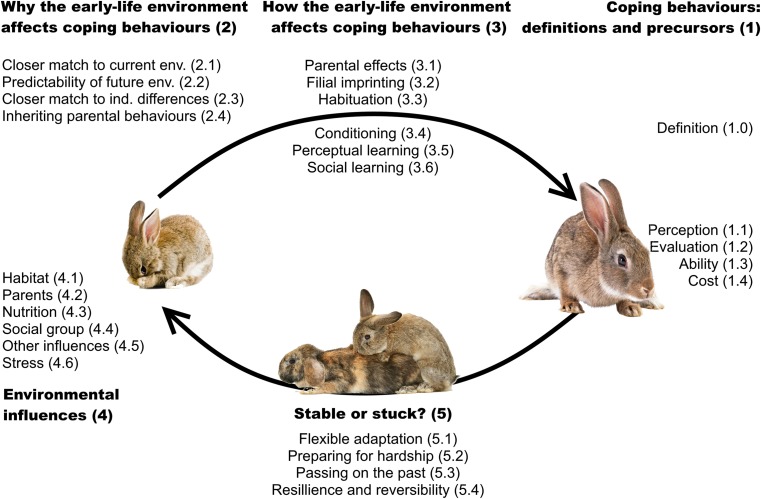
Understanding the ways in which individuals cope with threats, respond to challenges, make use of opportunities and mediate the harmful effects of their surroundings is important for predicting their ability to function in a rapidly changing world. Perhaps one of the most essential drivers of coping behaviour of adults is the environment experienced during their early-life development. Although the study of coping, defined as behaviours displayed in response to environmental challenges, has a long and rich research history in biology, recent literature has repeatedly pointed out that the processes through which coping behaviours develop in individuals are still largely unknown. In this review, we make a move towards integrating ultimate and proximate lines of coping behaviour research. After broadly defining coping behaviours (1), we review why, from an evolutionary perspective, the development of coping has become tightly linked to the early-life environment (2), which relevant developmental processes are most important in creating coping behaviours adjusted to the early-life environment (3), which influences have been shown to impact those developmental processes (4) and what the adaptive significance of intergenerational transmission of coping behaviours is, in the context of behavioural adaptations to a fast changing world (5). Important concepts such as effects of parents, habitat, nutrition, social group and stress are discussed using examples from empirical studies on mammals, fish, birds and other animals. In the discussion, we address important problems that arise when studying the development of coping behaviours and suggest solutions.
Keywords: Coping; Developmental processes; Early-life environment; Intergenerational effects; Parental effects; Personality.
Conflict of interest statement
Compliance with ethical standardsThe authors declare that they have no conflict of interest.
Figures
References
-
- Abbott LC, Winzer-Serhan UH. Smoking during pregnancy: lessons learned from epidemiological studies and experimental studies using animal models. Crit Rev Toxicol. 2012;42:279–303. - PubMed
-
- Adamec RE, Shallow T. Lasting effects on rodent anxiety of a single exposure to a cat. Physiol Behav. 1993;54:101–109. - PubMed
-
- Adkins-Regan E, Banerjee SB, Correa SM, Schweitzer C. Maternal effects in quail and zebra finches: behavior and hormones. Gen Comp Endocrinol. 2013;190:34–41. - PubMed
-
- Adret P. Operant conditioning, song learning and imprinting to taped song in the zebra finch. Anim Behav. 1993;46:149–159.
-
- Adriaenssens B, Johnsson JI. Shy trout grow faster: exploring links between personality and fitness-related traits in the wild. Behav Ecol. 2011;22:135–143.
Publication types
LinkOut - more resources
Full Text Sources
Other Literature Sources