. 2018 Feb 9:11:2.
doi: 10.1186/s13628-018-0042-4. eCollection 2018.

Thermal decomposition of the amino acids glycine, cysteine, aspartic acid, asparagine, glutamic acid, glutamine, arginine and histidine

Affiliations

Thermal decomposition of the amino acids glycine, cysteine, aspartic acid, asparagine, glutamic acid, glutamine, arginine and histidine

Ingrid M Weiss et al. BMC Biophys. .

Abstract

Background: The pathways of thermal instability of amino acids have been unknown. New mass spectrometric data allow unequivocal quantitative identification of the decomposition products.

Results: Calorimetry, thermogravimetry and mass spectrometry were used to follow the thermal decomposition of the eight amino acids G, C, D, N, E, Q, R and H between 185 °C and 280 °C. Endothermic heats of decomposition between 72 and 151 kJ/mol are needed to form 12 to 70% volatile products. This process is neither melting nor sublimation. With exception of cysteine they emit mainly H2O, some NH3 and no CO2. Cysteine produces CO2 and little else. The reactions are described by polynomials, AA→a NH3+b H2O+c CO2+d H2S+e residue, with integer or half integer coefficients. The solid monomolecular residues are rich in peptide bonds.

Conclusions: Eight of the 20 standard amino acids decompose at well-defined, characteristic temperatures, in contrast to commonly accepted knowledge. Products of decomposition are simple. The novel quantitative results emphasize the impact of water and cyclic condensates with peptide bonds and put constraints on hypotheses of the origin, state and stability of amino acids in the range between 200 °C and 300 °C.

Keywords: Amino acid; Quantitative mass spectrometry; Thermal analysis.


Conflict of interest statement

Not applicable.Not applicable.The authors declare that they have no competing interests.Springer Nature remains neutral with regard to jurisdictional claims in published maps and institutional affiliations.

Figures
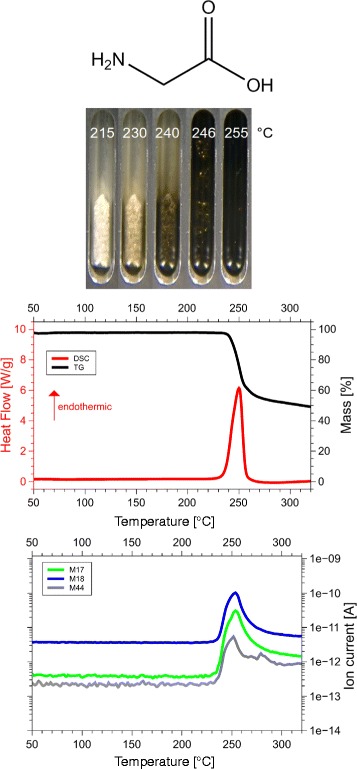
Fig. 1
Fig. 1
Glycine data. C2H5NO2, 75 Da, Hf=−528 kJ/mol
Fig. 2
Fig. 2
Cysteine data. C3H7NO2S, 121 Da, Hf=−534 kJ/mol
Fig. 3
Fig. 3
Aspartate data. C4H7NO4, 133 Da, Hf=−973 kJ/ mol
Fig. 4
Fig. 4
Asparagine data. C4H8N2O3, 132 Da, Hf=−789 kJ/mol
Fig. 5
Fig. 5
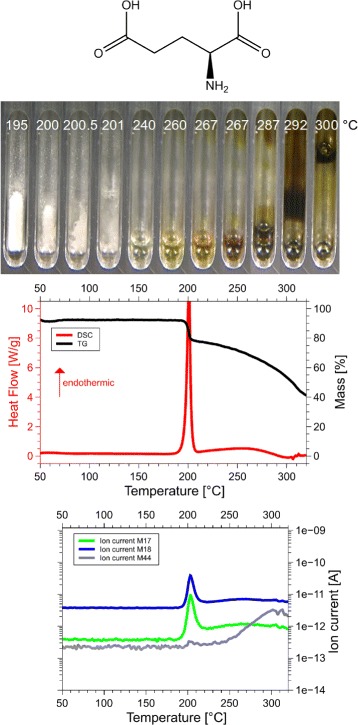
Glutamate data. C5H9NO4, 147 Da, Hf=−1097 kJ/mol
Fig. 6
Fig. 6
Glutamine data. C5H100N2O3, 146 Da, Hf=−826 kJ/mol
Fig. 7
Fig. 7
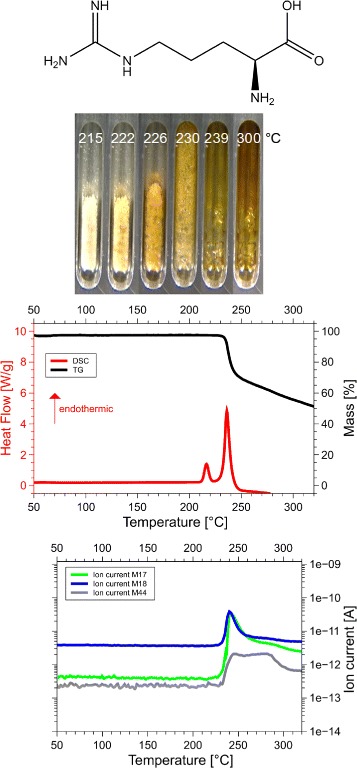
Arginine data. C6H14N4O2, 174 Da, Hf=−623 kJ/mol
Fig. 8
Fig. 8
Histidine data. C6H9N3O2, 155 Da, Hf=−467 kJ/mol
Fig. 9
Fig. 9
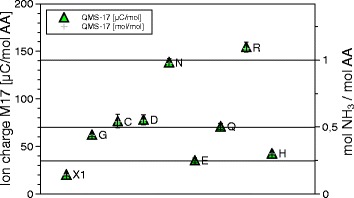
QMS data for the 17 Da channel. Signals in the 17 Da, the NH3 channel, for each of the amino acids. Ionic charges in the peaks on the left, mol NH3/mol amino acid on the right. The clustering of G, C, D, Q around 12 mol NH3 per mol AA and of N and R around 1 mol NH3 per mol AA is striking
Fig. 10
Fig. 10
QMS data for the 18 Da channel. Signals in the 18 Da, the H2O channel, for each of the amino acids. Ionic charges in the peaks on the left, mol H2O/mol amino acid on the right. The clustering of C and Q around the 12 mol H2O level, of N, E, R, H around the 1 mol H2O level, and the 2 mol point for D are striking
Fig. 11
Fig. 11
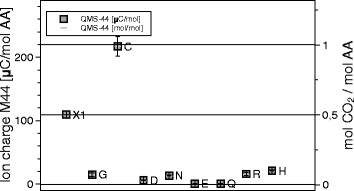
QMS data for the 44 Da channel. Signals in the 44 Da, the CO2 channel, for each of the amino acids. Ionic charges in the peaks on the left, mol CO2/mol amino acid on the right. Only C produces 1 mol CO2, the level of the others is negligible
Fig. 12
Fig. 12
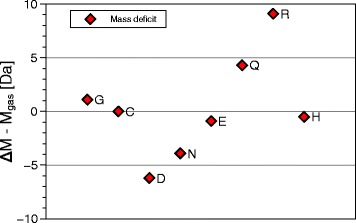
Comparison of mass balances registered by TGA and QMS experiments. The difference between the mass loss registered by TGA, ΔM and the volatile mass found as NH3, H2O, CO2 and H2S, ΔM − M gas remains below |9| Da. This is confirmation that no other gases are produced
Fig. 13
Fig. 13
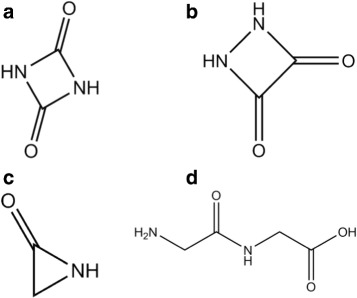
Interpretation of Glycine data. a, Residue of Gly, C2H2N2O2, 1,3-Diazetine-2,4,dione, 86 Da. b, Isomer of Fig. 13a, 1,2-Diazetine-3,4-dione, 86 Da. c, 2-Aziridinone, C2H3NO, 57 Da. d, Intermediate dimer, glygly, C4H8N2O3, 132 Da
Fig. 14
Fig. 14
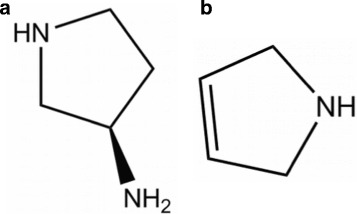
Interpretation of Cysteine data. a, Intermediate compound: 3-pyrrolidinamine, chemspider 144134, 86 Da. b, Residue of Cys, C4H7N, 2,5-Dihydro-1H-pyrrole, chemspider 13870958, 69 Da
Fig. 15
Fig. 15
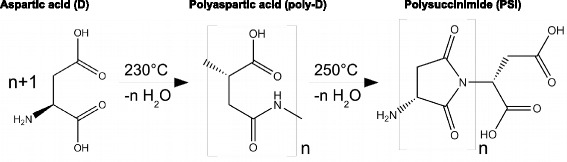
Interpretation of Aspartate data. The pathway from Aspartic acid (D) to polysuccimide (PSI). Compared with succinimide, the N-C bond in polysuccinimide economizes two hydrogen atoms
Fig. 16
Fig. 16
Interpretation of Asparagine data. Two pathways from asparagine (N) to polysuccinimide (PSI): either through polyasparagine (poly-N) or polyaspartic acid (poly-D). Compared with succiminide, the N-C bond in polysuccinimide economizes two hydrogen atoms
Fig. 17
Fig. 17
Interpretation of Glutamate data. a, The final residue of Glu, pyroglutamic acid, C5H7NO3, 129 Da. b, Succinimide, C4H5NO2, 99 Da. c, Pyrrolidone, C4H7NO, 85 Da
Fig. 18
Fig. 18
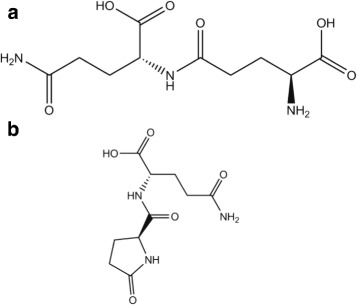
Interpretation of Glutamine data. a, Intermediate step, gamma-glutamylglutamine, C10H17N3O6, 275 Da. b, The residue of Gln: 5-Oxo-L-prolyl-L-glutamine, C10H15N3O5, 257 Da
Fig. 19
Fig. 19
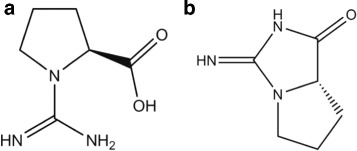
Interpretation of Arginine data. a, 1-Carbamimidoylproline, 157 Da, representing the intermediate step after ejection of NH3 from Arg. b, The final residue of Arg, C6H9N3O, 139 Da, “creatine-proline”. The creatine ring on top joins the proline ring
Fig. 20
Fig. 20
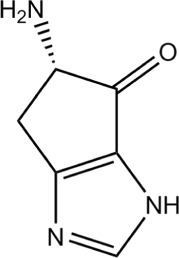
Interpretation of Histidine data. Final residue of His, C6H9N3O, 139 Da, consisting of two 5-rings: 2-amino-2,4-cyclopentadien-1-one (C5H5NO, chemspider 28719770) and imidazole
Fig. 21
Fig. 21
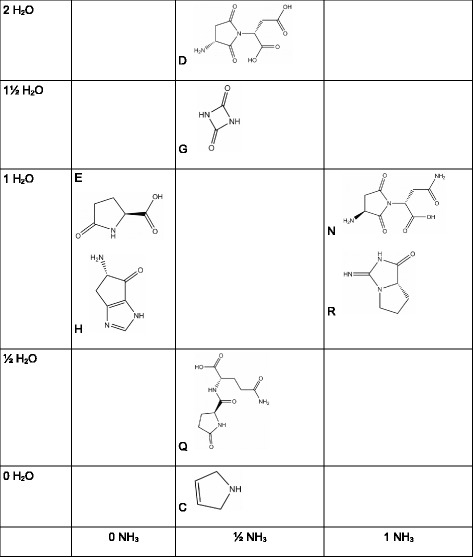
Overview of the residues with respect to H2O or NH3 contents. All residues are obtained by ejection of 0, 12, 1, 112 or 2 mols of H2O or NH3, placing them on two axes. All residues contain either 0, 12 or 1 mol NH3 or H2O, placing them on two axes. Most of them contain peptide bonds. The polysuccinimide of D and N is an exception, cysteine, for lack of oxygen, the other

References

    1. Nelson DL, Cox MM. Lehninger Principles of Biochemistry. New York: Macmillan; 2017.
    1. Boldyreva E. Crystalline amino acids. In: Boeyens JCA, Ogilvie JF, editors. Models, Mysteries and Magic of Molecules. Dordrecht: Springer; 2013.
    1. Barret G. Chemistry and Biochemistry of the Amino Acids. Heidelberg: Springer; 1985.
    1. Follmann H, Brownson C. Darwin’s warm little pond revisited: from molecules to the origin of life. Naturwissenschaften. 2009;96:1265–92. doi: 10.1007/s00114-009-0602-1. - DOI - PubMed
    1. Acree W, Chickos JS. Phase transition enthalpy measurements of organic and organometallic compounds. sublimation, vaporization and fusion enthalpies from 1880 to 2010. J Phys Chem Ref Data. 2010;39:043101. doi: 10.1063/1.3309507. - DOI