


Thinking in a Foreign language reduces the causality bias
- PMID: 29451106
- PMCID: PMC6295649
- DOI: 10.1177/1747021818755326
Thinking in a Foreign language reduces the causality bias
Abstract
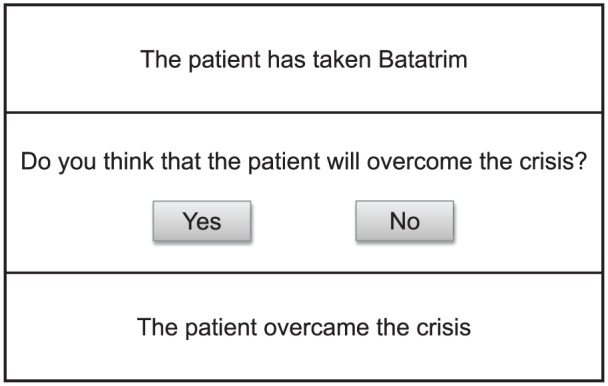
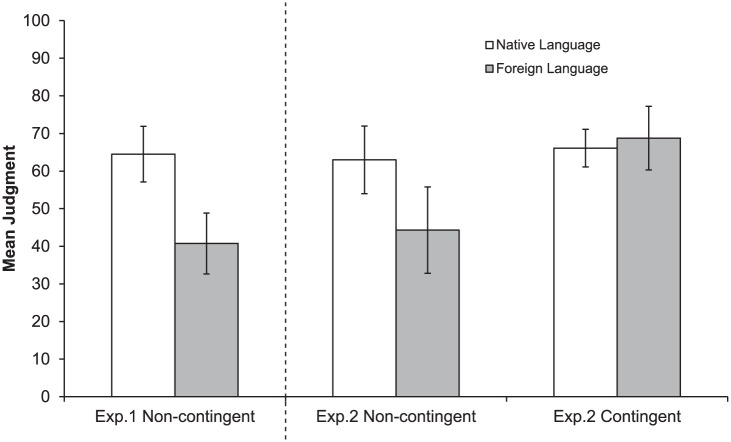
The purpose of this research is to investigate the impact of a foreign language on the causality bias (i.e., the illusion that two events are causally related when they are not). We predict that using a foreign language could reduce the illusions of causality. A total of 36 native English speakers participated in Experiment 1, 80 native Spanish speakers in Experiment 2. They performed a standard contingency learning task, which can be used to detect causal illusions. Participants who performed the task in their native tongue replicated the illusion of causality effect, whereas those performing the task in their foreign language were more accurate in detecting that the two events were causally unrelated. Our results suggest that presenting the information in a foreign language could be used as a strategy to debias individuals against causal illusions, thereby facilitating more accurate judgements and decisions in non-contingent situations. They also contribute to the debate on the nature and underlying mechanisms of the foreign language effect, given that the illusion of causality is rooted in basic associative processes.
Keywords: Cognitive biases; causality bias; contingency judgements; debiasing; foreign language effect; illusion of causality.
Conflict of interest statement
Figures
References
-
- Allan L. G. (1980). A note on measurement of contingency between two binary variables in judgment tasks. Bulletin of the Psychonomic Society, 15, 147–149.
-
- Allan L. G., Jenkins H. (1983). The effect of representations of binary variables on judgment of influence. Learning and Motivation, 14, 381–405.
-
- Alloy L. B., Abramson L. Y. (1979). Judgment of contingency in depressed and nondepressed students: Sadder but wiser? Journal of Experimental Psychology: General, 108, 441–485. - PubMed
-
- Alter A., Oppenheimer D. M., Epley N., Eyre R. (2007). Overcoming intuition: Metacognitive difficulty activates analytical thought. Journal of Experimental Psychology: General, 136, 569–576. - PubMed
-
- Baker A. G., Murphy R. A., Vallée-Tourangeau F., Mehta R. (2000). Contingency learning and causal reasoning. In Mowrer R. R., Klein S. B. (Eds.), Handbook of contemporary learning theories (pp. 255–306). Mahwah, NJ: Lawrence Erlbaum.
MeSH terms
LinkOut - more resources
Full Text Sources
Other Literature Sources
