


Does combined therapy of curcumin and epigallocatechin gallate have a synergistic neuroprotective effect against spinal cord injury?
- PMID: 29451216
- PMCID: PMC5840977
- DOI: 10.4103/1673-5374.224379
Does combined therapy of curcumin and epigallocatechin gallate have a synergistic neuroprotective effect against spinal cord injury?
Abstract
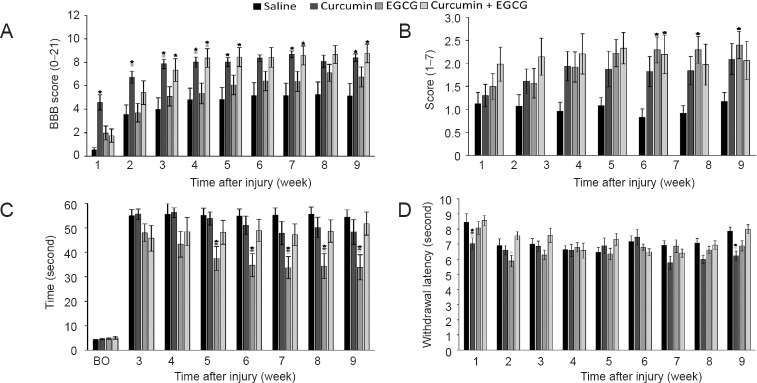
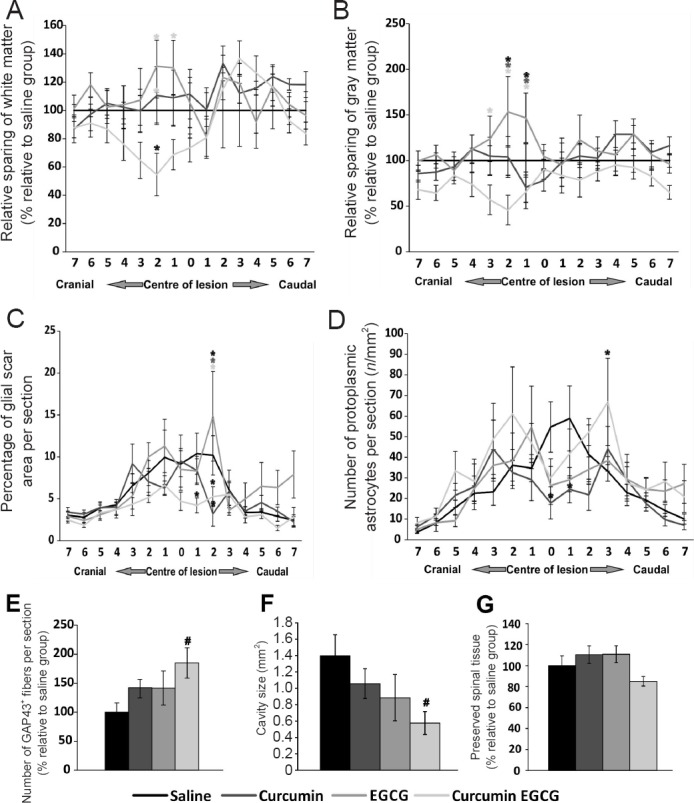
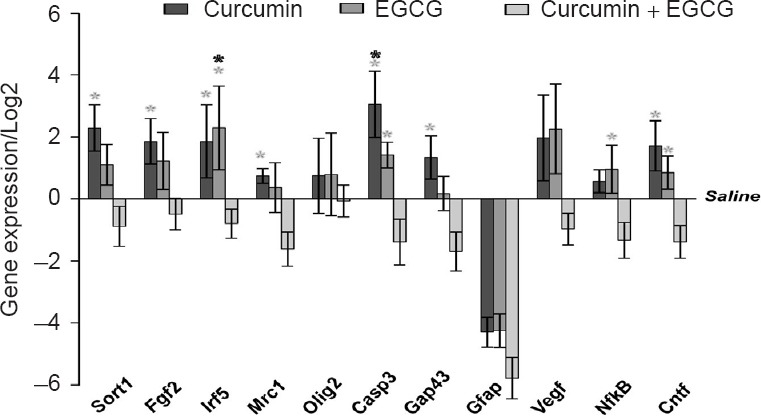
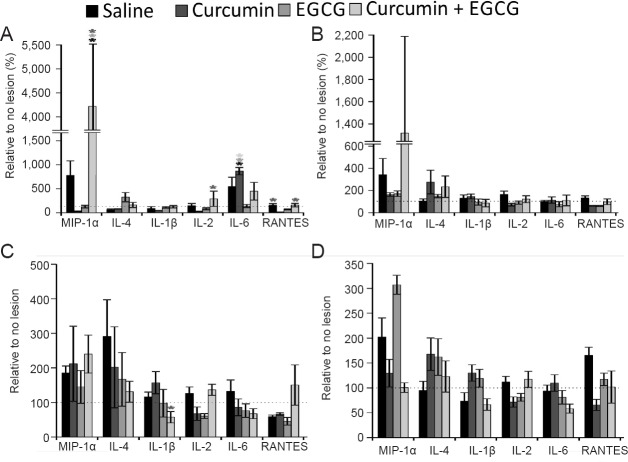
Systematic inflammatory response after spinal cord injury (SCI) is one of the factors leading to lesion development and a profound degree of functional loss. Anti-inflammatory compounds, such as curcumin and epigallocatechin gallate (EGCG) are known for their neuroprotective effects. In this study, we investigated the effect of combined therapy of curcumin and EGCG in a rat model of acute SCI induced by balloon compression. Immediately after SCI, rats received curcumin, EGCG, curcumin + EGCG or saline [daily intraperitoneal doses (curcumin, 6 mg/kg; EGCG 17 mg/kg)] and weekly intramuscular doses (curcumin, 60 mg/kg; EGCG 17 mg/kg)] for 28 days. Rats were evaluated using behavioral tests (the Basso, Beattie, and Bresnahan (BBB) open-field locomotor test, flat beam test). Spinal cord tissue was analyzed using histological methods (Luxol Blue-cresyl violet staining) and immunohistochemistry (anti-glial fibrillary acidic protein, anti-growth associated protein 43). Cytokine levels (interleukin-1β, interleukin-4, interleukin-2, interleukin-6, macrophage inflammatory protein 1-alpha, and RANTES) were measured using Luminex assay. Quantitative polymerase chain reaction was performed to determine the relative expression of genes (Sort1, Fgf2, Irf5, Mrc1, Olig2, Casp3, Gap43, Gfap, Vegf, NfκB, Cntf) related to regenerative processes in injured spinal cord. We found that all treatments displayed significant behavioral recovery, with no obvious synergistic effect after combined therapy of curcumin and ECGC. Curcumin and EGCG alone or in combination increased axonal sprouting, decreased glial scar formation, and altered the levels of macrophage inflammatory protein 1-alpha, interleukin-1β, interleukin-4 and interleukin-6 cytokines. These results imply that although the expected synergistic response of this combined therapy was less obvious, aspects of tissue regeneration and immune responses in severe SCI were evident.
Keywords: curcumin; epigallocatechin gallate; inflammatory response; neural regeneration; spinal cord injury.
Conflict of interest statement
The authors declare that the study was conducted in the absence of any commercial or financial relationships that could be construed as a potential conflict of interest
Figures
References
-
- Alvarez-Perez B, Homs J, Bosch-Mola M, Puig T, Reina F, Verdu E, Boadas-Vaello P. Epigallocatechin-3-gallate treatment reduces thermal hyperalgesia after spinal cord injury by down-regulating RhoA expression in mice. Eur J Pain. 2015;20:341–352. - PubMed
-
- Aydin MS, Caliskan A, Kocarslan A, Kocarslan S, Yildiz A, Gunay S, Savik E, Hazar A, Yalcin F. Intraperitoneal curcumin decreased lung, renal and heart injury in abdominal aorta ischemia/reperfusion model in rat. Int J Surg. 2014;12:601–605. - PubMed
-
- Basso DM, Beattie MS, Bresnahan JC. A sensitive and reliable locomotor rating scale for open field testing in rats. J Neurotrauma. 1995;12:1–21. - PubMed
-
- Bibikova M, Yeakley JM, Chudin E, Chen J, Wickham E, Wang-Rodriguez J, Fan JB. Gene expression profiles in formalin-fixed, paraffin-embedded tissues obtained with a novel assay for microarray analysis. Clin Chem. 2004;50:2384–2386. - PubMed
-
- Carstens E, Ansley D. Hindlimb flexion withdrawal evoked by noxious heat in conscious rats: magnitude measurement of stimulus-response function, suppression by morphine and habituation. J Neurophysiol. 1993;70:621–629. - PubMed
LinkOut - more resources
Full Text Sources
Other Literature Sources
Research Materials
Miscellaneous
