


Highly Elastic Biodegradable Single-Network Hydrogel for Cell Printing
- PMID: 29451384
- PMCID: PMC5876623
- DOI: 10.1021/acsami.8b01294
Highly Elastic Biodegradable Single-Network Hydrogel for Cell Printing
Abstract
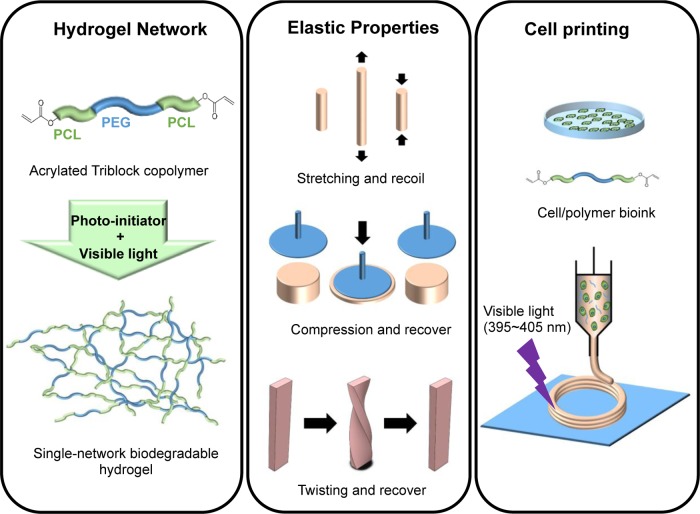
Cell printing is becoming a common technique to fabricate cellularized printed scaffold for biomedical application. There are still significant challenges in soft tissue bioprinting using hydrogels, which requires live cells inside the hydrogels. Moreover, the resilient mechanical properties from hydrogels are also required to mechanically mimic the native soft tissues. Herein, we developed a visible-light cross-linked, single-network, biodegradable hydrogel with high elasticity and flexibility for cell printing, which is different from previous highly elastic hydrogel with double-network and two components. The single-network hydrogel using only one stimulus (visible light) to trigger gelation can greatly simplify the cell printing process. The obtained hydrogels possessed high elasticity, and their mechanical properties can be tuned to match various native soft tissues. The hydrogels had good cell compatibility to support fibroblast growth in vitro. Various human cells were bioprinted with the hydrogels to form cell-gel constructs, in which the cells exhibited high viability after 7 days of culture. Complex patterns were printed by the hydrogels, suggesting the hydrogel feasibility for cell printing. We believe that this highly elastic, single-network hydrogel can be simply printed with different cell types, and it may provide a new material platform and a new way of thinking for hydrogel-based bioprinting research.
Keywords: biodegradable hydrogel; cell printing; elasticity; single network; tissue regeneration.
Conflict of interest statement
The authors declare no competing financial interest.
Figures
References
-
- Lin K.-F.; He S.; Song Y.; Wang C.-M.; Gao Y.; Li J.-Q.; Tang P.; Wang Z.; Bi L.; Pei G.-X. Low-Temperature Additive Manufacturing of Biomimic Three-Dimensional Hydroxyapatite/Collagen Scaffolds for Bone Regeneration. ACS Appl. Mater. Interfaces 2016, 8, 6905–6916. 10.1021/acsami.6b00815. - DOI - PubMed
-
- Yu Y.; Hua S.; Yang M.; Fu Z.; Teng S.; Niu K.; Zhao Q.; Yi C. Fabrication and Characterization of electrospinning/3D Printing Bone Tissue Engineering Scaffold. RSC Adv. 2016, 6, 110557–110565. 10.1039/C6RA17718B. - DOI
-
- Lee S. J.; Lee D.; Yoon T. R.; Kim H. K.; Jo H. H.; Park J. S.; Lee J. H.; Kim W. D.; Kwon I. K.; Park S. A. Surface Modification of 3D-Printed Porous Scaffolds via Mussel-Inspired Polydopamine and Effective Immobilization of rhBMP-2 to Promote Osteogenic Differentiation for Bone Tissue Engineering. Acta Biomater. 2016, 40, 182–191. 10.1016/j.actbio.2016.02.006. - DOI - PubMed
MeSH terms
Substances
Grants and funding
LinkOut - more resources
Full Text Sources
Other Literature Sources
