


What incentives increase data sharing in health and medical research? A systematic review
- PMID: 29451561
- PMCID: PMC5803640
- DOI: 10.1186/s41073-017-0028-9
What incentives increase data sharing in health and medical research? A systematic review
Erratum in
-
Erratum to: What incentives increase data sharing in health and medical research? A systematic review.Res Integr Peer Rev. 2017 May 23;2:7. doi: 10.1186/s41073-017-0034-y. eCollection 2017. Res Integr Peer Rev. 2017. PMID: 29457799 Free PMC article.
Abstract
Background: The foundation of health and medical research is data. Data sharing facilitates the progress of research and strengthens science. Data sharing in research is widely discussed in the literature; however, there are seemingly no evidence-based incentives that promote data sharing.
Methods: A systematic review (registration: 10.17605/OSF.IO/6PZ5E) of the health and medical research literature was used to uncover any evidence-based incentives, with pre- and post-empirical data that examined data sharing rates. We were also interested in quantifying and classifying the number of opinion pieces on the importance of incentives, the number observational studies that analysed data sharing rates and practices, and strategies aimed at increasing data sharing rates.
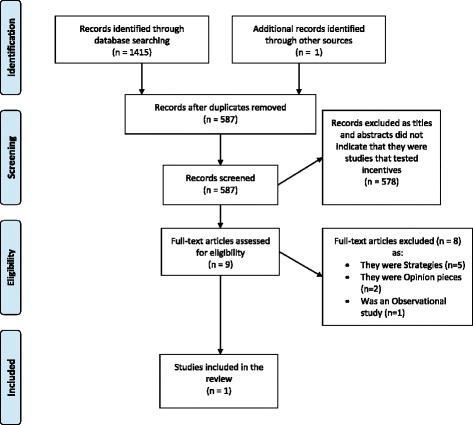
Results: Only one incentive (using open data badges) has been tested in health and medical research that examined data sharing rates. The number of opinion pieces (n = 85) out-weighed the number of article-testing strategies (n = 76), and the number of observational studies exceeded them both (n = 106).
Conclusions: Given that data is the foundation of evidence-based health and medical research, it is paradoxical that there is only one evidence-based incentive to promote data sharing. More well-designed studies are needed in order to increase the currently low rates of data sharing.
Keywords: Data sharing; Incentives; Meta-research; Open data.
Figures
References
-
- Destro Bisol G, Anagnostou P, Capocasa M, Bencivelli S, Cerroni A, Contreras J, Enke N, Fantini B, Greco P, Heeney C, et al. Perspectives on Open Science and scientific data sharing:an interdisciplinary workshop. J Anthropol Scie. 2014;92:179–200. - PubMed
Publication types
LinkOut - more resources
Full Text Sources
Other Literature Sources
