. 2018 Mar 1;10(3):786-802.
doi: 10.1093/gbe/evy036.

Culture-Facilitated Comparative Genomics of the Facultative Symbiont Hamiltonella defensa

Affiliations

Culture-Facilitated Comparative Genomics of the Facultative Symbiont Hamiltonella defensa

Germain Chevignon et al. Genome Biol Evol. .

Abstract

Many insects host facultative, bacterial symbionts that confer conditional fitness benefits to their hosts. Hamiltonella defensa is a common facultative symbiont of aphids that provides protection against parasitoid wasps. Protection levels vary among strains of H. defensa that are also differentially infected by bacteriophages named APSEs. However, little is known about trait variation among strains because only one isolate has been fully sequenced. Generating complete genomes for facultative symbionts is hindered by relatively large genome sizes but low abundances in hosts like aphids that are very small. Here, we took advantage of methods for culturing H. defensa outside of aphids to generate complete genomes and transcriptome data for four strains of H. defensa from the pea aphid Acyrthosiphon pisum. Chosen strains also spanned the breadth of the H. defensa phylogeny and differed in strength of protection conferred against parasitoids. Results indicated that strains shared most genes with roles in nutrient acquisition, metabolism, and essential housekeeping functions. In contrast, the inventory of mobile genetic elements varied substantially, which generated strain specific differences in gene content and genome architecture. In some cases, specific traits correlated with differences in protection against parasitoids, but in others high variation between strains obscured identification of traits with likely roles in defense. Transcriptome data generated continuous distributions to genome assemblies with some genes that were highly expressed and others that were not. Single molecule real-time sequencing further identified differences in DNA methylation patterns and restriction modification systems that provide defense against phage infection.


Figures
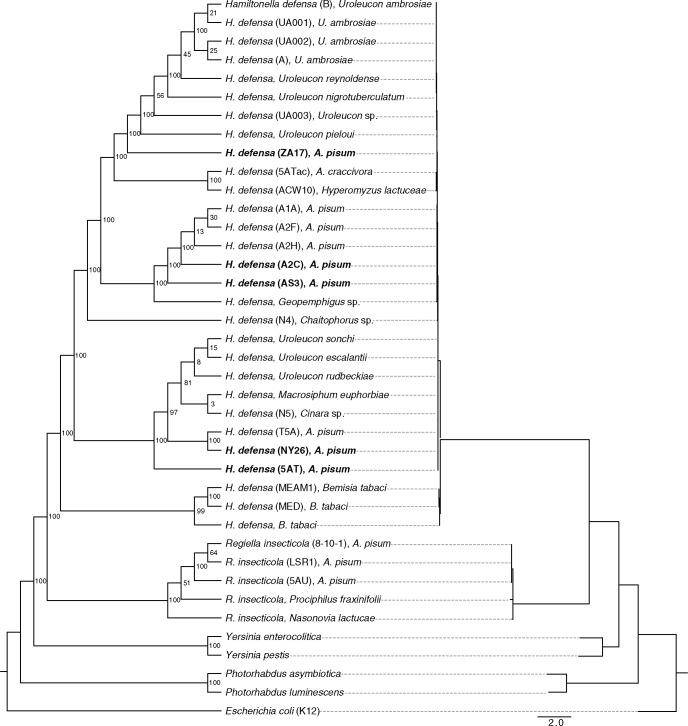
<sc>Fig</sc>. 1.—
Fig. 1.—
Maximum-likelihood cladogram (left) and phylogram (right) based on amino acid sequences of eight loci from 30 strains of Hamiltonella defensa, five strains of Regiella insecticola and selected outgroups. Taxon labels for H. defensa and R. insecticola indicate the name of the strain in parenthesis followed by the name of the aphid or whitefly host species. Taxon labels for outgroups indicate the species name and strain if appropriate. Bold font identifies the four strains of H. defensa from Acyrthosiphon pisum sequenced during the current study plus the reannotated 5AT strain. Numbers at nodes indicate support based on the percentage of 100 bootstrap replicates that recovered the same node. Scale bar for the phylogram indicates nucleotide substitutions per site.
<sc>Fig</sc>. 2.—
Fig. 2.—
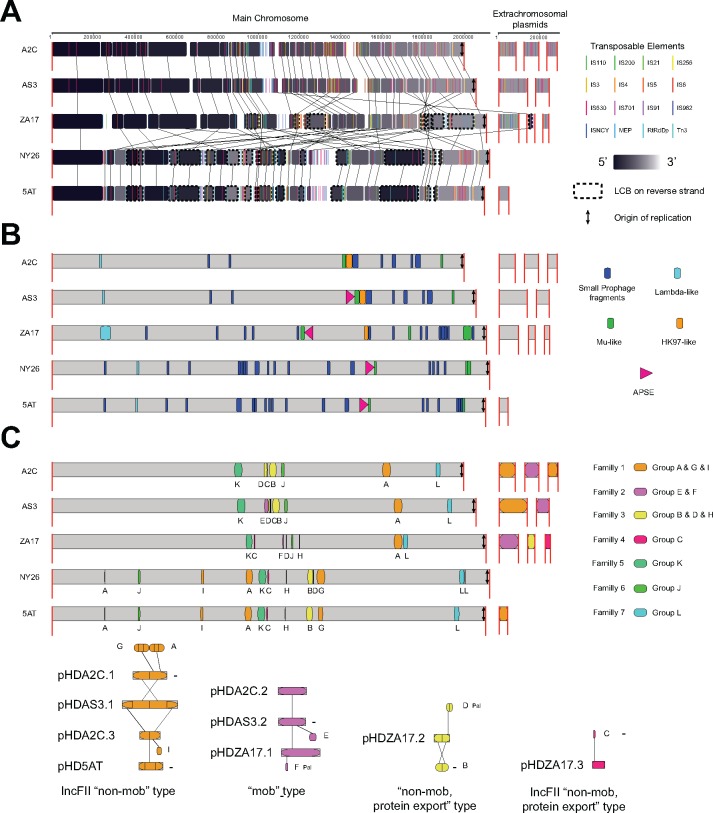
Whole genome alignments for Acyrthosiphon pisum-associated strains of Hamiltonella defensa. (A) The A2C strain was set as the reference with the main chromosome shown to the left and extrachromosomal plasmids shown to the right. Long red vertical bars indicate the boundaries of the main chromosome or extrachromosomal plasmids. Alignments are divided into Locally Collinear Blocks (LCBs) that correspond to regions of the genome in each strain that are internally free of rearrangements. Black blocks correspond to LCBs in the 5′ end and light gray blocks correspond to LCBs in the 3′ end of the main chromosome and extrachromosomal plasmids. Colored bars indicate the position of different TEs. Vertical arrows indicate the position of the origin of replication (ori) for each strain. Below A2C are alignments of the other strains. A dashed line surrounding an LCB indicates its reversal relative to A2C. (B) Location of prophage islands in the genomes of each strain. Dark blue indicates the location of small prophage fragments of different origins, while other colors indicate the location of APSE and other larger prophage islands present in all or particular strains. (C) Extrachromosomal plasmids and plasmid islands. The lower part of the figure illustrates the extrachromosomal plasmids. Plasmids that share homology are grouped by color and classification type. Internal vertical bars and letters identify domains in each plasmid while external vertical bars indicate homologous domains between plasmids. Plasmids in reverse complement are tagged with a minus sign “−”. The upper part of the figure shows the location of plasmid islands in the main chromosome. Islands derived from integration of extrachromosomal plasmids are indicated by the same color with letters corresponding to the domain of the extrachromosomal plasmid that still persists. Islands with other colors and letters derive from integration and decay of plasmids of unknown origin.
<sc>Fig</sc>. 3.—
Fig. 3.—
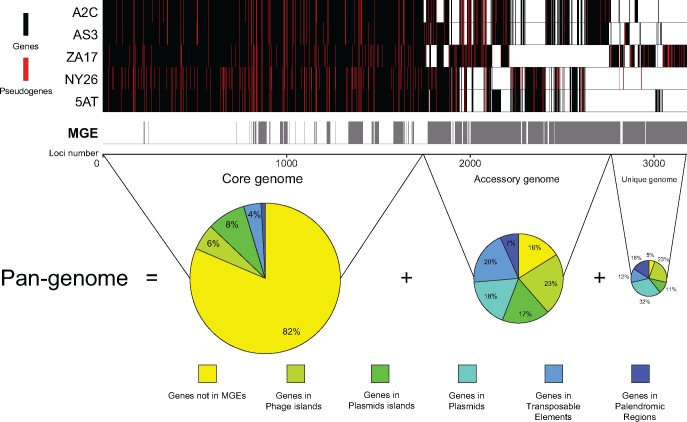
Genomic maps illustrating the Pan-genome for Acyrthosiphon pisum-associated strains of Hamiltonella defensa. Loci and Mobile Genetic Elements (MGE) in the Core, Accessory, and Unique genome are ordered along the x axis for each strain. Vertical bars symbolize orthologous genes. A black bar indicates the gene is present and putatively functional in a given strain, a red bar indicates the gene is present but pseudogenized, and no bar indicates the gene is absent. Gray bars below the strains indicate MGEs, which consist of phage islands, plasmid islands, plasmids, TEs, and palindromic regions. Note that most loci in the Accessary and Unique genome are associated with MGEs. Pie charts show the proportion of genes in the Core, Accessory, and Unique genome in different types of MGEs versus other domains.
<sc>Fig</sc>. 4.—
Fig. 4.—
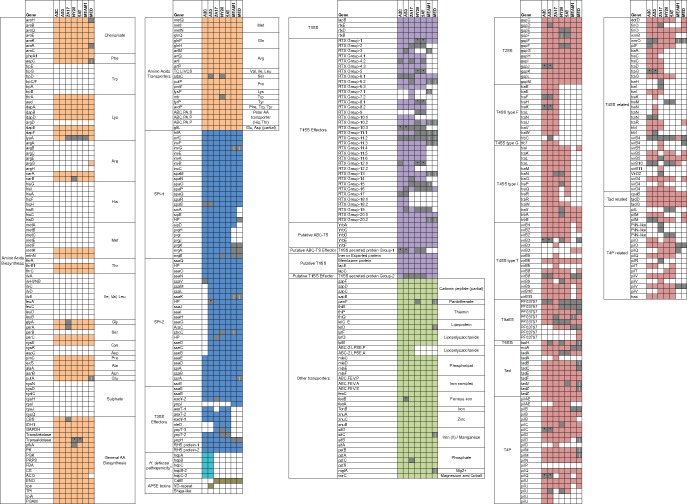
Gene content associated with specific functional activities in Acyrthosiphon pisum- and Bemisia tabaci-associated Hamiltonella defensa. These include: amino acid biosynthesis* and transport (brown boxes), Type 3 secretory systems (T3SS SPI-1, SPI-2) and their effectors (blue boxes), the H. defensa pathogenicity** cluster (aqua boxes), APSE toxins (olive boxes), Type 1 secretory system (T1SS) and effectors in the RTX toxin family, a putative group 2 T1SS plus effectors (purple boxes), other transporters with predicted functions in acquisition of growth factor including vitamins (light green boxes), and Type 2 and Type 4 secretory systems (T2SS, T4SS), Tight adherence (Tad) transport system, and Type VI pilus (T4P) components (red boxes)***. For each strain, a colored box indicates the gene is intact and putatively functional, an open box indicates the gene is absent, and a gray box indicates the gene is present but pseudogenized. Pseudogenization by point mutation is indicated by a black dot while pseudogenization by MGE-associated breakage is indicated by a vertical line. * Open boxes present in all strains regarding genes from amino acids biosynthesis correspond to genes present in Buchnera aphidicola (adapted from Rao et al. 2015). ** H. defensa pathogenicity refers to the gene cluster on pHDA2C.1 and pHDAS3.1 with similarity to the Serratia entomophila lysis cluster on the plasmid pADAP. *** Genes present in T4SS-, Tad-, and T4P-related boxes correspond to genes with similarities with T4SS, Tad, and T4P identified by our annotation pipeline but were not identified by the specific secretion system prediction tool TXSScan (Abby et al. 2016).
<sc>Fig</sc>. 5.—
Fig. 5.—
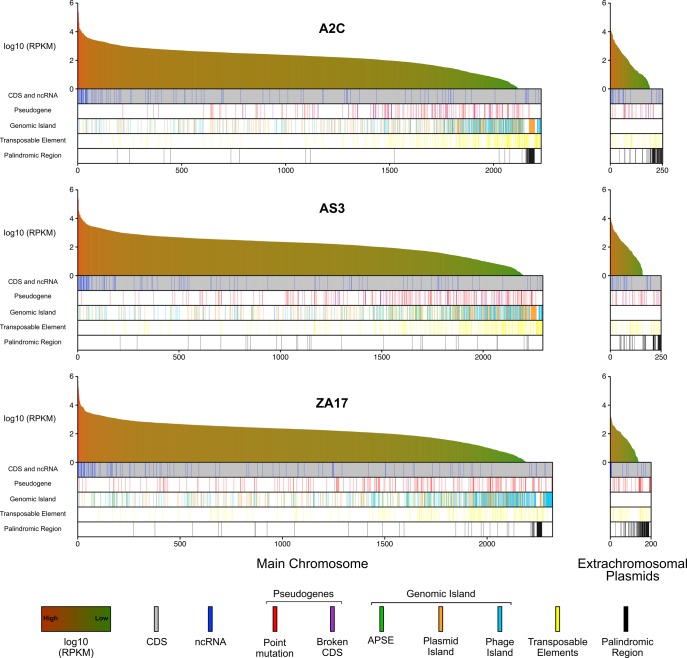
Transcriptional profiling by RNAseq of in vitro cultured A2C, AS3, and ZA17. For each strain, RPKM values (log10) are ordered from highest (red) to lowest (green) for all CDSs (gray bars) and ncRNAs (blue bars) in the main chromosome (left) and extrachromosomal plasmids (right). CDSs that have been pseudogenized by point mutation or MGE insertion (Broken CDS) are indicated. CDSs and ncRNAs in APSEs, other phage and plasmid islands, transposable elements, or palindromic regions are also indicated.

References

    1. Abby SS, et al.2016. Identification of protein secretion systems in bacterial genomes. Sci Rep. 6:23080.. - PMC - PubMed
    1. Altschul SF, Gish W, Miller W, Myers EW, Lipman DJ.. 1990. Basic local alignment search tool. J Mol Biol. 2153:403–410. - PubMed
    1. Anders S, Pyl PT, Huber W.. 2015. HTSeq a Python framework to work with high-throughput sequencing data. Bioinformatics 312:166–169. - PMC - PubMed
    1. Ankrah NYD, Luan J, Douglas AE.. 2017. Cooperative metabolism in a three-partner insect-bacterial symbiosis revealed by metabolic modeling. J Bacteriol. 19915:e00872–16.. - PMC - PubMed
    1. Argemi X, et al.2017. Whole-genome sequencing of seven strains of Staphylococcus lugdunensis allows identification of mobile genetic elements. Genome Biol Evol. 1183–1189. - PMC - PubMed

Publication types

LinkOut - more resources