Review
. 2018 Mar;24(3):319-331.
doi: 10.1016/j.molmed.2018.01.008. Epub 2018 Feb 13.

Untapped Reserves: Controlling Primordial Follicle Growth Activation

Affiliations
Review

Untapped Reserves: Controlling Primordial Follicle Growth Activation

Amanda Kallen et al. Trends Mol Med. 2018 Mar.

Abstract

Even with the benefit of assisted reproductive technologies (ART), many women are unable to conceive and deliver healthy offspring. One common cause of infertility is the inability to produce eggs capable of contributing to live birth. This can occur despite standard-of-care treatment to maximize the recovery of eggs from growing ovarian follicles. Dormant primordial follicles in the human ovary are a 'reserve ' that can be exploited clinically to overcome this problem. We discuss how controlling primordial follicle growth activation (PFGA) can produce increased numbers of high-quality eggs available for fertility treatment(s). We consider the state of the art in interventions used to control PFGA, and consider genetic and epigenetic strategies on the horizon that might improve compromised oocyte quality to increase live births.

Keywords: cryopreservation; follicle; in vitro fertilization (IVF); infertility; oncofertility; ovary.


Conflict of interest statement

Conflict of interest statement

No conflicts of interest are noted or occurred during the preparation of this manuscript.

Figures
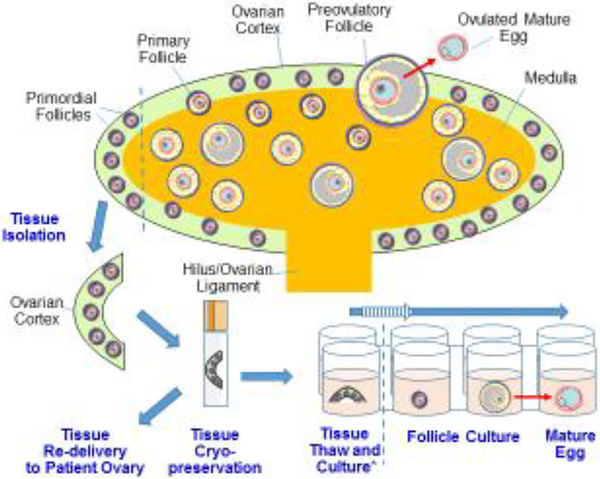
Figure 1.
Figure 1.. Human Ovarian anatomy and tissue handling for fertility support and preservation.
A cartoon representation of the human ovary, its organization, and its constituent follicles is shown. The exterior cortex (green) is the location of most if not all primordial follicles, while growing follicles are found more centrally within the medulla (orange). Once per cycle, a follicle survives to ovulate (top, red arrow). Clinical access to the primordial reserve of follicles can be gained by surgical removal of “strips” of ovarian cortex (left, TISSUE ISOLATION). Cortical strips can be cryopreserved, and optionally thawed and re-grafted to a patient’s ovary, whereupon follicle growth can resume and conception might follow [–36]. Alternatively, tissue can be thawed and placed into a tissue culture scheme (bottom right). In a ‘one-step’ system, follicles are immediately isolated and cultured singly. In a ‘two-step’ system (*), cortex strips are first cultured until a growing follicle is visible, after which the growing follicle is mechanically isolated for further culture. Ideally, optimization of follicle culture will result in the production of a mature, offspring competent egg (bottom right, red arrow). Note that for each stage of tissue handling and culture in vitro, follicle-enclosed eggs are accessible for treatment, including the possible injection of reagents designed to improve egg quality.
Figure 2.
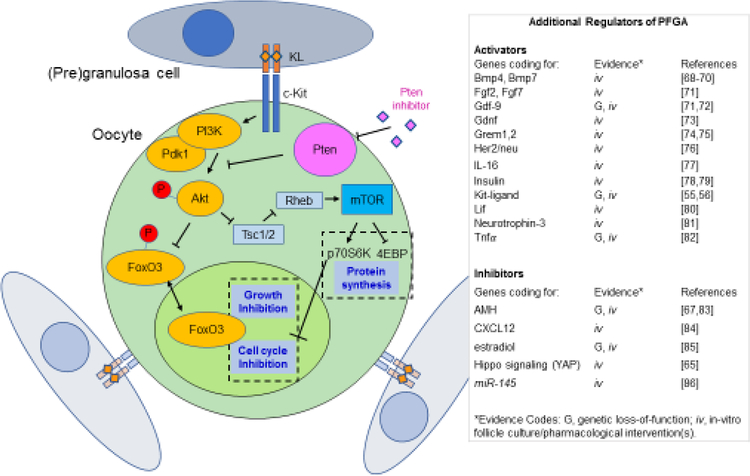
Figure 2.. Molecular regulation of PFGA in Mice.
The cartoon on the left depicts primordial follicles consisting of a primordial oocyte and a few pregranulosa cells stay dormant due to the negative regulation of cell growth and the cell cycle by transcription factor FoxO3, and negative regulation of the mTOR signaling pathway, both controlled by the upstream action of Pten [69,93,105]. Accordingly, pharmacological inhibition of Pten using molecules such as bpV(HOpic) can result in enhanced PFGA. FoxO3 has been shown to inhibit the cell cycle via regulation of Cyclin dependent kinase inhibitor 1b (Cdkn1b/p27). Oocytes with low mechanistic Target of Rapamycin (mTOR) activity are likely to be held in a state of low protein synthesis due to a lack of phosphorylation of the mTOR target Eukaryotic translation initiation factor 4E-binding protein (4-EBP), remaining out of an active cell cycle due to activity of P70S6-kinase (P70S6K), itself a positive regulator of cyclin D1, cyclin dependent kinase 4 (CDK4), and Retinoblastoma (Rb) proteins [106]. The table on the right presents an updated list of genes and factors shown to impact PFGA, with experimental evidence categorized by in vitro and/or in vivo genetic evidence. Cartoon adapted from [105].

References

    1. Pereira N et al. (2017) The safety of intracytoplasmic sperm injection and long-term outcomes. Reproduction 154, F61–F70 - PubMed
    1. Toner JP et al. (2016) Society for Assisted Reproductive Technology and assisted reproductive technology in the United States: a 2016 update. Fertil. Steril 106, 541–546 - PubMed
    1. Potdar N et al. (2014) Oocyte vitrification in the 21st century and post-warming fertility outcomes: a systematic review and meta-analysis. Reprod. Biomed. Online 29, 159–176 - PubMed
    1. Biggers JD (2012) IVF and embryo transfer: historical origin and development. Reprod. Biomed. Online 25, 118–127 - PubMed
    1. Wilkinson J et al. (2017) Developments in IVF warrant the adoption of new performance indicators for ART clinics, but do not justify the abandonment of patient-centred measures. Hum. Reprod 32, 1155–1159 - PubMed

Publication types