


Yield of the RYR2 Genetic Test in Suspected Catecholaminergic Polymorphic Ventricular Tachycardia and Implications for Test Interpretation
- PMID: 29453246
- PMCID: PMC6364978
- DOI: 10.1161/CIRCGEN.116.001424
Yield of the RYR2 Genetic Test in Suspected Catecholaminergic Polymorphic Ventricular Tachycardia and Implications for Test Interpretation
Abstract
Background: Pathogenic RYR2 variants account for ≈60% of clinically definite cases of catecholaminergic polymorphic ventricular tachycardia. However, the rate of rare benign RYR2 variants identified in the general population remains a challenge for genetic test interpretation. Therefore, we examined the results of the RYR2 genetic test among patients referred for commercial genetic testing and examined factors impacting variant interpretability.
Methods: Frequency and location comparisons were made for RYR2 variants identified among 1355 total patients of varying clinical certainty and 60 706 Exome Aggregation Consortium controls. The impact of the clinical phenotype on the yield of RYR2 variants was examined. Six in silico tools were assessed using patient- and control-derived variants.
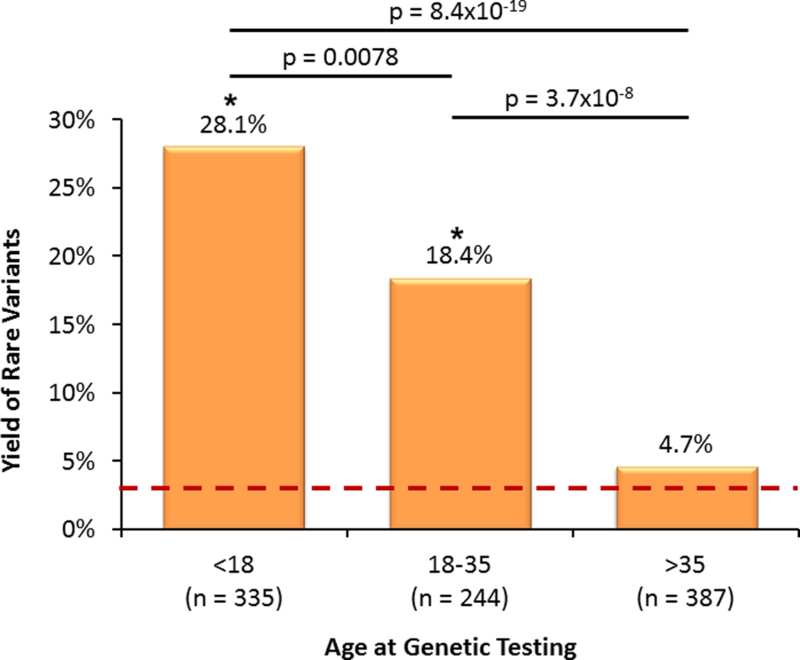
Results: A total of 18.2% (218/1200) of patients referred for commercial testing hosted rare RYR2 variants, statistically less than the 59% (46/78) yield among clinically definite cases, resulting in a much higher potential genetic false discovery rate among referrals considering the 3.2% background rate of rare, benign RYR2 variants. Exclusion of clearly putative pathogenic variants further complicates the interpretation of the next novel RYR2 variant. Exonic/topologic analyses revealed overrepresentation of patient variants in exons covering only one third of the protein. In silico tools largely failed to show evidence toward enhancement of variant interpretation.
Conclusions: Current expert recommendations have resulted in increased use of RYR2 genetic testing in patients with questionable clinical phenotypes. Using the largest to date catecholaminergic polymorphic ventricular tachycardia patient versus control comparison, this study highlights important variables in the interpretation of variants to overcome the 3.2% background rate that confounds RYR2 variant interpretation.
Keywords: cardiologist; exons; genetic testing; phenotype; uncertainty.
© 2018 American Heart Association, Inc.
Figures



Comment in
-
Is Careful Assessment of Rare Variants in the RYR2 Gene Piercing the Guidelines' Strong Armor?Circ Genom Precis Med. 2018 Feb;11(2):e002072. doi: 10.1161/CIRCGEN.118.002072. Circ Genom Precis Med. 2018. PMID: 29453248 No abstract available.
-
Letter by Ruiz-Guerrero et al Regarding Article, "Yield of the RYR2 Genetic Test in Suspected Catecholaminergic Polymorphic Ventricular Tachycardia and Implications for Test Interpretation".Circ Genom Precis Med. 2018 May;11(5):e002159. doi: 10.1161/CIRCGEN.118.002159. Circ Genom Precis Med. 2018. PMID: 29752400 No abstract available.
-
Response by Kapplinger et al to Letter Regarding Article, "Yield of the RYR2 Genetic Test in Suspected Catecholaminergic Polymorphic Ventricular Tachycardia and Implications for Test Interpretation".Circ Genom Precis Med. 2018 May;11(5):e002176. doi: 10.1161/CIRCGEN.118.002176. Circ Genom Precis Med. 2018. PMID: 29752402 No abstract available.
References
-
- Hayashi M, Denjoy I, Extramiana F, Maltret A, Buisson NR, Lupoglazoff JM, et al. Incidence and risk factors of arrhythmic events in catecholaminergic polymorphic ventricular tachycardia. Circulation 2009;119:2426–2434. - PubMed
-
- Leenhardt A, Lucet V, Denjoy I, Grau F, Ngoc DD, Coumel P. Catecholaminergic polymorphic ventricular tachycardia in children. A 7-year follow-up of 21 patients. Circulation 1995;91:1512–1519. - PubMed
-
- Liu N, Ruan Y, Priori SG. Catecholaminergic polymorphic ventricular tachycardia. Prog Cardiovasc Dis 2008;51:23–30. - PubMed
-
- Medeiros-Domingo A, Bhuiyan ZA, Tester DJ, Hofman N, Bikker H, van Tintelen JP, et al. The RYR2-encoded ryanodine receptor/calcium release channel in patients diagnosed previously with either catecholaminergic polymorphic ventricular tachycardia or genotype negative, exercise-induced long QT syndrome: a comprehensive open reading frame mutational analysis. J Am Coll Cardiol 2009;54:2065–2074. - PMC - PubMed
-
- George CH, Jundi H, Thomas NL, Fry DL, Lai FA. Ryanodine receptors and ventricular arrhythmias: emerging trends in mutations, mechanisms and therapies. J Mol Cell Cardiol 2007;42:34–50. - PubMed
Publication types
MeSH terms
Substances
Grants and funding
LinkOut - more resources
Full Text Sources
Other Literature Sources
