


Adherence to antiretroviral therapy and factors affecting low medication adherence among incident HIV-infected individuals during 2009-2016: A nationwide study
- PMID: 29453393
- PMCID: PMC5816616
- DOI: 10.1038/s41598-018-21081-x
Adherence to antiretroviral therapy and factors affecting low medication adherence among incident HIV-infected individuals during 2009-2016: A nationwide study
Abstract
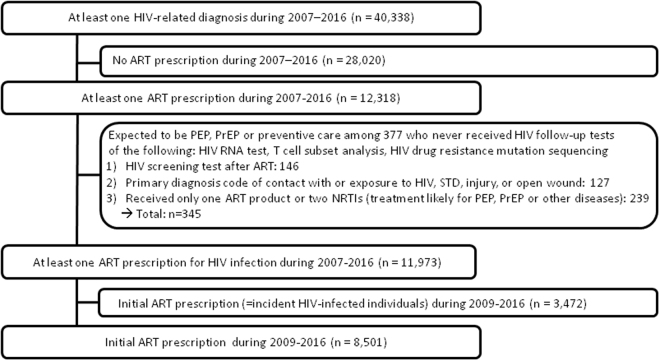
For ideal clinical benefit, human immunodeficiency virus (HIV)-infected individuals should receive continuous medication. This is the first nationwide antiretroviral therapy (ART) adherence study in Asia, where medication monitoring at national level is systemically available. We estimated the ART adherence of incident HIV-infected individuals and investigated factors affecting low medication adherence using the national health insurance (NHI) claims data from 2007 to 2016. Medication possession ratio (MPR) was used to measure medication adherence and risk factors were identified by multivariable logistic regression analysis. Of the 8,501 newly diagnosed HIV-infected individuals during 2009-2016 with at least one ART prescription, 70.4% of HIV patients had adequate adherence to ART defined as MPR ≥95%. Requiring prophylactic antibiotics, female gender, age of 0-19 and same or over 50 s compared to 30-39, and having a history of malignancy, lower socioeconomic status, not visiting tertiary hospital, and being diagnosed in the earlier years were risk factors for lower adherence (Odds ratio 1.7, 1.6, 1.6, 1.4, 1.6, 2.1, 1.2, and 1.6 to 3.8 respectively). Health authority should take into consideration of these modifiable and unmodifiable barriers to establish sustainable monitoring system at national level and to improve adherence.
Conflict of interest statement
The authors declare no competing interests.
Figures
References
-
- Joint United Nations Programme on HIV/AIDS, Joint United Nations Programme on HIV/Aids. 90-90-90: an ambitious treatment target to help end the AIDS epidemic. Geneva: UNAIDS (2014).
-
- Granich, R. et al. Universal voluntary HIV testing with immediate antiviral therapy as a strategy for elimination of HIV transmission: a mathematical model, Lancet. 373 (2009). - PubMed
Publication types
MeSH terms
Substances
LinkOut - more resources
Full Text Sources
Other Literature Sources
Medical
