


Circulating cell-free mitochondrial DNA, but not leukocyte mitochondrial DNA copy number, is elevated in major depressive disorder
- PMID: 29453441
- PMCID: PMC5983469
- DOI: 10.1038/s41386-017-0001-9
Circulating cell-free mitochondrial DNA, but not leukocyte mitochondrial DNA copy number, is elevated in major depressive disorder
Abstract
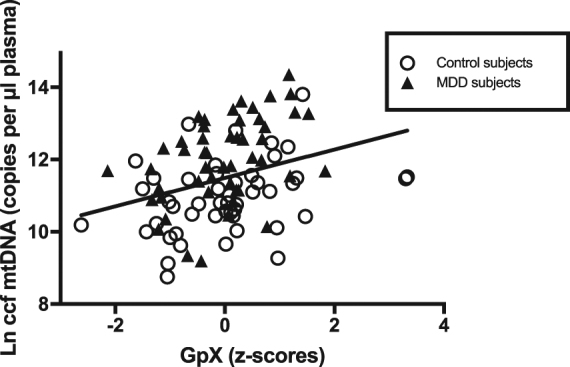
Major depressive disorder (MDD) has been linked to mitochondrial defects, which could manifest in mitochondrial DNA (mtDNA) polymorphisms or mutations. Additionally, copy number of mtDNA (mtDNA-cn) can be quantified in peripheral blood mononuclear cells (PBMC)s, indirectly reflecting cellular energetics, or in the circulating cell-free mtDNA (ccf-mtDNA) levels, which may reflect a fraction of the mitochondrial genome released during cellular stress. Few studies have examined ccf-mtDNA in MDD, and no studies have tested its relationship with intracellular mtDNA-cn or with antidepressant treatment response. Here, mtDNA levels were quantified in parallel from: (i) PBMCs and (ii) cell-free plasma of 50 unmedicated MDD subjects and 55 controls, in parallel with PBMC telomere length (TL) and antioxidant enzyme glutathione peroxidase (GpX) activity. MtDNA measures were repeated in 19 MDD subjects after 8 weeks of open-label SSRI treatment. In analyses adjusted for age, sex, BMI, and smoking, MDD subjects had significantly elevated levels of ccf-mtDNA (F = 20.6, p = 0.00002). PBMC mtDNA-cn did not differ between groups (p > 0.4). In preliminary analyses, we found that changes in ccf-mtDNA with SSRI treatment differed between SSRI responders and non-responders (F = 6.47, p = 0.02), with the non-responders showing an increase in ccf-mtDNA and responders not changing. Baseline ccf-mtDNA was positively correlated with GpX (r = 0.32, p = 0.001), and PBMC mtDNA correlated positively with PBMC TL (r = 0.38, p = 0.0001). These data suggest that plasma ccf-mtDNA and PBMC mtDNA-cn reflect different cellular processes and that the former may be more reflective of certain aspects of MDD pathophysiology and of the response to SSRI antidepressants.
Conflict of interest statement
J.L. is a cofounder and consultant to Telomere Diagnostic Inc. (formerly Telome Health), a diagnostics company related to telomere biology. The remaining authors declare no competing financial interests.
Figures



References
-
- Suomalainen A, Majander A, Haltia M, Somer H, Lonnqvist J, Savontaus ML, et al. Multiple deletions of mitochondrial DNA in several tissues of a patient with severe retarded depression and familial progressive external ophthalmoplegia. J Clin Invest. 1992;90:61–66. doi: 10.1172/JCI115856. - DOI - PMC - PubMed
Publication types
MeSH terms
Substances
Grants and funding
LinkOut - more resources
Full Text Sources
Other Literature Sources
